Instant
01 · Ask
Ask the AI a follow-up
Got more questions about salvage Material Recovery? Describe the bit you're unsure about — the AI explains options, sequencing and what to ask the rubbish clearance.

How salvage and material recovery works — what gets recovered, sorted and sold on.
You've read the brief on salvage Material Recovery. Now lean on us to find the right rubbish clearance — and stay in control of the job.
Got more questions about salvage Material Recovery? Describe the bit you're unsure about — the AI explains options, sequencing and what to ask the rubbish clearance.
Costs, timelines, pitfalls and the right questions to ask before any rubbish clearance starts on salvage Material Recovery.
Itemised quotes from up to 3 local rubbish clearances on salvage Material Recovery — so you can compare like-for-like, not lump sums.
Ready when you are
Enter your postcode and get free quotes from local pros.
Four moves that separate a smooth job from a nightmare.
Reclaimed timber often reveals rot or woodworm once lifted, rendering it valueless.
Modern adhesives or rusted Victorian bolts can make "clean" removal impossible without breaking the item.
Recovered materials are heavy and weather-sensitive; leaving reclaimed bricks out in a frost without cover can cause them to blow.
Materials salvaged from old industrial sites or farm buildings may contain chemical residues that require specialist cleaning.
Indicative UK ranges and what affects price.
By job type
Quote spread is typically ± 18% — always get 3 quotes.
Rubbish Clearance quick-view
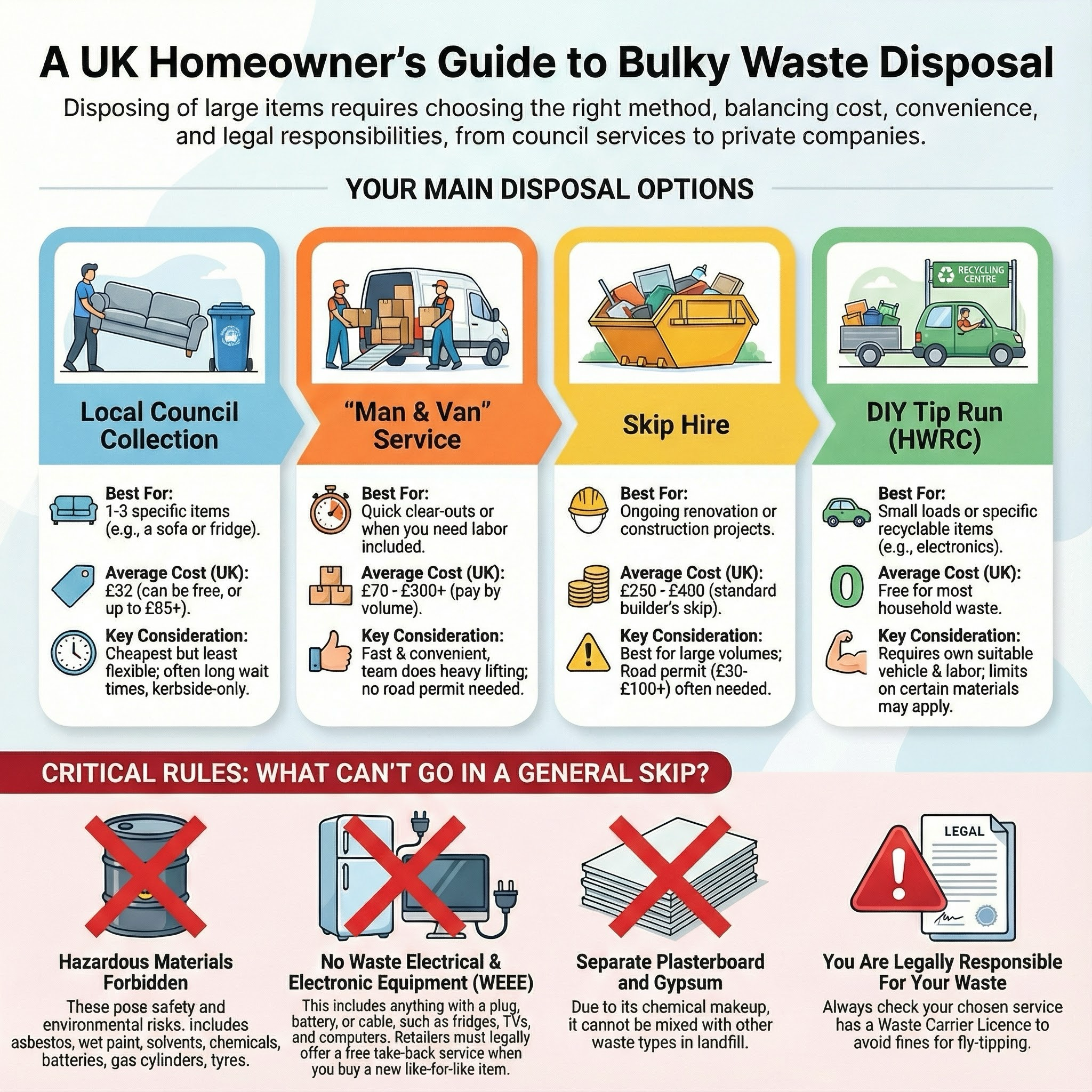
Rubbish Clearance explained
Whether you are stripping out a Victorian terrace or clearing a garden outbuilding, professional salvage recovery ensures that character-rich materials like York stone, period fireplaces, and structural timber are preserved rather than crushed. This guide outlines the costs, timelines, and regulations involved in professional material reclamation.
Prices for salvage recovery vary significantly based on the volume of material and the difficulty of extraction. Most specialists charge a combination of a daily rate and a disposal fee for any non-salvageable waste generated during the process.
| Service Item | Low £ | High £ | Notes |
|---|---|---|---|
| Initial Site Assessment | £100 | £250 | Often waived if a full contract is signed. |
| Daily Labour (per person) | £250 | £450 | Higher for specialists in architectural stone or timber. |
| Small Recovery (e.g., single fireplace) | £150 | £350 | Includes careful removal and basic cleaning. |
| Medium Recovery (e.g., floorboards) | £500 | £1,200 | Based on a standard 3-bedroom semi-detached. |
| Large Scale (e.g., brick/stone walls) | £1,500 | £4,000+ | Dependent on quantity and site access. |
The primary factor affecting price is labour intensity. While a demolition crew might clear a room in an hour with a sledgehammer, a salvage expert may take a full day to carefully lift and palletise original parquet flooring.
Always clarify who "owns" the salvage value. Some contractors offer lower labour rates in exchange for keeping and reselling the recovered materials.
Many homeowners attempt DIY salvage to save costs, but the risk of damage is high. Reclaimed items lose significant value if they are cracked or broken during removal; for example, a damaged marble fireplace surround can lose 80% of its resale value instantly.
Professional recovery is essential for structural elements or items involving utilities. You must use a professional if the work involves gas appliances (Gas Safe), electrical circuits (Part P), or if the building is a Listed Building, where unauthorised removal of features is a criminal offence.
In some cases, yes. High-demand items like York stone, oak beams, or cast-iron radiators have market value. However, the cost of the labour to remove them often outweighs the resale value, so many companies offer "free removal" instead of a cash payment.
Generally, no. Salvage yards look for authentic period pieces. Modern MDF skirting or reproduction fireplaces have very little resale value and are usually better off being recycled as general waste.
Yes, but they must be cleaned of all old mortar and should be tested for "frost-resistance" if being used for external walls. Your building inspector will also need to approve them to ensure they meet modern structural standards.
A WTN is a legal document that tracks waste from your property to its final destination. You must keep a copy of this for two years to prove you have met your legal "Duty of Care" as a householder.
Look for the width and the species. Wide-plank pine or hardwoods like oak and teak are highly sought after. If the boards are very thin or heavily damaged by previous plumbing work, they may only be suitable for firewood or upcycling projects.
This guide was written with AI assistance and is intended for general information only. Prices are estimates based on UK averages and may vary by region. Always get at least three quotes and consult a qualified professional before starting any work.
Ask follow-ups in plain English. The AI explains options, sequencing and what to ask the rubbish clearance — so you walk in informed.
Disposing of an old mattress or a bulky bed frame is one of the more challenging tasks for UK homeowners. Beyond the physical strain of navigating heavy, awkwar...
READ GUIDE →GuideManaging commercial waste is a significantly different beast compared to standard residential rubbish. Whether you are a landlord clearing a shop unit, a home-b...
READ GUIDE →GuideDisposing of an old sofa or armchair in the UK has become more complex due to recent environmental legislation. Bulky furniture is difficult to move, and many i...
READ GUIDE →GuideScrapping a car in the UK is a straightforward process, but it is governed by strict environmental and legal regulations. Whether your vehicle is a non-runner, ...
READ GUIDE →GuideAccumulating black bin bags is a common headache for UK homeowners, whether it’s due to a missed council collection, a deep spring clean, or the aftermath of a ...
READ GUIDE →GuideWhether you are decommissioning a commercial suite or simply reclaiming a spare bedroom from years of "home office" clutter, a professional office clean-out is ...
READ GUIDE →