Instant
01 · Ask
Ask the AI a follow-up
Got more questions about building Inspection Cost &? Describe the bit you're unsure about — the AI explains options, sequencing and what to ask the surveying.

Pre-purchase home buyer or full building survey — by a RICS-regulated surveyor.
You've read the brief on building Inspection Cost &. Now lean on us to find the right surveying — and stay in control of the job.
Got more questions about building Inspection Cost &? Describe the bit you're unsure about — the AI explains options, sequencing and what to ask the surveying.
Costs, timelines, pitfalls and the right questions to ask before any surveying starts on building Inspection Cost &.
Itemised quotes from up to 3 local surveyings on building Inspection Cost & — so you can compare like-for-like, not lump sums.
Ready when you are
Enter your postcode and get free quotes from local pros.
Four moves that separate a smooth job from a nightmare.
Surveyors cannot move heavy furniture or lift fitted carpets; ensure the seller clears access to the loft and cellar.
Reports often contain "boiler-plate" legal language; focus on the specific red-rated items rather than the general disclaimers.
"Rising damp" is often misdiagnosed; ensure your surveyor checks for simple fixes like blocked air bricks or high ground levels first.
A report identifies the problem but doesn't always provide a quote; always get a builder's estimate for any "red" flagged issues before exchanging contracts.
Indicative UK ranges and what affects price.
By job type
Quote spread is typically ± 18% — always get 3 quotes.
Surveying quick-view
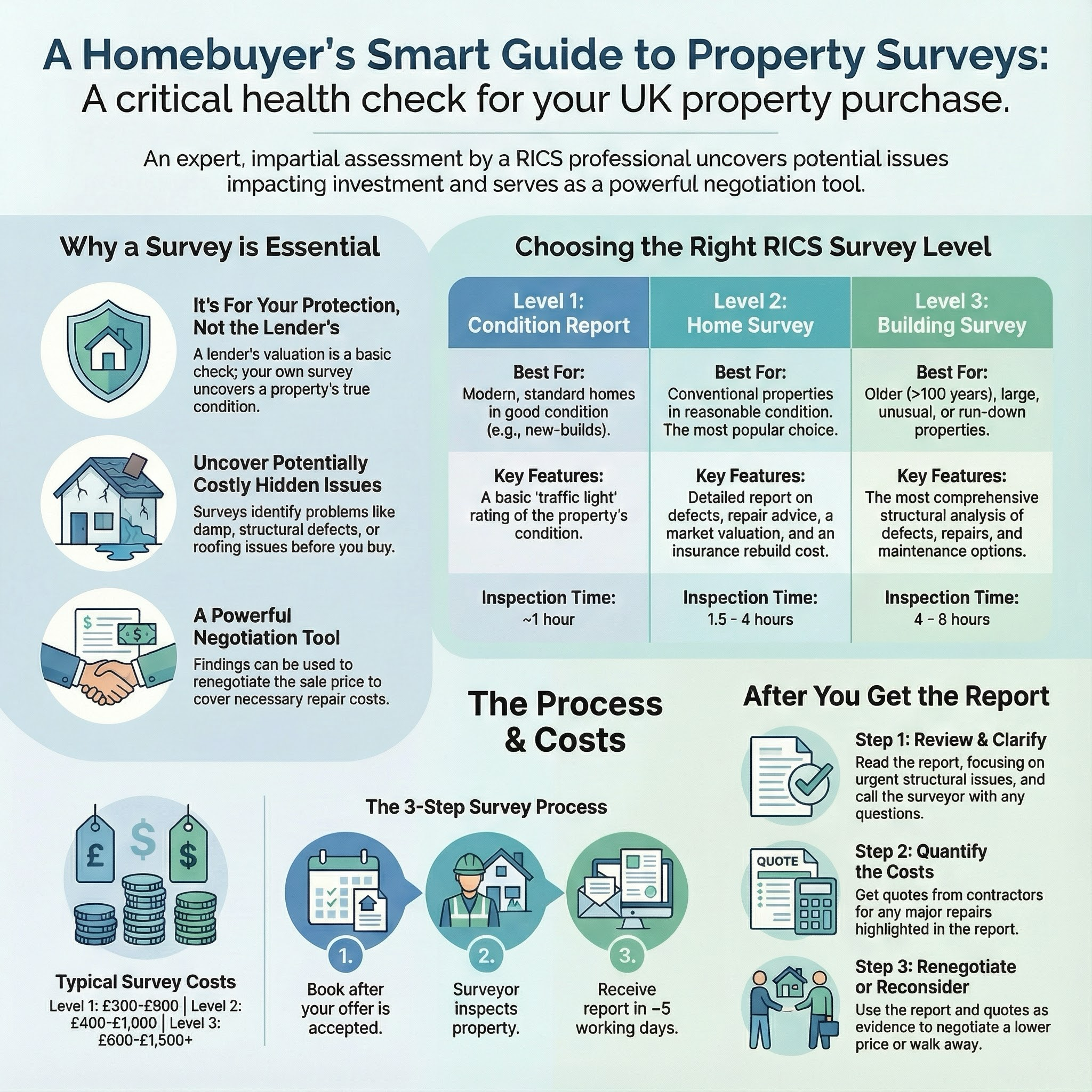
Surveying explained
By identifying issues such as subsidence, rising damp, or structural instability early, you gain the leverage needed for price negotiations or the peace of mind that your investment is sound. In the UK's diverse housing market—ranging from Victorian terraces to modern timber frames—a tailored survey is the only way to truly understand what lies beneath the surface.
| Survey Type | Low £ | High £ | Notes |
|---|---|---|---|
| RICS Level 1 (Condition Report) | £350 | £550 | Basic overview for modern, standard homes. |
| RICS Level 2 (HomeBuyer Report) | £450 | £900 | The most popular choice for mid-range properties. |
| RICS Level 3 (Building Survey) | £750 | £1,800+ | Deep dive for old, large, or unusual properties. |
| Specific Structural Inspection | £400 | £700 | Focuses on one specific issue, like a single crack. |
| Snagging Survey | £300 | £600 | Specifically for new-build properties. |
Prices vary significantly based on the property's purchase price, size, and location, with London and the South East typically seeing 20-30% higher fees. Older properties (pre-1900) generally require a Level 3 survey due to their complex construction methods and higher risk of hidden defects.
Building inspections must be carried out by a qualified professional. A DIY "walk-around" cannot replace the trained eye and specialized equipment (like damp meters and thermal cameras) used by a surveyor. Furthermore, a DIY report holds no weight in legal disputes or mortgage negotiations.
Professional surveyors carry Professional Indemnity Insurance, meaning if they miss a major defect, you are financially protected—a safety net you do not have with a DIY approach.
No. A mortgage valuation is for the lender's benefit to ensure the property is worth the loan amount. It often takes just 15 minutes and may not even involve an internal inspection. It does not protect you from structural defects.
A Level 2 (HomeBuyer Report) is usually sufficient for a 1930s property in reasonable condition. However, if the house has been heavily extended or shows signs of significant cracking, a Level 3 survey is safer.
Surveyors will flag materials they suspect contain asbestos (common in Artex or floor tiles), but they do not perform lab testing. If suspected, you will need a specialist asbestos survey.
You can use the report to ask the seller to fix the issue before completion, or more commonly, negotiate a reduction in the sale price to cover the cost of the repairs yourself.
Generally, yes. A Level 2 or 3 survey will identify the structural layout of the house. However, if you plan to remove it, you will still need a Structural Engineer to calculate the size of the required steel beam (RSJ).
This guide was written with AI assistance and is intended for general information only. Prices are estimates based on UK averages and may vary by region. Always get at least three quotes and consult a qualified professional before starting any work.
Ask follow-ups in plain English. The AI explains options, sequencing and what to ask the surveying — so you walk in informed.
For UK homeowners embarking on a major renovation or extension, professional project management is the difference between a dream build and a financial headache...
READ GUIDE →GuideFor UK homeowners planning a significant renovation, extension, or new build, a professional estimation service is the foundation of a successful project. Unlik...
READ GUIDE →GuideA Property Condition Assessment (PCA) acts as a vital health check for UK homeowners and prospective buyers. Unlike a basic mortgage valuation, which only confi...
READ GUIDE →GuideA professional house inspection is an essential safeguard for UK homeowners, whether you are buying a new property, planning a major renovation, or simply maint...
READ GUIDE →GuideA Level 3 Building Survey, formerly known as a Full Structural Survey, is the most comprehensive "health check" available for UK residential properties. It prov...
READ GUIDE →GuideScope of Advice • Evaluate existing shared structure agreements • Identify areas of dispute and potential conflict • Recommend negotiation strategies and legal ...
READ GUIDE →