Instant
01 · Ask
Ask the AI a follow-up
Got more questions about property Condition Assessment? Describe the bit you're unsure about — the AI explains options, sequencing and what to ask the surveying.

Written assessment of property condition — for sale, insurance, dispute or major refurbishment planning.
You've read the brief on property Condition Assessment. Now lean on us to find the right surveying — and stay in control of the job.
Got more questions about property Condition Assessment? Describe the bit you're unsure about — the AI explains options, sequencing and what to ask the surveying.
Costs, timelines, pitfalls and the right questions to ask before any surveying starts on property Condition Assessment.
Itemised quotes from up to 3 local surveyings on property Condition Assessment — so you can compare like-for-like, not lump sums.
Ready when you are
Enter your postcode and get free quotes from local pros.
Four moves that separate a smooth job from a nightmare.
Surveyors cannot move heavy furniture or lift fitted carpets; if they can't see an area, they cannot assess it.
Heavy rain or fog can limit the use of poles or drones for roof inspections, potentially leaving the report incomplete.
A Condition Assessment is not a "Full Structural Survey" (Level 3) and will not involve invasive testing or "opening up" of the fabric.
Sellers present during the inspection may attempt to distract the surveyor or hide defects behind storage boxes.
Indicative UK ranges and what affects price.
By job type
Quote spread is typically ± 18% — always get 3 quotes.
Surveying quick-view
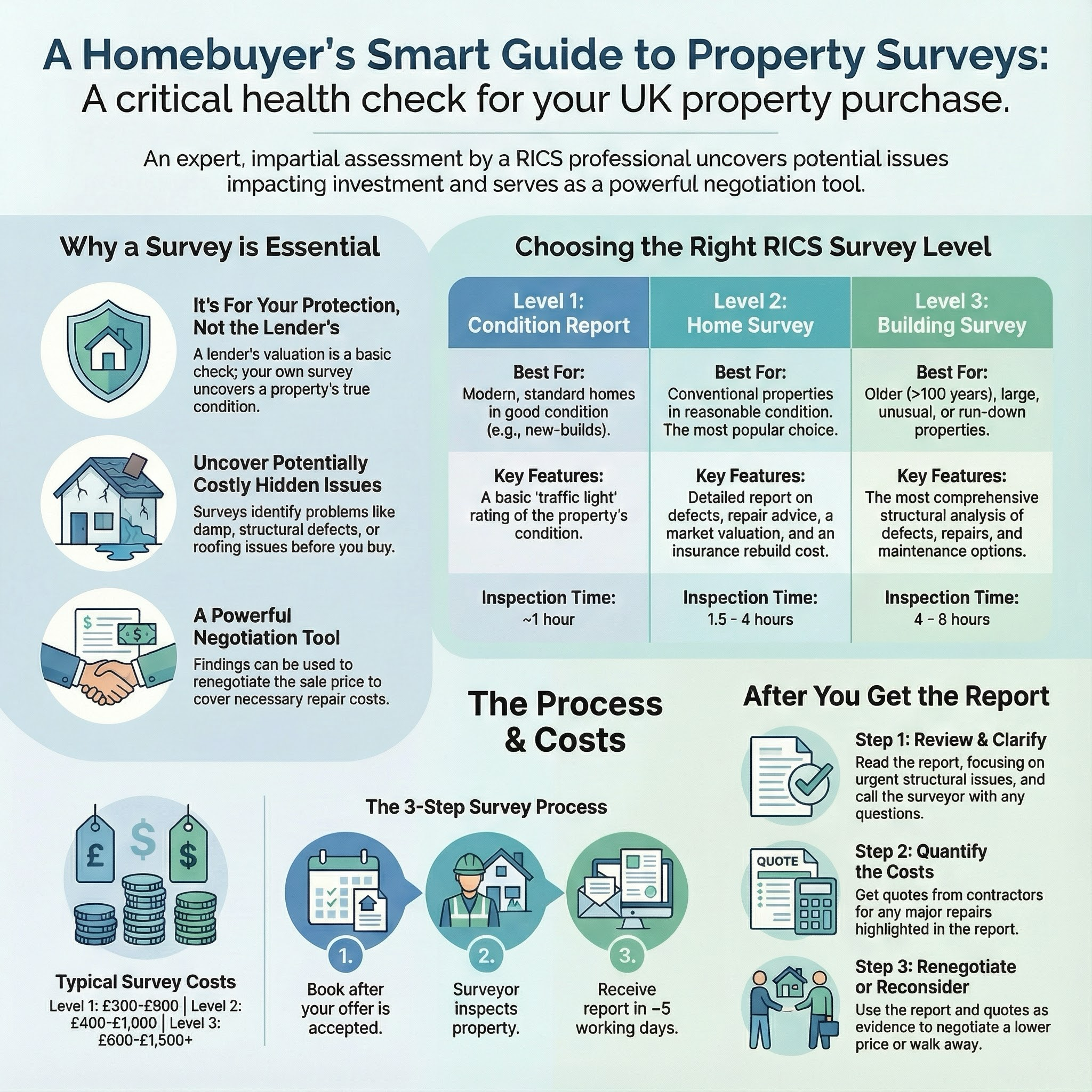
Surveying explained
For modern homes or those in seemingly good order, this assessment offers peace of mind by identifying urgent defects, safety hazards, and legal compliance issues. It is an essential tool for avoiding "money pits" and negotiating sale prices based on the actual condition of the structure.
| Item | Low £ | High £ | Notes |
|---|---|---|---|
| Flat / 1-Bed House | £300 | £450 | Standard RICS Level 1 or equivalent |
| 3-Bed Semi-Detached | £450 | £650 | Includes grounds and basic services check |
| 4+ Bed Detached | £600 | £900 | Higher cost for multiple outbuildings |
| Specialist Commercial PCA | £850 | £1,800+ | Includes detailed compliance for businesses |
Prices in the UK are primarily influenced by the property's market value, its age, and its location (London and the South East typically command a 20% premium). These figures include VAT and the final digital report.
A Property Condition Assessment must be carried out by a professional. While a homeowner can spot obvious cracks, a qualified surveyor is trained to identify the subtle signs of structural movement, "hidden" damp, and breaches of UK Building Regulations.
Attempting to self-assess a property to save on fees can lead to thousands of pounds in unforeseen repair costs later. Professional reports are also often required by solicitors and lenders.
No. A mortgage valuation is for the lender's benefit to ensure the property is worth the loan amount. A Condition Assessment is for your benefit, detailing the actual state of the building and necessary repairs.
A Level 1 (Condition Assessment) is best for modern, standard-construction homes. Level 2 (HomeBuyer) is better for older but conventional homes. Level 3 (Building Survey) is essential for period properties, fixer-uppers, or homes with unusual construction.
While some surveyors provide "ballpark" figures, a standard PCA focuses on the condition. You should use the report to get formal quotes from relevant trades (e.g., roofers or damp specialists).
This doesn't mean you shouldn't buy the house, but it does mean you should get a specialist quote for the repair. You can then use this quote to negotiate the purchase price downwards with the seller.
It is not necessary for you to be there, and it is often easier for the surveyor to work alone. However, most surveyors are happy to have a brief chat on-site or a phone call after the report is issued.
This guide was written with AI assistance and is intended for general information only. Prices are estimates based on UK averages and may vary by region. Always get at least three quotes and consult a qualified professional before starting any work.
Ask follow-ups in plain English. The AI explains options, sequencing and what to ask the surveying — so you walk in informed.
For UK homeowners embarking on a major renovation or extension, professional project management is the difference between a dream build and a financial headache...
READ GUIDE →GuideFor UK homeowners planning a significant renovation, extension, or new build, a professional estimation service is the foundation of a successful project. Unlik...
READ GUIDE →GuideA professional house inspection is an essential safeguard for UK homeowners, whether you are buying a new property, planning a major renovation, or simply maint...
READ GUIDE →GuideA professional building inspection is a critical safeguard for UK homeowners, whether you are purchasing a new property or planning significant renovations. It ...
READ GUIDE →GuideA Level 3 Building Survey, formerly known as a Full Structural Survey, is the most comprehensive "health check" available for UK residential properties. It prov...
READ GUIDE →GuideScope of Advice • Evaluate existing shared structure agreements • Identify areas of dispute and potential conflict • Recommend negotiation strategies and legal ...
READ GUIDE →