Instant
01 · Ask
Ask the AI a follow-up
Got more questions about level 3 building survey? Describe the bit you're unsure about — the AI explains options, sequencing and what to ask the surveying.

In-depth survey for older or unusual buildings — full structural review and condition assessment.
You've read the brief on level 3 building survey. Now lean on us to find the right surveying — and stay in control of the job.
Got more questions about level 3 building survey? Describe the bit you're unsure about — the AI explains options, sequencing and what to ask the surveying.
Costs, timelines, pitfalls and the right questions to ask before any surveying starts on level 3 building survey.
Itemised quotes from up to 3 local surveyings on level 3 building survey — so you can compare like-for-like, not lump sums.
Ready when you are
Enter your postcode and get free quotes from local pros.
Four moves that separate a smooth job from a nightmare.
Surveyors cannot move heavy furniture, lift fitted carpets, or force open locked hatches. This can lead to "could not inspect" caveats.
Heavy rain or snow can make it impossible to safely inspect roofs or see damp patterns clearly.
No survey is intrusive; defects hidden behind dry-lining, wall coverings, or insulation may remain undetected.
While a surveyor "flushes the loo" and turns on taps, they are not qualified electricians or Gas Safe engineers.
Indicative UK ranges and what affects price.
By job type
Quote spread is typically ± 18% — always get 3 quotes.
Surveying quick-view
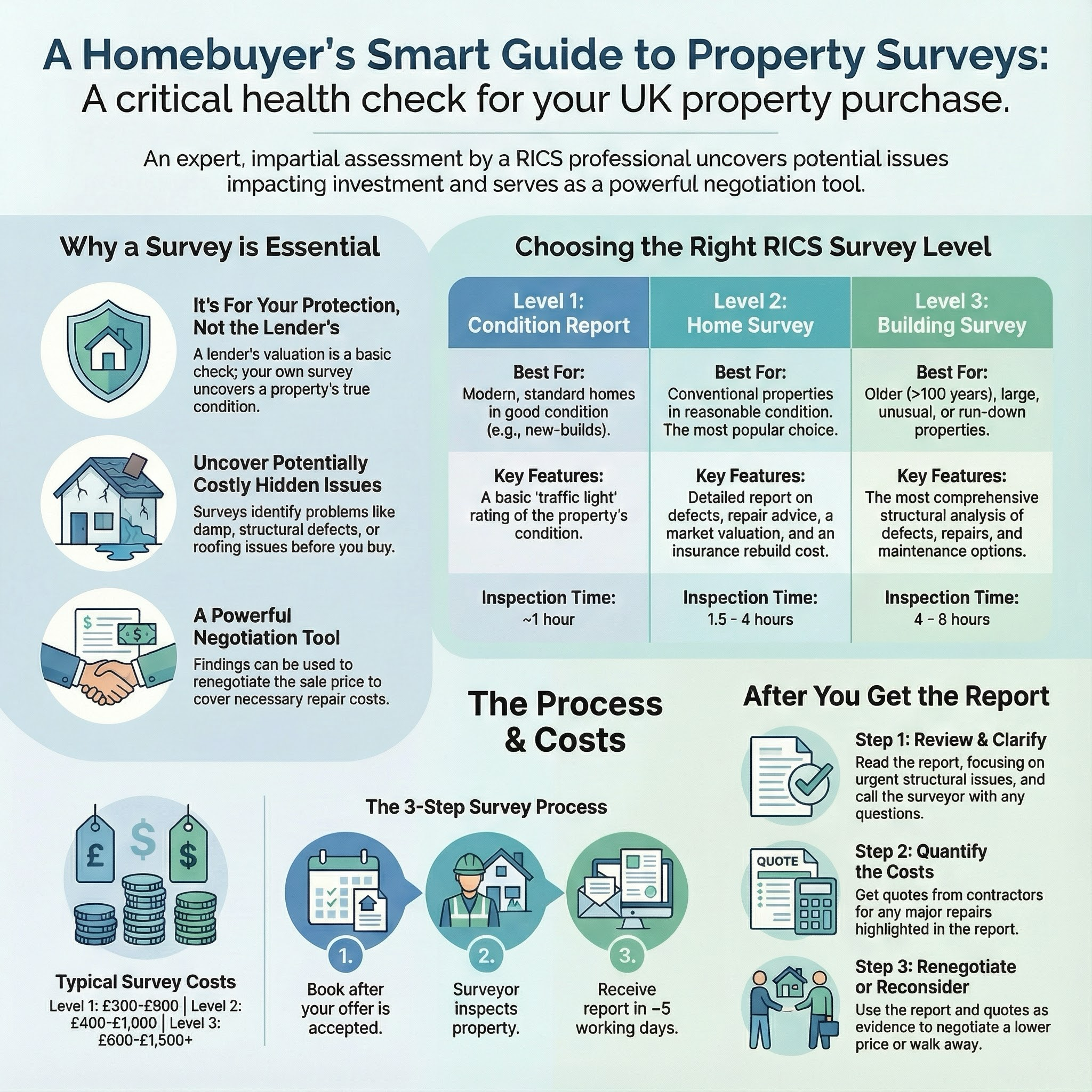
Surveying explained
A Level 3 Building Survey, formerly known as a Full Structural Survey, is the most comprehensive "health check" available for UK residential properties. It provides an in-depth analysis of a building’s condition, structural integrity, and potential defects, making it the gold standard for older homes, listed buildings, or properties in poor repair. For UK homeowners and buyers, this survey is a vital tool for risk management. It goes far beyond a standard valuation or a Level 2 HomeBuyer report, offering detailed advice on repairs, maintenance schedules, and estimated costs that can be used to renegotiate a purchase price or plan future budgets. <h2>What Does the Work Involve?</h2> A Level 3 survey is a thorough, non-destructive inspection of all accessible parts of the property. The surveyor will: <ul> <li><strong>Structural Assessment:</strong> Examine the main walls, chimney stacks, and roof structures for signs of movement, subsidence, or failing masonry.</li> <li><strong>Roof & Loft Inspection:</strong> Access the roof void to check for timber rot, woodworm, adequate insulation, and the condition of the felt and battens.</li> <li><strong>Damp & Timber:</strong> Use moisture meters to check for rising and penetrating damp, while inspecting floors and joinery for dry or wet rot.</li> <li><strong>External Fabric:</strong> Check the condition of windows, doors, guttering, and external rendering or pointing.</li> <li><strong>Services Observation:</strong> Visually inspect the visible parts of the electrical, gas, and plumbing systems (though they do not perform pressure tests).</li> <li><strong>Grounds & Boundaries:</strong> Inspect outbuildings, retaining walls, and drainage covers, noting any risks from large trees or Japanese Knotweed.</li> <li><strong>Comprehensive Reporting:</strong> Produce a detailed document outlining every defect, the likely cause, and the urgency of the required repairs.</li> </ul> <h2>Typical Costs</h2> The cost of a Level 3 survey depends primarily on the property's size, age, and location. Prices in London and the South East are typically 20-30% higher than the national average. <table> <thead> <tr> <th>Property Type</th> <th>Low £</th> <th>High £</th> <th>Notes</th> </tr> </thead> <tbody> <tr> <td>1-2 Bed Flat / Small Cottage</td> <td>£550</td> <td>£850</td> <td>Includes VAT; complex period conversions cost more.</td> </tr> <tr> <td>3-4 Bed Semi/Detached House</td> <td>£800</td> <td>£1,300</td> <td>The most common price range for UK family homes.</td> </tr> <tr> <td>Large Period / Listed Property</td> <td>£1,400</td> <td>£2,500+</td> <td>Requires specialist knowledge of heritage materials.</td> </tr> <tr> <td>Re-inspection / Follow-up</td> <td>£150</td> <td>£350</td> <td>Checking specific repairs after they have been completed.</td> </tr> <tr> <td>Valuation Add-on</td> <td>£100</td> <td>£200</td> <td>Level 3 reports do not include a valuation by default.</td> </tr> </tbody> </table> <p>Factors affecting the final quote include the complexity of the architecture, the estimated rebuild value, and whether the surveyor needs to use specialist equipment like telescopic cameras or drones to view high-level roofs.</p> <h2>How Long Does It Take?</h2> The timeline for a Level 3 survey is longer than other types due to the level of detail required in both the inspection and the write-up. <ul> <li><strong>On-site Inspection:</strong> 4 to 8 hours depending on the size and condition of the property.</li> <li><strong>Report Drafting:</strong> 3 to 5 working days for the surveyor to compile findings and cost estimates.</li> <li><strong>Total Turnaround:</strong> Typically 7 to 10 working days from the site visit to receiving the final PDF report.</li> </ul> <h2>DIY or Professional?</h2> A Level 3 survey must be carried out by a qualified professional, typically a member of the <strong>Royal Institution of Chartered Surveyors (RICS)</strong>, the <strong>Residential Property Surveyors Association (RPSA)</strong>, or the <strong>Chartered Association of Building Engineers (CABE)</strong>. <blockquote>Attempting a "DIY survey" is not recommended and will not be accepted by mortgage lenders or insurers. Professional surveyors carry Professional Indemnity Insurance, which protects you if they miss a significant structural flaw.</blockquote> <h2>Choosing the Right Tradesperson</h2> Selecting the right surveyor is about more than just finding the lowest price. You need someone with local knowledge of common soil types and regional building styles. <ul> <li><strong>Check Credentials:</strong> Ensure they are RICS-regulated (look for MRICS or FRICS designations).</li> <li><strong>Local Expertise:</strong> Ask if they have experience with specific local issues, such as mining subsidence or flint wall construction.</li> <li><strong>Sample Reports:</strong> Always ask to see a sample Level 3 report to ensure the detail meets your expectations.</li> <li><strong>Red Flags:</strong> Avoid surveyors who offer "Level 3" reports at "Level 2" prices, as they may rush the inspection or provide a generic, caveat-heavy report.</li> </ul> <strong>Questions to ask:</strong> <ul> <li>"Will you be the one visiting the property, or do you use sub-contractors?"</li> <li>"Do you include estimated costs for the repairs you identify?"</li> <li>"Are you able to use a drone or pole-camera for high-level roof areas?"</li> <li>"How soon after the visit can we have a phone debrief to discuss the main findings?"</li> </ul> <h2>UK Regulations</h2> Surveyors must adhere to strict professional standards to ensure their reports are accurate and legally robust. <ul> <li><strong>RICS Home Survey Standard:</strong> The mandatory framework that defines the minimum requirements for a Level 3 report.</li> <li><strong>Health and Safety:</strong> Surveyors are governed by the Health and Safety at Work Act; they will not enter unsafe lofts or climb onto high roofs without proper access.</li> <li><strong>Professional Indemnity Insurance (PII):</strong> All RICS members must hold PII to cover claims of negligence.</li> <li><strong>Terms of Engagement:</strong> You should receive a formal document outlining exactly what will (and won't) be inspected before the survey begins.</li> </ul> <h2>Common Problems</h2> Even the best surveys can be hampered by practical issues on site. Awareness of these can help you prepare the property. <ul> <li><strong>Restricted Access:</strong> Surveyors cannot move heavy furniture, lift fitted carpets, or force open locked hatches. This can lead to "could not inspect" caveats.</li> <li><strong>Weather Interference:</strong> Heavy rain or snow can make it impossible to safely inspect roofs or see damp patterns clearly.</li> <li><strong>Hidden Defects:</strong> No survey is intrusive; defects hidden behind dry-lining, wall coverings, or insulation may remain undetected.</li> <li><strong>Services Not Tested:</strong> While a surveyor "flushes the loo" and turns on taps, they are not qualified electricians or Gas Safe engineers.</li> </ul> <h2>Frequently Asked Questions</h2> <details> <summary>What is the difference between a Level 2 and a Level 3 survey?</summary> <div> <p>A Level 2 survey (HomeBuyer Report) uses a "traffic light" system to rate the condition of a modern, standard property. A Level 3 survey is much more descriptive, detailing the construction methods, the cause of defects, and providing repair advice and costings.</p> </div> </details> <details> <summary>Does a Level 3 survey include a valuation?</summary> <div> <p>No, a Level 3 report focuses purely on the condition of the building. Most surveyors can provide a market valuation and a reinstatement cost (for insurance) as an optional extra for an additional fee.</p> </div> </details> <details> <summary>Can I attend the survey while it's happening?</summary> <div> <p>Most surveyors prefer to work alone to ensure they don't miss anything, but many are happy for you to meet them at the end of the inspection for a 15-minute walk-around of the key issues.</p> </div> </details> <details> <summary>Will the surveyor test for asbestos?</summary> <div> <p>The surveyor will flag materials that they suspect contain asbestos based on the age of the property, but they will not take samples for lab testing. A specialist asbestos survey is required for definitive proof.</p> </div> </details> <details> <summary>Do I need a Level 3 survey for a new build?</summary> <div> <p>Generally, no. For a new build, a "Snagging Survey" is more appropriate. Level 3 is intended for older properties or those that have been significantly altered.</p> </div> </details> <details> <summary>What happens if the surveyor finds a major problem?</summary> <div> <p>You can use the report to ask the seller to fix the issue before completion, or more commonly, to negotiate a reduction in the purchase price based on the repair estimates provided in the report.</p> </div> </details>
This guide was written with AI assistance and is intended for general information only. Prices are estimates based on UK averages and may vary by region. Always get at least three quotes and consult a qualified professional before starting any work.
Ask follow-ups in plain English. The AI explains options, sequencing and what to ask the surveying — so you walk in informed.
For UK homeowners embarking on a major renovation or extension, professional project management is the difference between a dream build and a financial headache...
READ GUIDE →GuideFor UK homeowners planning a significant renovation, extension, or new build, a professional estimation service is the foundation of a successful project. Unlik...
READ GUIDE →GuideA Property Condition Assessment (PCA) acts as a vital health check for UK homeowners and prospective buyers. Unlike a basic mortgage valuation, which only confi...
READ GUIDE →GuideA professional house inspection is an essential safeguard for UK homeowners, whether you are buying a new property, planning a major renovation, or simply maint...
READ GUIDE →GuideA professional building inspection is a critical safeguard for UK homeowners, whether you are purchasing a new property or planning significant renovations. It ...
READ GUIDE →GuideScope of Advice • Evaluate existing shared structure agreements • Identify areas of dispute and potential conflict • Recommend negotiation strategies and legal ...
READ GUIDE →