Instant
01 · Ask
Ask the AI a follow-up
Got more questions about estimation and Quote Request Service? Describe the bit you're unsure about — the AI explains options, sequencing and what to ask the surveying.

Pre-build cost estimate — by a quantity surveyor with bill of quantities and detailed cost plan.
You've read the brief on estimation and Quote Request Service. Now lean on us to find the right surveying — and stay in control of the job.
Got more questions about estimation and Quote Request Service? Describe the bit you're unsure about — the AI explains options, sequencing and what to ask the surveying.
Costs, timelines, pitfalls and the right questions to ask before any surveying starts on estimation and Quote Request Service.
Itemised quotes from up to 3 local surveyings on estimation and Quote Request Service — so you can compare like-for-like, not lump sums.
Ready when you are
Enter your postcode and get free quotes from local pros.
Four moves that separate a smooth job from a nightmare.
Estimates often fail if they assume standard foundations without seeing a soil report, leading to massive overspends on piling.
Using 2023 or 2024 rates for a 2025 project can leave you with a 10% shortfall before you even start.
Forgetting the cost of scaffolding, temporary fencing, and site security.
If you haven't chosen your kitchen or flooring, the estimator uses "allowances" which are often lower than the homeowner's actual taste.
Indicative UK ranges and what affects price.
By job type
Quote spread is typically ± 18% — always get 3 quotes.
Surveying quick-view
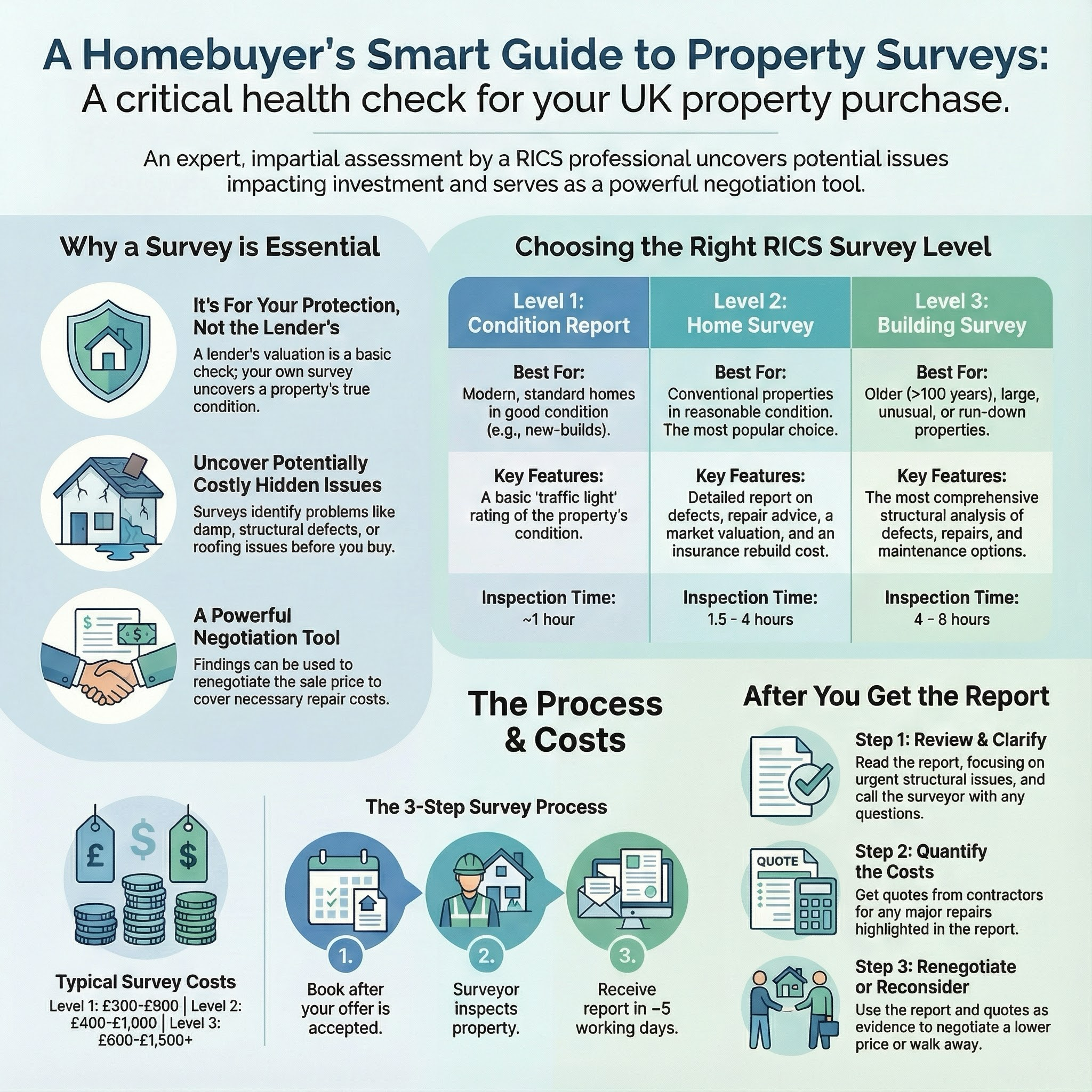
Surveying explained
Securing an accurate cost plan early prevents the "budget creep" that plagues many domestic projects. It also provides the essential documentation required by banks and mortgage lenders to release funds for home improvement loans or self-build mortgages.
| Service Type | Low £ | High £ | Notes |
|---|---|---|---|
| Basic Extension Estimate | £250 | £500 | Based on standard architectural drawings. |
| Full Bill of Quantities (New Build) | £700 | £1,500+ | Highly detailed for tendering to multiple contractors. |
| Site Survey / Consultation Fee | £120 | £250 | Initial visit and feasibility advice. |
| Hourly Rate (Quantity Surveyor) | £60 | £100 | For bespoke revisions or complex consultancy. |
Prices generally include VAT and depend on the complexity of the design. A simple "box" extension is significantly cheaper to estimate than a period property renovation with bespoke structural requirements.
While online calculators exist, DIY estimating often misses "preliminaries" like insurance, waste management, and site setup, which can account for 10-20% of the budget. Professionals use "live" price books (like BCIS) that reflect real-time inflation in the UK construction industry.
Professional estimates are often a mandatory requirement for self-build mortgages or high-value home improvement loans.
No. An estimate is a professional "best guess" of what a project should cost based on market data. A quote is a fixed price offered by a builder to actually do the work. You use the estimate to check if the builder's quote is fair.
Most UK lenders require a formal cost breakdown from a qualified surveyor or a detailed quote from a reputable builder before approving a construction loan or mortgage stage payment.
A professional estimate should always clearly state whether VAT is included. Most domestic builders must charge 20% VAT, so ensure this is factored into your total budget.
This is an allowance for a specific part of the work that cannot be accurately priced yet (e.g., tiling before the tiles are chosen). It acts as a placeholder in your budget.
Yes. This is called "Value Engineering." An estimator can suggest alternative materials or construction methods that achieve a similar result for a lower price.
This guide was written with AI assistance and is intended for general information only. Prices are estimates based on UK averages and may vary by region. Always get at least three quotes and consult a qualified professional before starting any work.
Ask follow-ups in plain English. The AI explains options, sequencing and what to ask the surveying — so you walk in informed.
For UK homeowners embarking on a major renovation or extension, professional project management is the difference between a dream build and a financial headache...
READ GUIDE →GuideA Property Condition Assessment (PCA) acts as a vital health check for UK homeowners and prospective buyers. Unlike a basic mortgage valuation, which only confi...
READ GUIDE →GuideA professional house inspection is an essential safeguard for UK homeowners, whether you are buying a new property, planning a major renovation, or simply maint...
READ GUIDE →GuideA professional building inspection is a critical safeguard for UK homeowners, whether you are purchasing a new property or planning significant renovations. It ...
READ GUIDE →GuideA Level 3 Building Survey, formerly known as a Full Structural Survey, is the most comprehensive "health check" available for UK residential properties. It prov...
READ GUIDE →GuideScope of Advice • Evaluate existing shared structure agreements • Identify areas of dispute and potential conflict • Recommend negotiation strategies and legal ...
READ GUIDE →