Instant
01 · Ask
Ask the AI a follow-up
Got more questions about porcelain Tile Installation? Describe the bit you're unsure about — the AI explains options, sequencing and what to ask the tiler.

Porcelain wall or floor tiles — denser, more frost-resistant, harder-wearing than ceramic.
You've read the brief on porcelain Tile Installation. Now lean on us to find the right tiler — and stay in control of the job.
Got more questions about porcelain Tile Installation? Describe the bit you're unsure about — the AI explains options, sequencing and what to ask the tiler.
Costs, timelines, pitfalls and the right questions to ask before any tiler starts on porcelain Tile Installation.
Itemised quotes from up to 3 local tilers on porcelain Tile Installation — so you can compare like-for-like, not lump sums.
Ready when you are
Enter your postcode and get free quotes from local pros.
Four moves that separate a smooth job from a nightmare.
When one tile edge sits higher than its neighbour, creating a trip hazard and an unsightly finish.
Usually caused by movement in the subfloor or failing to use flexible grout over underfloor heating.
A white salty residue that can appear on grout lines if the substrate was damp during installation.
In wet rooms, if the "fall" towards the drain isn't perfectly calculated, water will pool and cause mould growth.
Indicative UK ranges and what affects price.
By job type
Quote spread is typically ± 18% — always get 3 quotes.
Tiler quick-view
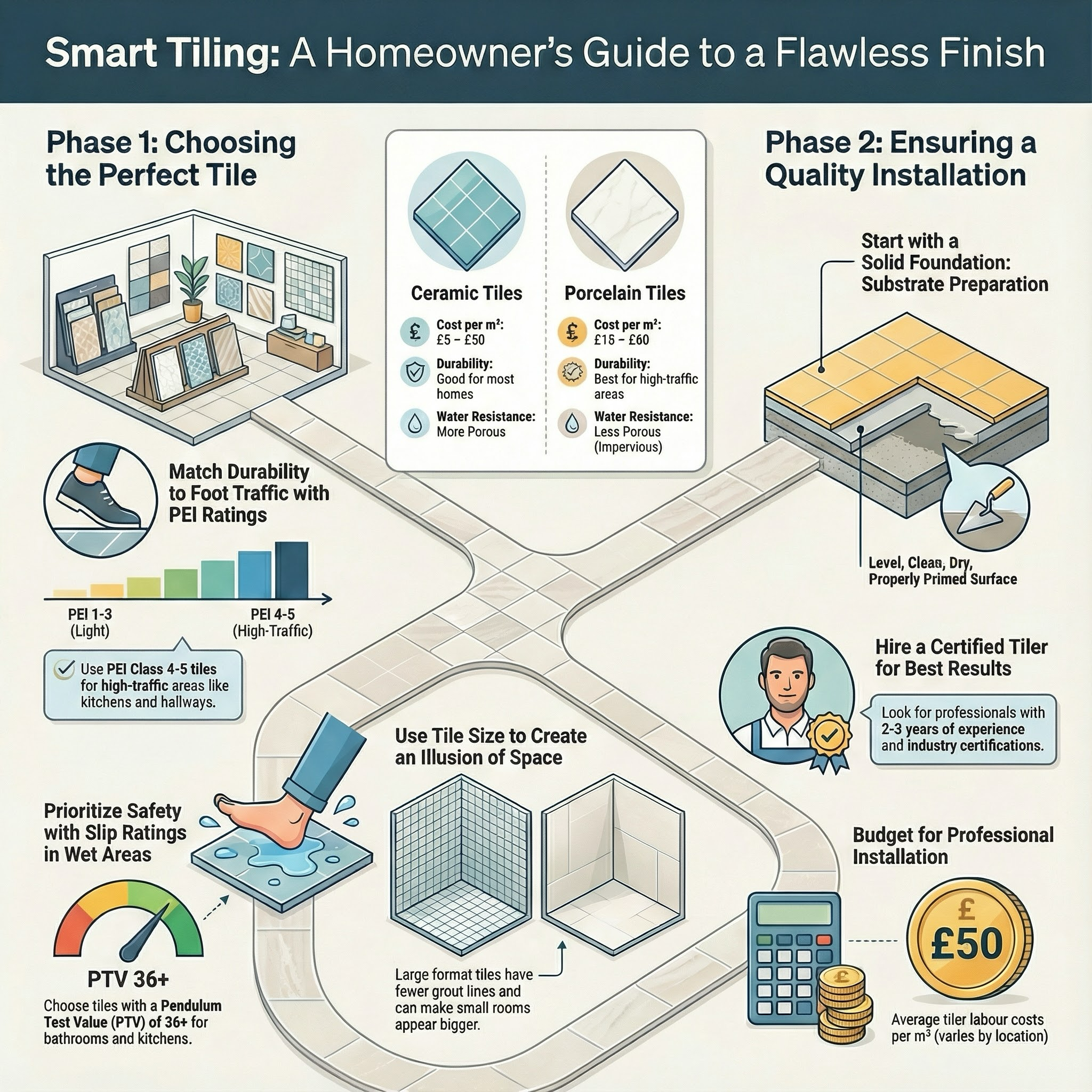
Tiler explained
While porcelain is incredibly hard-wearing, its density makes it challenging to cut and install without professional-grade equipment. A successful installation relies heavily on meticulous subfloor preparation and the correct choice of adhesives to ensure a lifetime of service.
| Item | Low £ | High £ | Notes |
|---|---|---|---|
| Labour (per m²) | £40 | £75 | Higher for large format or herringbone patterns. |
| Standard Porcelain Tiles (per m²) | £25 | £60 | Budget to mid-range options. |
| Premium/Large Format Tiles (per m²) | £70 | £120+ | Italian or Spanish designer ranges. |
| Adhesive & Grout (per m²) | £10 | £20 | Includes flexible additives for underfloor heating. |
| Subfloor Prep (Self-levelling) | £15 | £25 | Per m² including materials and labour. |
Prices vary significantly based on your location in the UK, with London and the South East typically seeing a 20-30% premium. The size of the tile also impacts the price; very small mosaics or very large "slab" tiles require significantly more time and precision to install correctly.
Porcelain is a notoriously difficult material for DIYers because it is brittle and extremely hard. Standard manual tile cutters often fail to score porcelain cleanly, leading to wasted materials and jagged edges.
Professional tilers use water-cooled diamond blades and mechanical levelling clips that ensure a perfectly flat finish that is almost impossible to achieve by hand.
If you are installing porcelain over underfloor heating or in a wet room, a professional is essential to ensure the installation meets British Standard BS 5385. Incorrectly installed porcelain can crack or "de-bond" if the wrong adhesive is used on a flexible substrate.
3 Questions to Ask Your Tiler:
Yes, but the floor must be "overboarded" first with 6mm or 12mm cement backer boards or specialized uncoupling membranes. Tiling directly onto floorboards will almost certainly result in cracked tiles due to the natural flex and expansion of the wood.
Most glazed porcelain tiles do not require sealing. However, "polished" porcelain (which has open pores from the polishing process) and the grout lines themselves often benefit from a penetrative sealer to prevent staining.
Rectified tiles have been mechanically finished to have perfectly square, sharp edges, allowing for very thin grout lines (1.5mm–2mm). Non-rectified tiles have slightly rounded edges and require wider grout joints to mask small size variations.
No. Porcelain is non-porous and will not "grip" standard ceramic adhesive. You must use a polymer-modified adhesive specifically designed for porcelain to ensure a permanent bond.
Avoid wax-based cleaners which can leave a dull film. Use a pH-neutral tile cleaner and a microfibre mop; for textured tiles, a soft brush may be needed to dislodge dirt from the surface pattern.
This guide was written with AI assistance and is intended for general information only. Prices are estimates based on UK averages and may vary by region. Always get at least three quotes and consult a qualified professional before starting any work.
Ask follow-ups in plain English. The AI explains options, sequencing and what to ask the tiler — so you walk in informed.
Updating wall tiles is one of the most effective ways to modernise a UK kitchen or bathroom without a full renovation. Beyond the aesthetic lift, professional t...
READ GUIDE →GuideMosaic tiling is the ultimate way to add texture, colour, and a bespoke feel to your UK home. Whether it’s a kitchen splashback, a wet room floor, or a decorati...
READ GUIDE →GuideVictorian geometric and encaustic tiles are a quintessential feature of British period properties, from London townhouses to seaside villas. These intricate pat...
READ GUIDE →GuideOrdering tiles is more than just picking a pattern you like. For UK homeowners, it involves calculating precise quantities, accounting for wastage, and ensuring...
READ GUIDE →GuideTiling a bathroom wall while incorporating an access hatch is a practical necessity for many UK homes. It allows for seamless aesthetics while providing vital a...
READ GUIDE →GuideBrick tiling, often referred to as "brick slips," has become a staple of UK interior design. Whether you are looking to create an industrial-style feature wall ...
READ GUIDE →