Instant
01 · Ask
Wet room or splashback?
Different skills and adhesives for floors, walls, wet rooms and large-format tiles. Describe the job and the AI tells you what to ask for.

Kitchen splashbacks, bathroom walls and floors — clean grout lines, proper waterproofing, itemised quotes.
Read the brief on adhesives, tanking and layout — then let Three local tilers quote on the spec.
Different skills and adhesives for floors, walls, wet rooms and large-format tiles. Describe the job and the AI tells you what to ask for.
C1 vs C2 adhesive, tanking membranes, grout colours, edge profiles, dry-lay rules. The lingo that separates a 5-year job from a 25-year one.
Three local tilers quote on the same spec — adhesive grade, grout, edges, prep — so you can pick craft, not just price.
Ready when you are
Enter your postcode and get free quotes from local pros.
Four moves that separate a smooth job from a nightmare.
Wet rooms need flexible C2 adhesive. Wall tiles need different adhesive to floor tiles. Cheap rapid-set on a power shower wall is how tiles fall off in 18 months.
If it's a wet room or walk-in shower, the substrate must be tanked (waterproof membrane) before tiles. Skip this and the tile job is a slow leak in waiting.
Tiles should be laid so cuts are even on opposite walls — not full tiles on one side and 20mm slivers on the other. Insist on a dry lay first.
Dark grout on a white tile = stark, grid-like, hides dirt. Pale grout on the same tile = soft, hides mistakes, stains horribly. Choose the grout before you tile.
Indicative UK ranges and what affects price.
By job type
Quote spread is typically ± 18% — always get 3 quotes.
Visual breakdown of costs, timelines and the questions you should be asking.
Tiler quick-view
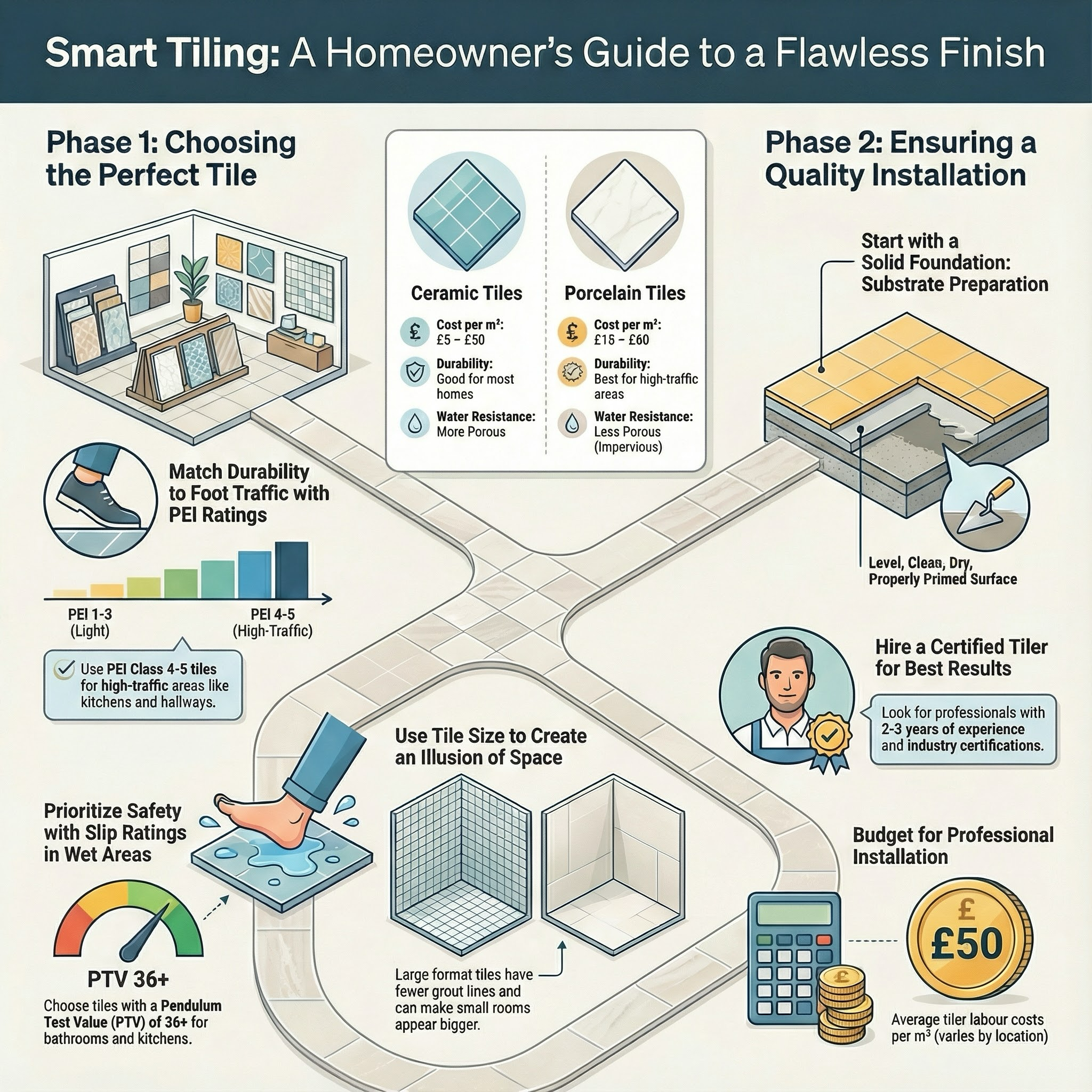
Tiler explained
Everything you need to know before hiring a tiler.
A professional tiler is a specialist tradesperson responsible for the installation of tiles on walls and floors. Whether you are refreshing a kitchen splashback, renovating a family bathroom, or installing durable flooring in a hallway, a tiler ensures a finish that is both aesthetically pleasing and structurally sound.
Beyond simple aesthetics, tilers provide essential technical expertise. They understand the nuances of different materials, from standard ceramic and porcelain to luxury natural stone like marble or slate. Their work involves precise measurements, complex geometric layouts, and ensuring surfaces are perfectly waterproofed in high-moisture environments.
Hiring a skilled tiler is an investment in the longevity of your home. Poorly installed tiles can lead to water damage, cracking, and "lippage" (uneven edges), whereas a professional finish adds significant value and durability to your property.
The process of hiring a tiler involves several distinct stages, beginning with a detailed assessment of the substrate (the surface being tiled) and ending with a clean, polished finish.
While tiling is often viewed as a DIY-friendly task, the reality is frequently more complex. Professional tilers possess the expensive specialist tools—such as bridge saws and diamond-tipped drills—required to cut modern, hard-wearing porcelain and natural stone without cracking them.
Precision and Symmetry: A professional ensures that grout lines are perfectly straight and that the layout is balanced. They have the experience to hide imperfections in "out of square" walls common in older UK properties.
Waterproofing and Longevity: In bathrooms and wet rooms, a professional understands the importance of "tanking." Failure to correctly waterproof a substrate before tiling can lead to catastrophic leaks and timber rot that are incredibly expensive to repair.
Substrate Knowledge: Different surfaces require different adhesives. A professional knows which products to use on plywood, screed, or plasterboard to prevent tiles from de-bonding or cracking over time, especially when underfloor heating is involved.
Tiling costs in the UK are typically calculated either by the square metre (m²) or as a daily rate. Prices vary depending on your location, the type of tile being used, and the complexity of the pattern (e.g., Herringbone or Chevron patterns cost more due to the extra cutting involved).
| Service | Low £ | High £ | Notes |
|---|---|---|---|
| Wall Tiling (per m²) | £35 | £65 | Labour only; excludes tiles and adhesive. |
| Floor Tiling (per m²) | £40 | £75 | Includes basic preparation. |
| Kitchen Splashback | £180 | £350 | Small, focused area; usually a flat fee. |
| Victorian Path Tiling | £1,200 | £3,000+ | Highly specialist work involving small mosaic pieces. |
| Daily Rate | £200 | £350 | Varies by region (higher in London/South East). |
Factors affecting the final price include the size of the tiles (very large format tiles require two people to lift), the condition of the existing walls, and whether you require old tiles to be removed and disposed of.
Finding a reliable tiler requires more than just looking at the lowest quote. Because tiling is a finishing trade, the quality of the work will be visible every single day.
Questions to ask before hiring:
It is usually best to let the tiler supply the adhesive and grout. Professionals know which products work best with specific tile types and substrates. They often have access to trade-quality brands that offer better performance than DIY-store alternatives.
While possible, it is generally not recommended. Tiling over old tiles adds weight to the wall, increases the thickness (which can affect door frames and fittings), and relies on the old adhesive remaining strong. For the best result, always strip back to the original substrate.
An average-sized family bathroom usually takes 3 to 5 days. This includes a day for preparation and layout, two days for fixing tiles, and a final day for grouting and silicone sealing once the adhesive has fully cured.
Tanking is the application of a waterproof membrane or liquid coating to walls and floors before tiling. In the UK, it is now standard practice (and often a building requirement) for shower areas and wet rooms to prevent moisture from seeping into the building structure.
Describe the job in plain English. The AI asks a few smart questions, then tells you whether a tiler is the right call, what it should cost, and what to ask before they start.
Bathroom Wall Work Costs Scope of Works Survey & moisture reading – locate damp, loose plaster, failed grout or mould patches. Strip‑out & prep – remove...
READ GUIDE →GuideBathroom wall tiling is one of the most effective ways to modernise a UK home while providing essential protection against moisture. High-quality tiling does mo...
READ GUIDE →GuideTiling a bathroom wall while incorporating an access hatch is a practical necessity for many UK homes. It allows for seamless aesthetics while providing vital a...
READ GUIDE →GuideDecorative wall tiling is more than just a practical solution for splash zones; it is a design statement that can transform a kitchen, bathroom, or living area....
READ GUIDE →GuideCeramic, porcelain or natural stone tiling for bathrooms, kitchens or hallways — supplied, fitted and grouted by a tiler.
READ GUIDE →GuideUpdating wall tiles is one of the most effective ways to modernise a UK kitchen or bathroom without a full renovation. Beyond the aesthetic lift, professional t...
READ GUIDE →Professional floor tiling is one of the most effective ways to transform a UK home, offering a blend of durability, hygiene, and timeless style. Whether you are...
READ GUIDE →GuidePub floors endure more punishment than almost any other interior surface. Between heavy foot traffic, dragged furniture, and frequent spills of acidic or sugary...
READ GUIDE →Cracked, chipped, or "blown" tiles are more than just an aesthetic annoyance for UK homeowners. If left unaddressed, damaged tiles in wet areas like bathrooms a...
READ GUIDE →GuideMinor damage to tiles and windows can quickly escalate into costly structural issues if left unaddressed. In the UK, damp from cracked grout or heat loss throug...
READ GUIDE →