Instant
01 · Ask
New, replace or upgrade?
New build, replace old, or retrofit a solid roof on the existing? Describe what's there and the AI tells you scope.

Conservatory builds, repairs, roof replacements and orangeries — costed per m² with glazing options.
Read the brief on roof types, Building Regs and foundations — then let Three local installers quote.
New build, replace old, or retrofit a solid roof on the existing? Describe what's there and the AI tells you scope.
Cold vs warm vs solid roof, Building Regs Part L for habitable, planning rules, dwarf-wall foundations, self-cleaning glass.
Three local installers quote on the same spec — frame, roof, foundation, electrics — so you can compare cost honestly.
Ready when you are
Enter your postcode and get free quotes from local pros.
Four moves that separate a smooth job from a nightmare.
Polycarbonate (cold) = cheapest but freezes/bakes. Tiled (warm/solid) = year-round usable but needs Building Regs. Solid roof retrofits are a common upgrade.
Solid-roof conservatories are habitable extensions under Part L. The retrofit specialist must handle Building Control — confirm before signing.
A conservatory needs proper concrete foundations under any dwarf walls — same depth as house foundations. Slab-on-grade only is a future settlement crack.
Self-cleaning, solar-control, low-E coating on conservatory glass roof. The £400 upgrade pays back in usable summer hours.
Indicative UK ranges and a typical week-by-week schedule.
By job type
Quote spread is typically ± 18% — always get 3 quotes.
Mid-size conservatory · week by week
Schedule slips on dependencies — pad each phase by 10–20% for real-world delays.
Visual breakdown of costs, timelines and the questions you should be asking.
Conservatories quick-view
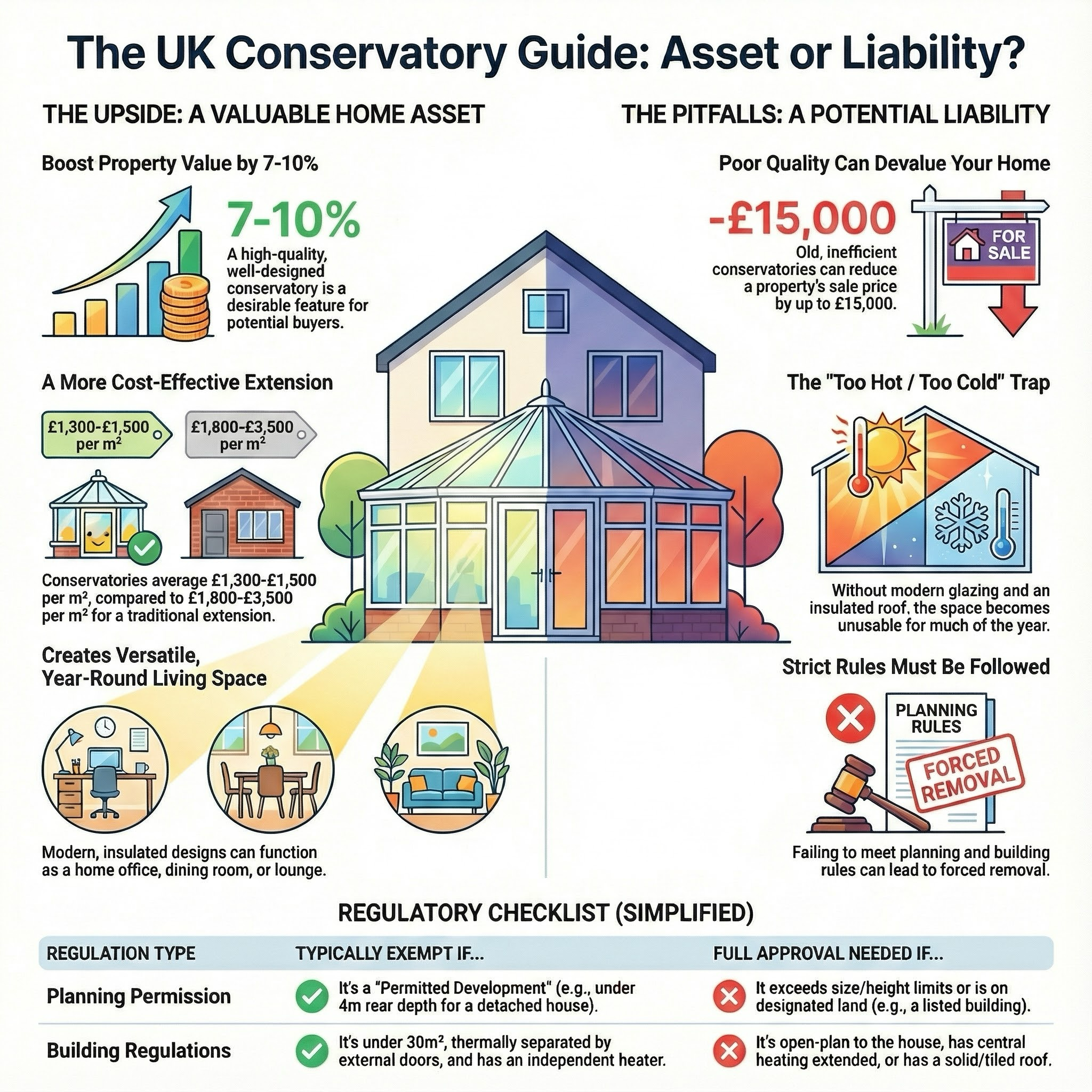
Conservatories explained
Everything you need to know before hiring a conservatories.
A conservatory specialist is a skilled professional who designs, builds, and maintains glass-walled extensions. These tradespeople combine elements of bricklaying, glazing, and roofing to create bright, versatile spaces that add significant value and square footage to UK homes.
Modern conservatory services have evolved far beyond the basic "white uPVC" structures of the past. Today’s experts handle everything from traditional Victorian and Edwardian styles to contemporary orangeries and high-performance tiled roof replacements that ensure the room remains comfortable year-round.
Whether you are looking to build a new sunroom from scratch, repair a leaking roof, or upgrade your existing structure with energy-efficient glass, a conservatory specialist provides the technical expertise to ensure the build is structurally sound and thermally efficient.
Hiring a conservatory professional involves a structured process to ensure the new structure integrates seamlessly with your existing property. Here is the typical workflow:
While some small repair tasks might seem like DIY projects, building or upgrading a conservatory requires professional expertise to meet UK Building Regulations. A professional ensures the structure can handle "snow loads" and wind pressure, preventing catastrophic failure during extreme weather.
Thermal efficiency is another critical factor. Under Part L of the Building Regulations, new extensions must meet strict insulation standards. A professional installer will use Low-E glass and thermally broken frames to prevent the "greenhouse effect" in summer and heat loss in winter.
Furthermore, hiring a member of a competent person scheme like FENSA or CERTASS is vital. These installers can self-certify their work, providing you with the necessary certification required when you eventually come to sell your home.
The cost of a conservatory varies significantly based on the materials used, the complexity of the groundworks, and the type of roofing system selected. Below are estimated costs for 2025/26 including VAT.
| Service | Low £ | High £ | Notes |
|---|---|---|---|
| Small uPVC Lean-to | £10,000 | £15,000 | Basic design, polycarbonate roof. |
| Victorian/Edwardian (3m x 3m) | £15,000 | £25,000 | uPVC with glass roof and dwarf wall. |
| Tiled Roof Replacement | £6,000 | £12,000 | Retrofitting a solid roof to existing frames. |
| Modern Orangery | £30,000 | £60,000+ | Substantial brickwork and lantern roof. |
| General Repairs/Leak Fixing | £300 | £1,500 | Replacing seals, panels, or guttering. |
Price fluctuations are often driven by the choice of frame material (aluminium is typically 30-50% more expensive than uPVC) and the necessity for extensive drainage or utility rerouting during the groundworks phase.
Choosing the right installer is the difference between a room you use every day and a "white elephant" that is too hot or too cold. Follow these steps to find a reputable pro:
Questions to ask before hiring:
In most cases, conservatories are considered "Permitted Development" and do not require planning permission, provided they meet specific size limits and height restrictions. However, if you live in a Conservation Area or a Listed Building, or if the extension exceeds 50% of the land around the original house, you will likely need formal approval.
Older conservatories often struggle with temperature regulation, but modern builds with solar-control glass or solid tiled roofs are designed for 365-day use. Adding integrated heating, such as electric underfloor heating or vertical radiators, is highly recommended for the winter months.
A standard uPVC conservatory usually takes between 3 to 5 weeks to complete. This includes roughly one week for groundworks and foundations, one week for the frames and roof, and a final week for internal finishing and flooring. Complex orangeries or those requiring significant brickwork may take 8 weeks or longer.
Tiled roofs offer superior thermal insulation, making the room feel more like a traditional house extension. Glass roofs, however, provide maximum natural light. Many homeowners now opt for "hybrid" roofs which feature large glass panels inset into a solid, insulated tiled structure.
Describe the job in plain English. The AI asks a few smart questions, then tells you whether a conservatories is the right call, what it should cost, and what to ask before they start.
Aluminium conservatories offer the slimmest sightlines and longest life. UK costs, brands and when aluminium pays back vs uPVC.
READ GUIDE →GuideConservatory foundations and slabs are the make-or-break element. UK costs, depth requirements, and the common mistakes.
READ GUIDE →GuideConservatory blinds and heat control solutions. UK costs for pinoleum, pleated, vertical and motorised options.
READ GUIDE →GuideConservatory regulations are a maze. UK guide to permitted development, Building Regs exemption and when you need a planning application.
READ GUIDE →GuideWhat conservatories really cost in the UK in 2026. Style-by-style, brand-by-brand, with what's included and how to read a quote.
READ GUIDE →GuideUnderfloor heating transforms a cold conservatory into a year-round room. UK costs for wet and electric systems and how they integrate with the existing boiler.
READ GUIDE →GuideWithout ventilation conservatories become hothouses. UK costs for roof vents, trickle vents and mechanical extract.
READ GUIDE →GuideEdwardian conservatories are the rectangular box-shape classic. UK costs, comparison vs Victorian and where the style suits best.
READ GUIDE →GuideGable conservatories have a tall feature front. UK costs, the dramatic apex aesthetic and where they suit best.
READ GUIDE →GuideGarden rooms compete with conservatories for indoor-outdoor living. UK costs compared, and which gives better value and use.
READ GUIDE →GuideLean-to conservatories are the simplest and cheapest. UK costs, when they suit, and how they look on bungalows and small homes.
READ GUIDE →GuideLightweight tiled roofs convert a hot/cold conservatory into a year-round room. UK costs, brands and the warm-roof transformation.
READ GUIDE →GuideOrangeries are the brick-pillared upgrade from a conservatory. UK costs, lantern roofs and how they bridge garden room and extension.
READ GUIDE →GuideP-shape and L-shape conservatories combine styles for maximum space. UK costs, layouts and which suits semi-detached homes.
READ GUIDE →GuideConservatory glazing makes the difference between greenhouse and year-round room. UK costs for self-cleaning, solar-control and low-E glass.
READ GUIDE →GuideVictorian conservatories are the multi-faceted bay-fronted classic. UK costs, planning, glazing and how the style suits period homes.
READ GUIDE →GuideuPVC is the UK's default conservatory frame material. Costs, brands and how to spec a uPVC conservatory that lasts.
READ GUIDE →