Instant
01 · Ask
Carpet, LVT, wood or tile?
Different rooms, different priorities. Describe the rooms (bathroom, kitchen, hall, bedroom) and the AI tells you the right material for each.

Laminate, hardwood, vinyl, tiles and carpet — measured up, costed per m² and fitted in days not weeks.
Read the brief on subfloor prep, underlay and acclimatisation — then let three NICF/CFA fitters quote.
Different rooms, different priorities. Describe the rooms (bathroom, kitchen, hall, bedroom) and the AI tells you the right material for each.
Subfloor moisture limits, UFH compatibility, scotia vs threshold, T-bar profiles, latex screed depths. Know how the floor lays.
Three NICF/CFA fitters quote on the same spec — material, underlay, prep, edge finish — so you pick the fitter, not the cheapest carpet.
Ready when you are
Enter your postcode and get free quotes from local pros.
Four moves that separate a smooth job from a nightmare.
Engineered wood and LVT/luxury vinyl tile must sit in the room they'll be fitted for 48 hours before laying. Skip this and they expand or contract in service.
Some woods aren't UFH-compatible. Engineered, LVT and tile all work — solid hardwood doesn't. Confirm the spec before buying.
Concrete subfloors must read under 75% RH (or 4% CM) before flooring. A moisture meter is a £50 tool — the fitter should use one.
Carpet, LVT, engineered wood — each needs a specific underlay. The supplier's recommendation, not the cheapest roll, is what makes the floor last.
Indicative UK ranges and what affects price.
By job type
Quote spread is typically ± 18% — always get 3 quotes.
Visual breakdown of costs, timelines and the questions you should be asking.
Flooring quick-view
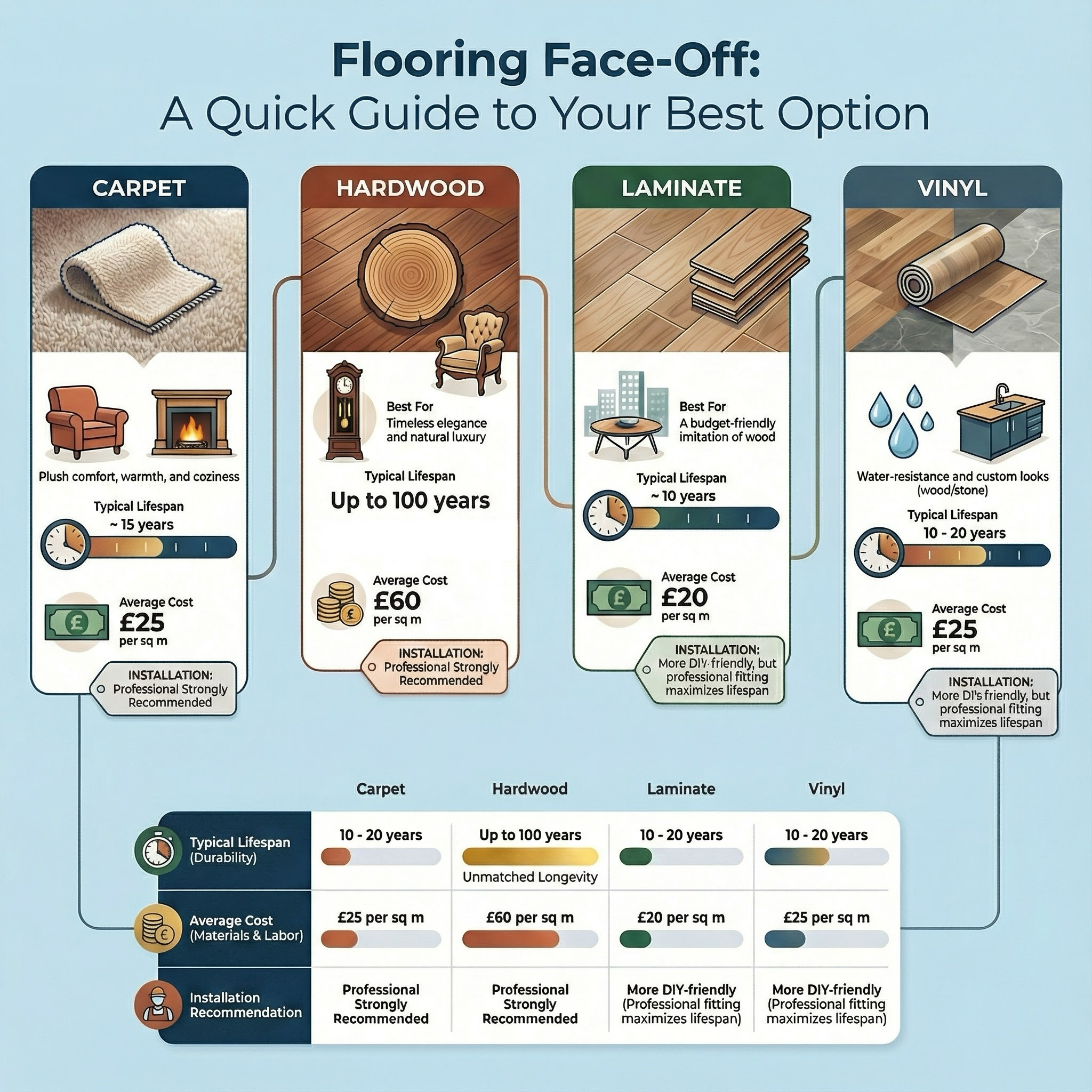
Flooring explained
Everything you need to know before hiring a flooring.
A professional flooring specialist transforms the foundation of your home’s interior, providing both aesthetic appeal and structural durability. Whether you are looking for the warmth of real oak, the practicality of luxury vinyl, or the comfort of high-quality carpet, these experts ensure a finish that lasts for decades.
UK homeowners typically call upon flooring contractors for whole-house renovations, damp-proofing subfloors, or replacing worn-out surfaces in high-traffic areas. Beyond just laying the visible material, they are experts in floor levelling, moisture testing, and acoustic insulation.
Modern flooring requires precision tools and specific adhesives that differ greatly between materials. From intricate herringbone patterns to seamless wet-room vinyl, a professional floor layer ensures your investment is protected by following manufacturer specifications and British Standards.
While many homeowners attempt DIY flooring, the "finish" is where the difference becomes obvious. Professionals understand the complex expansion requirements of different materials; without proper gaps, your floor can "peak" or buckle during seasonal temperature changes.
Subfloor preparation is the most critical stage. A professional will identify issues like rising damp or uneven joists that would ruin expensive materials within months. They also adhere to BS 8203 (for resilient floor coverings) and BS 8201 (for wood flooring), ensuring the installation meets insurance and warranty requirements.
Hiring a pro also gives you access to commercial-grade equipment, such as heavy-duty floor sanders and moisture meters, which are expensive to hire and difficult to operate without experience. This ensures a level of symmetry and detail around door frames and radiators that is hard to achieve otherwise.
| Service | Low £ | High £ | Notes |
|---|---|---|---|
| Carpet Fitting (Labour only) | £10 per m² | £18 per m² | Excludes underlay and grippers. |
| Laminate Installation | £15 per m² | £28 per m² | Higher cost for herringbone patterns. |
| Luxury Vinyl Tile (LVT) - Click | £20 per m² | £35 per m² | Includes basic underlayment. |
| Engineered/Solid Wood | £30 per m² | £60 per m² | Dependent on fixing method (glue/nail). |
| Self-Levelling Screeding | £15 per m² | £25 per m² | Essential for uneven concrete floors. |
| Plywood Subfloor Prep | £12 per m² | £20 per m² | 6mm or 9mm ply for timber subfloors. |
Note: Total costs are heavily influenced by the condition of your existing subfloor and the complexity of the room layout. Expect to pay more for rooms with many alcoves, curved walls, or integrated floor sockets.
Most fitters expect the room to be completely empty. While some may offer to move heavy items for a fee, they generally won't take responsibility for electronics or fragile items. It is always best to clear the space entirely to allow the fitter to work efficiently.
Yes, but you must choose compatible materials. Engineered wood and LVT are excellent for underfloor heating as they conduct heat well. You must ensure the flooring is rated for the specific temperature of your system to prevent warping or adhesive failure.
This usually happens due to a lack of expansion gaps around the perimeter or because the material wasn't properly acclimatised. Wood and laminate naturally expand and contract with humidity; if they have no room to move, they will push against each other and lift.
A standard 15-20m² room usually takes one day for carpet or laminate. Real wood or glue-down LVT may take 2-3 days, especially if the subfloor requires a screed that needs time to dry before the top layer is applied.
Describe the job in plain English. The AI asks a few smart questions, then tells you whether a flooring is the right call, what it should cost, and what to ask before they start.
Bamboo is the eco-friendly hard floor. UK costs, strand-woven vs vertical and how it compares to oak on durability.
READ GUIDE →GuideBathroom floors must be waterproof and slip-safe. UK costs for tile, LVT, vinyl and how to spec for a wetroom.
READ GUIDE →GuideCork is warm, soft underfoot and sustainable. UK costs, look options and where it suits best in modern homes.
READ GUIDE →GuideElectric underfloor heating mats heat bathrooms and kitchens. UK costs, types and how the install works.
READ GUIDE →GuideSelf-levelling compound fixes uneven subfloors. UK costs, application steps and when to use it.
READ GUIDE →GuideDamaged floors can usually be repaired without full replacement. UK costs for board replacement, water damage and scratch repair.
READ GUIDE →GuideThe right underlay extends floor life and improves comfort. UK costs by type and what to choose for laminate, LVT and carpet.
READ GUIDE →GuideHallways take the most foot traffic in any house. UK costs for floors that survive boots, grit and a constant flow of people.
READ GUIDE →GuideKitchen floors face spills, dropped pans and heavy traffic. UK costs by material and which floors survive a working kitchen.
READ GUIDE →GuideMarmoleum and traditional linoleum are sustainable hard floors. UK costs, the difference vs vinyl, and where lino is the right choice.
READ GUIDE →GuidePolished concrete is the contemporary industrial floor. UK costs, methods (mechanical vs poured) and where it suits best.
READ GUIDE →GuideRubber floors are durable, shock-absorbing and surprisingly attractive. UK costs for gyms, kitchens, garages and modern interiors.
READ GUIDE →GuideNatural stone is the heritage hard floor. UK costs by stone type, sealing requirements and where stone suits best.
READ GUIDE →GuideTile floors are the most durable hard finish for kitchens and bathrooms. UK costs, porcelain vs ceramic and large-format vs small.
READ GUIDE →Carpet is still the UK's most popular bedroom flooring. Costs, pile types, underlay choices and the modern stain-resistant range.
READ GUIDE →GuideStairs need their own approach. UK costs for stair carpet, wood treads, runners and combinations.
READ GUIDE →LVT has overtaken laminate as the premium hard floor of choice. UK costs, click vs glue-down and where it suits best.
READ GUIDE →GuideSheet vinyl is the cheapest waterproof floor. UK costs, install methods and where modern designer vinyl beats LVT on value.
READ GUIDE →