Instant
01 · Ask
Short-term or long-term?
1 month while you move, 6 months between houses, indefinite storage? Describe and the AI tells you which provider type and unit size.

Self-storage, container storage, document and archive — priced per ft² per month, flexible terms.
Read the brief on unit sizes, climate control and insurance — then let Three local storage providers quote.
1 month while you move, 6 months between houses, indefinite storage? Describe and the AI tells you which provider type and unit size.
Unit sizing, access hours, climate control, insurance options, retrieval fees. Know what to ask.
Three local providers quote on the same volume — unit size, climate, access, insurance — so monthly cost matches need.
Ready when you are
Enter your postcode and get free quotes from local pros.
Four moves that separate a smooth job from a nightmare.
Personal storage units are cheaper than business contracts. Specify which on enquiry — business has VAT and SLA requirements.
Most storage facilities offer optional insurance; many homeowner policies don't extend to off-site goods. Get cover one way or another.
Antiques, art, electronics, paper — these need climate-controlled units. Standard units swing 5–35°C and 40–90% humidity in a year.
Some facilities are office-hours only. If you need evening or weekend access, confirm before signing.
Indicative UK ranges and what affects price.
By job type
Quote spread is typically ± 18% — always get 3 quotes.
Visual breakdown of costs, timelines and the questions you should be asking.
Storage quick-view
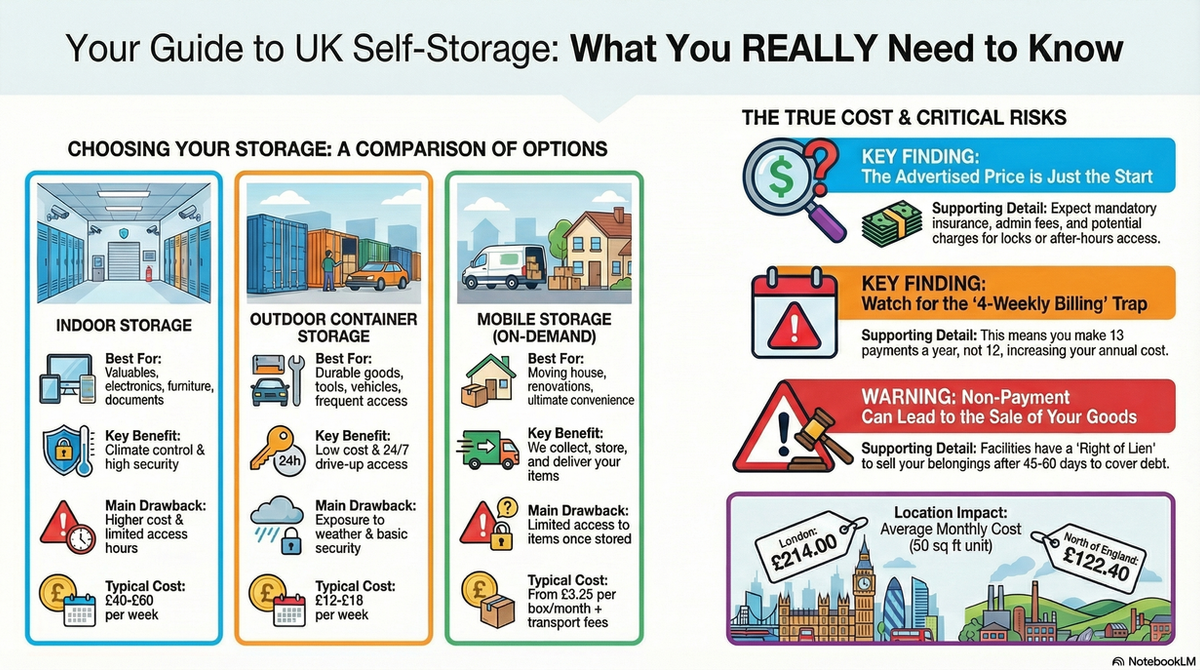
Storage explained
Everything you need to know before hiring a storage.
Storage services provide a vital lifeline for UK homeowners during major life transitions. Whether you are navigating a complex house move, renovating your property, or simply decluttering to create a more functional living environment, professional storage facilities offer a secure, off-site solution for your belongings.
From modern, climate-controlled self-storage units to rugged outdoor shipping containers, the industry caters to a wide variety of needs. Modern facilities go beyond simple lock-and-key services, offering high-tech security, flexible contracts, and specialised options for sensitive items like documents or antiques.
Hiring a professional storage provider ensures your possessions are kept in a clean, dry, and monitored environment. This removes the stress of cramming items into damp garages or overflowing lofts, protecting the long-term value of your furniture and personal effects.
The process of securing storage is generally straightforward, but service levels can vary significantly between providers. Here is what you can typically expect from a professional facility:
A typical job progresses from an initial space estimation to signing a rental agreement. Most providers require a form of ID and a security deposit before you move your items in using their provided loading bays.
While it might be tempting to use a friend's spare room or a garden shed, professional storage offers protections that domestic spaces cannot match. Security is the primary driver; professional sites are purpose-built to deter theft and are often monitored by remote security centres outside of business hours.
Environmental control is another critical factor. UK weather can be notoriously damp; professional indoor units are ventilated and heated to ensure that soft furnishings, electronics, and paperwork do not suffer from dampness or pest infestations. Furthermore, reputable facilities are members of the Self Storage Association UK (SSA UK), which sets industry standards for safety and transparency.
Insurance is perhaps the most important reason to go professional. Most home insurance policies will not cover items stored away from the primary residence. Professional providers offer specific goods-in-storage insurance, ensuring you are financially protected against fire, flood, or theft.
Storage costs are usually billed every four weeks or monthly. Prices vary based on the location (London and the South East are significantly more expensive) and the level of security or climate control provided.
| Service / Unit Size | Low £ (Per Week) | High £ (Per Week) | Notes |
|---|---|---|---|
| Small Locker (approx. 10 sq ft) | £5 | £15 | Ideal for a few boxes or suitcases. |
| 50 sq ft Unit | £20 | £45 | Fits the contents of a typical 1-bed flat. |
| 100 sq ft Unit | £40 | £75 | Fits the contents of an average 2-bed house. |
| 160 sq ft Container | £35 | £60 | Outdoor "drive-up" shipping container. |
| Document Storage | £2 | £5 | Per standard archive box per month. |
| Insurance Premium | £3 | £10 | Varies based on total value of goods. |
Note: Prices are estimates including VAT. Factors affecting the final quote include the floor level (ground floor units often carry a premium), the duration of the contract, and any introductory "first month half price" offers.
Selecting a facility isn't just about the lowest price; it is about the safety of your belongings. Use this checklist to evaluate potential providers:
Questions to ask before signing:
Most facilities require your goods to be insured. While they will offer their own policy, you can often use a third-party specialist storage insurer which may be cheaper, provided you can present a valid summary of cover to the facility manager.
You cannot store flammable liquids, explosives, gas canisters, food or perishable items, livestock, or illegal goods. Most facilities also prohibit the storage of high-value jewellery and large amounts of cash.
As a rule of thumb, a 50 sq ft unit holds the contents of a transit van, while a 150 sq ft unit holds the contents of a standard removal lorry. Most providers have online size estimators or "visualiser" tools to help you decide.
Not necessarily. Some facilities offer 24/7 access as standard, while others charge an additional monthly fee for this privilege. Many smaller or older facilities may only be accessible during 9-to-5 business hours.
Describe the job in plain English. The AI asks a few smart questions, then tells you whether a storage is the right call, what it should cost, and what to ask before they start.
Shipping container storage. UK costs.
READ GUIDE →GuideOffice storage solutions. UK costs.
READ GUIDE →GuideSelf-storage unit rental. UK costs and types.
READ GUIDE →Converting garage to storage space. UK costs.
READ GUIDE →GuideGarage organisation systems. UK costs.
READ GUIDE →GuideGarden storage solutions. UK costs.
READ GUIDE →