Instant
01 · Ask
Ask the AI a follow-up
Got more questions about home Appliance Repair? Describe the bit you're unsure about — the AI explains options, sequencing and what to ask the appliance repair.

What things cost to fix in 2026, when to repair vs replace, and how to spot a fair quote.
You've read the brief on home Appliance Repair. Now lean on us to find the right appliance repair — and stay in control of the job.
Got more questions about home Appliance Repair? Describe the bit you're unsure about — the AI explains options, sequencing and what to ask the appliance repair.
Costs, timelines, pitfalls and the right questions to ask before any appliance repair starts on home Appliance Repair.
Itemised quotes from up to 3 local appliance repairs on home Appliance Repair — so you can compare like-for-like, not lump sums.
Ready when you are
Enter your postcode and get free quotes from local pros.
Four moves that separate a smooth job from a nightmare.
Inexperienced "handymen" may replace a part that isn't broken because they haven't identified the root cause, leading to wasted money.
Technicians often cannot work on appliances stacked in tight cupboards or behind heavy furniture unless cleared beforehand.
Using cheap, non-branded parts from online marketplaces can lead to premature failure or even fire hazards.
These are the hardest to fix; try to take a video of the appliance acting up or showing an error code before the technician arrives.
Indicative UK ranges and what affects price.
By job type
Quote spread is typically ± 18% — always get 3 quotes.
Appliance Repair quick-view
Appliance Repair explained
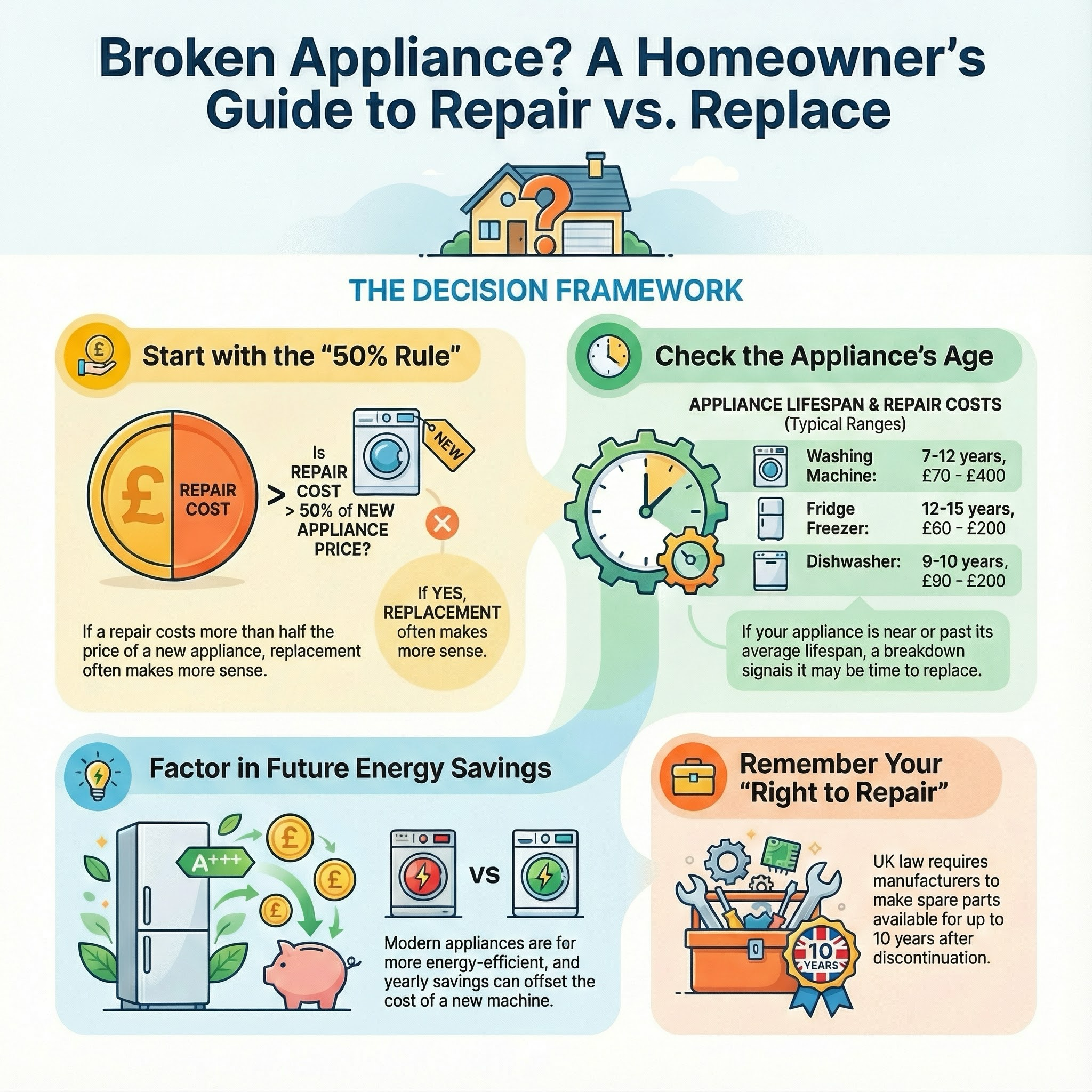
Repairing an appliance is often significantly cheaper than replacing it, particularly with the rising cost of high-end white goods. Choosing a professional repair also supports sustainability by reducing the volume of electronic waste sent to landfill, provided the work is carried out by a qualified technician using quality components.
The cost of appliance repair in the UK is largely determined by the brand of the machine and the complexity of the part required. Premium brands like Miele or Sub-Zero often carry higher part costs and require specialist diagnostic tools.
| Item | Low £ | High £ | Notes |
|---|---|---|---|
| Call-out Charge | £65 | £115 | Usually covers the first 30-60 minutes of diagnosis. |
| Labour (per hour) | £50 | £90 | Charged after the initial call-out period. |
| Small Parts (Seals/Belts) | £20 | £55 | Door seals, drive belts, or simple thermostats. |
| Major Parts (Motor/PCB) | £160 | £380 | Control boards, drum motors, or compressors. |
| Integrated Unit Handling | £30 | £75 | Additional labour to remove and refit decor panels. |
| Average Total Repair | £140 | £480 | Includes VAT, parts, and labour for a single visit. |
Prices vary by region, with London and the South East typically seeing rates at the higher end of these scales. Always check if the call-out fee is deducted from the final repair bill if you choose to go ahead with the work.
While basic maintenance—such as cleaning filters or replacing a lightbulb—is suitable for DIY, most appliance repairs require professional intervention. Modern machines are governed by complex electronic control boards (PCBs) that are easily damaged by static or incorrect handling.
Safety Warning: Under UK law, any repair involving the gas supply of an oven or hob must be performed by a Gas Safe registered engineer. Attempting this yourself is illegal and extremely dangerous.
Professional repairs also maintain your appliance’s warranty and home insurance validity. A botched DIY repair on a washing machine that later causes a flood could lead to an insurance claim being rejected.
Finding a reliable technician ensures the job is done safely and prevents the "buy cheap, pay twice" scenario. Look for the following when hiring:
Questions to ask:
A general rule of thumb is the "50% rule." If the repair cost exceeds 50% of the price of a new, equivalent model, replacement is usually better. For premium brands, the threshold is often higher as they are built to last 15–20 years.
Most UK technicians charge a diagnostic or call-out fee to cover their time and travel. However, many reputable firms will waive this fee if you proceed with the quoted repair.
If your appliance is under warranty, you should always contact the manufacturer first. Using an independent technician may void your remaining warranty, though they are often faster to attend than manufacturer-contracted engineers.
Ensure the area is clear and the appliance is empty (e.g., remove laundry or food). If it is a fridge or freezer repair, you may need to have a plan for your perishables in case the unit needs to be powered down for an extended period.
Integrated appliances require extra time to remove the decorative kitchen door and pull the unit out from under the worktop. This extra labour time is reflected in the final invoice.
Standard professional repairs in the UK typically come with a 3 to 12-month warranty on the specific part fitted and the labour associated with that specific fault.
This guide was written with AI assistance and is intended for general information only. Prices are estimates based on UK averages and may vary by region. Always get at least three quotes and consult a qualified professional before starting any work.
Ask follow-ups in plain English. The AI explains options, sequencing and what to ask the appliance repair — so you walk in informed.
Microwaves are a staple of the modern UK kitchen, offering convenience for everything from defrosting to full meal preparation. While basic freestanding models ...
READ GUIDE →GuideA faulty fridge or freezer is one of the most urgent domestic repairs, with food safety and waste being the primary concerns. For many UK homeowners, a professi...
READ GUIDE →GuideA cold oven is a major disruption to any UK household, but a failed heating element is one of the most common and cost-effective repairs you can undertake. Inst...
READ GUIDE →GuideScope of Works • inspect appliance and perform diagnostic checks (power, suction, switches, wiring) • clean and test filters, dust bin or bag and airway for blo...
READ GUIDE →GuideA faulty microwave display is a common frustration for UK homeowners. Whether the screen has gone completely dark, is flickering, or showing unintelligible "gho...
READ GUIDE →GuideA faulty oven can bring a UK household to a standstill, turning meal times into a logistical challenge. Whether it is a failed heating element, a noisy fan, or ...
READ GUIDE →