Instant
01 · Ask
Ask the AI a follow-up
Got more questions about fridge/freezer repair? Describe the bit you're unsure about — the AI explains options, sequencing and what to ask the appliance repair.

Not cooling, leaking or noisy — fixed without losing the contents of the freezer drawer.
You've read the brief on fridge/freezer repair. Now lean on us to find the right appliance repair — and stay in control of the job.
Got more questions about fridge/freezer repair? Describe the bit you're unsure about — the AI explains options, sequencing and what to ask the appliance repair.
Costs, timelines, pitfalls and the right questions to ask before any appliance repair starts on fridge/freezer repair.
Itemised quotes from up to 3 local appliance repairs on fridge/freezer repair — so you can compare like-for-like, not lump sums.
Ready when you are
Enter your postcode and get free quotes from local pros.
Four moves that separate a smooth job from a nightmare.
Often caused by a failed defrost heater or a split door gasket allowing moist air inside.
Usually a sign of dusty condenser coils or a slow refrigerant leak, forcing the motor to work harder.
Typically caused by a blocked "meltwater" drain hole at the back of the fridge.
Suggests an evaporator fan failure or a blockage in the air ducts between the two compartments.
Indicative UK ranges and what affects price.
By job type
Quote spread is typically ± 18% — always get 3 quotes.
Appliance Repair quick-view
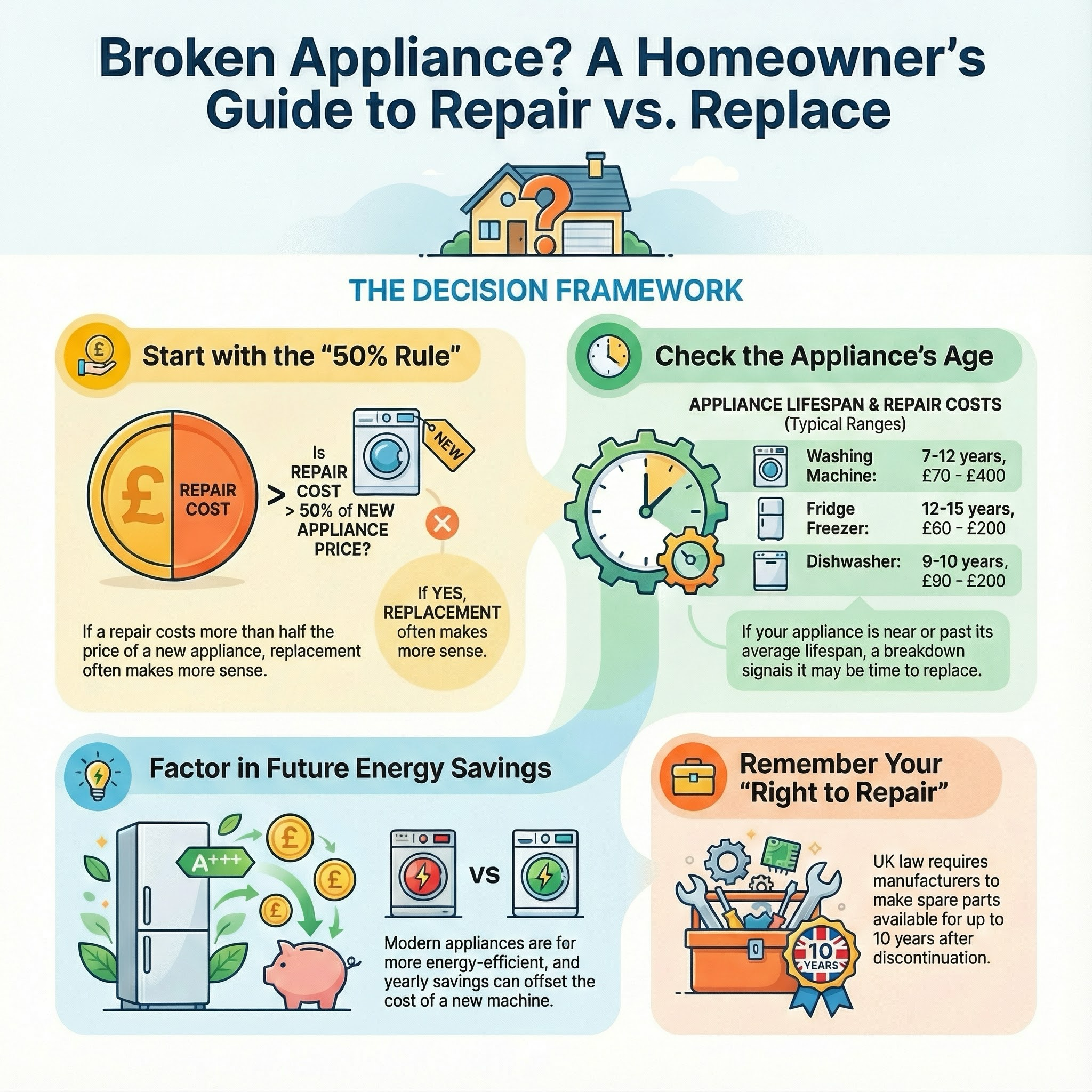
Appliance Repair explained
Whether it is a minor thermostat issue or a complex refrigerant leak, understanding the repair process helps you decide if your appliance is worth saving. Most modern units can be restored to full efficiency for a fraction of the cost of a new model.
Prices vary based on your location in the UK and whether the appliance is a standard freestanding unit or a complex integrated model. Integrated appliances usually incur higher labour costs due to the time required to remove them from cabinetry.
| Item | Low £ | High £ | Notes |
|---|---|---|---|
| Call-out / Diagnostic Fee | £65 | £125 | Often deducted from the final repair bill. |
| Labour (per hour) | £55 | £95 | Excludes the cost of parts. |
| Minor Parts (Sensors/Seals) | £30 | £110 | Common fixes for temperature fluctuations. |
| Major Parts (Fan Motors/Boards) | £90 | £260 | Control boards for premium brands can be higher. |
| Compressor Replacement | £300 | £550 | Includes labour and F-gas refrigerant. |
| Appliance Disposal (WEEE) | £40 | £90 | Safe recycling of old units containing gases. |
Note: If your appliance is over 10 years old and requires a new compressor, the repair cost may exceed 50% of the value of a new, more energy-efficient model.
Homeowners can safely perform basic maintenance, such as cleaning condenser coils or unblocking the drainage hole. However, any work involving the electrical system or the sealed refrigerant circuit must be handled by a professional.
In the UK, it is illegal for an unqualified person to handle refrigerant gases. Always hire a technician who is F-gas certified to ensure the gases are recovered and handled according to environmental laws.
Questions to ask:
Generally, if the repair costs more than 50% of a new unit, replacement is better. Older units are also significantly less energy-efficient than modern 'A' rated appliances.
This is often the start relay trying to kick-start the compressor. If the compressor is failing or the relay is burnt out, the fridge will stop cooling shortly after.
No. Refrigerant handling requires specialist equipment and F-gas certification. DIY kits are often ineffective and can be dangerous if the system has a leak.
You should vacuum the condenser coils at the back or bottom of the unit every 6 to 12 months. This prevents overheating and can extend the life of the compressor.
Clear a workspace around the unit, ensure it is accessible (especially if integrated), and have a plan for your chilled food in case the unit needs to be powered down for a few hours.
This guide was written with AI assistance and is intended for general information only. Prices are estimates based on UK averages and may vary by region. Always get at least three quotes and consult a qualified professional before starting any work.
Ask follow-ups in plain English. The AI explains options, sequencing and what to ask the appliance repair — so you walk in informed.
Microwaves are a staple of the modern UK kitchen, offering convenience for everything from defrosting to full meal preparation. While basic freestanding models ...
READ GUIDE →GuideA cold oven is a major disruption to any UK household, but a failed heating element is one of the most common and cost-effective repairs you can undertake. Inst...
READ GUIDE →GuideScope of Works • inspect appliance and perform diagnostic checks (power, suction, switches, wiring) • clean and test filters, dust bin or bag and airway for blo...
READ GUIDE →GuideA faulty microwave display is a common frustration for UK homeowners. Whether the screen has gone completely dark, is flickering, or showing unintelligible "gho...
READ GUIDE →GuideA faulty oven can bring a UK household to a standstill, turning meal times into a logistical challenge. Whether it is a failed heating element, a noisy fan, or ...
READ GUIDE →GuideHigh-end food processors from brands like Magimix, Kenwood, and KitchenAid are significant investments for any UK kitchen. When these machines stop spinning or ...
READ GUIDE →