Instant
01 · Ask
Which appliance, what symptom?
Spinning issue, leak, no power? Describe the symptoms and the AI tells you the likely cause and rough cost.

Washing machines, ovens, fridges and dishwashers — diagnosed in the first visit, fixed in the second.
Read the brief on diagnosis fees, repair-or-replace math and OEM parts — then let Three local repairers quote.
Spinning issue, leak, no power? Describe the symptoms and the AI tells you the likely cause and rough cost.
Fixed diagnosis fees, OEM parts, warranty check first, repair vs replace thresholds. Know when to fix and when to bin.
Three local repairers quote on the same diagnosis — parts, labour, warranty on the repair — so you don't get bilked.
Ready when you are
Enter your postcode and get free quotes from local pros.
Four moves that separate a smooth job from a nightmare.
Most repairers charge a fixed diagnosis fee that's deducted from the repair cost if you proceed. Confirm it before they arrive.
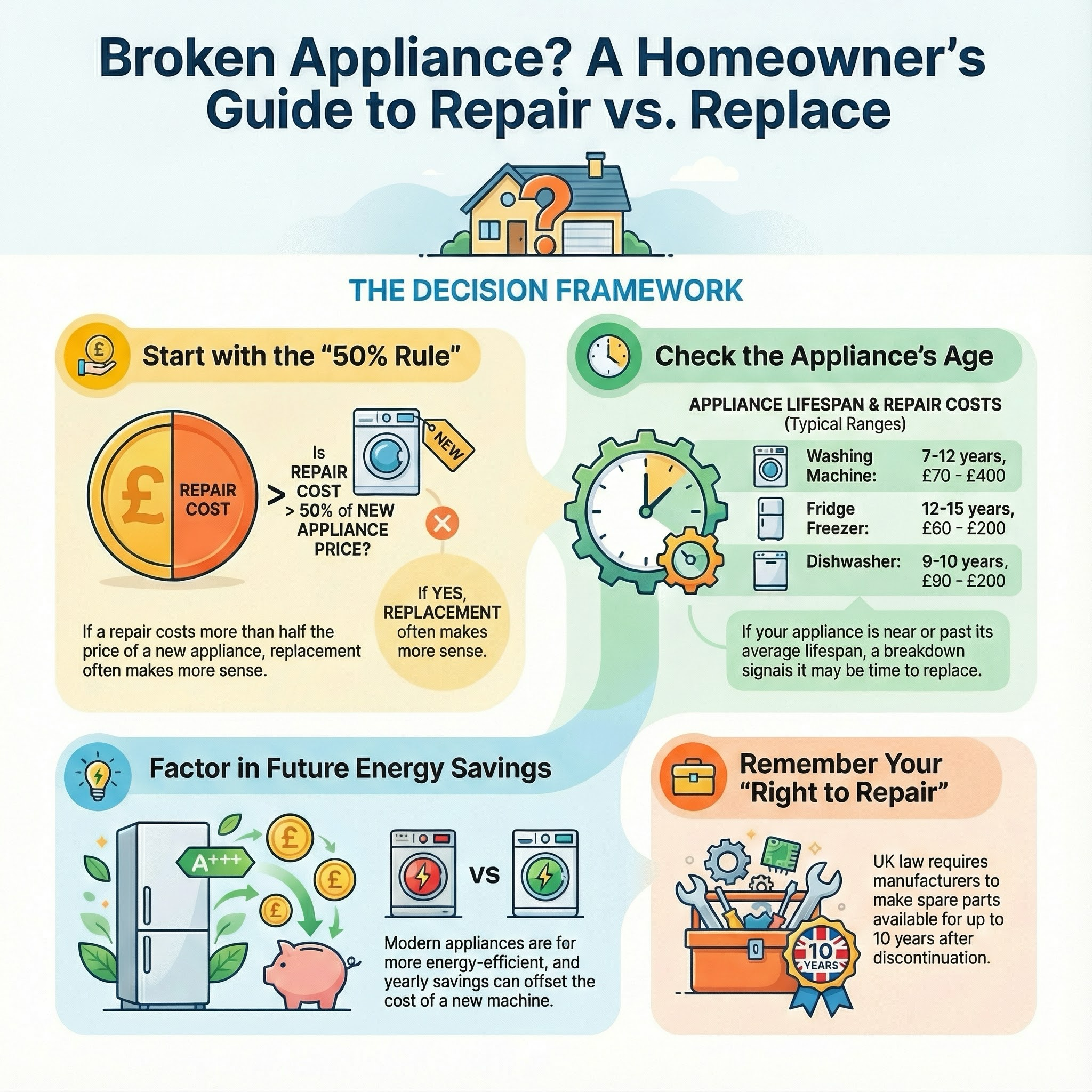
Rule of thumb: if the repair costs more than 50% of a new appliance, replace. £150 on a £300 washing machine is a coin-flip.
Always check warranty before calling out third-party. Many appliances have 2–10 year manufacturer cover most owners forget about.
Original (OEM) parts vs generic. OEM matches the warranty, generic is 30–50% cheaper but cuts the life of the appliance. Ask which.
Indicative UK ranges and what affects price.
By job type
Quote spread is typically ± 18% — always get 3 quotes.
Visual breakdown of costs, timelines and the questions you should be asking.
Appliance Repair quick-view
Appliance Repair explained
Everything you need to know before hiring a appliance repair.
A faulty domestic appliance can bring a busy UK household to a standstill. Whether it is a washing machine that refuses to drain, an oven that won't heat, or a fridge-freezer making ominous noises, appliance repair specialists are the experts who diagnose and fix these essential machines.
Most specialists cover a wide range of "white goods," including dishwashers, tumble dryers, and hobs. They combine electrical knowledge with mechanical skills to identify failed components, source genuine replacement parts, and ensure your home remains safe and functional.
Hiring a professional is often a more sustainable and cost-effective alternative to buying new. By extending the lifespan of your appliances, you reduce electronic waste and save the significant expense of a full replacement.
While DIY videos are plentiful, domestic appliances are complex and potentially dangerous. Modern machines are packed with sensitive electronics that are easily damaged by incorrect handling, leading to much higher repair bills than the original fault.
Safety is the primary concern. Appliances combine water and electricity—a lethal combination if not handled correctly. Furthermore, any work involving a gas cooker or hob must be carried out by a Gas Safe registered engineer by law. Attempting to fix these yourself is not only illegal but puts your home at risk of fire or explosion.
Professional repairers also understand the nuances of different brands. They know which components are prone to failure and have access to trade-only databases for technical diagrams. Additionally, a professional repair usually comes with a 6 to 12-month warranty on the parts and labour provided.
Pricing for appliance repairs usually consists of a fixed call-out fee (which covers the first hour of labour/diagnosis) plus the cost of parts. Below are realistic estimates for 2025/26 across the UK.
| Service | Low £ | High £ | Notes |
|---|---|---|---|
| Standard Call-out Fee | £60 | £95 | Often deducted from the final bill if you proceed. |
| Washing Machine Pump/Belt | £90 | £160 | Includes parts and labour. |
| Electric Oven Element | £85 | £150 | Common fix; price varies by brand (e.g., Miele vs Beko). |
| Dishwasher Leak Repair | £100 | £180 | Depends on whether it's a seal or a major hose. |
| Fridge-Freezer Regassing | £120 | £220 | Requires F-Gas certified technician. |
| Tumble Dryer Thermal Fuse | £75 | £130 | Usually a quick fix if the part is in stock. |
Prices in London and the South East typically sit 20-30% higher than the national average. Complex repairs on high-end integrated appliances may also incur higher labour costs due to the difficulty of removing the unit from cabinetry.
A good rule of thumb is the "50% Rule." If the repair cost exceeds 50% of the price of a new, equivalent model—and the machine is more than 7-8 years old—replacement is often the better long-term investment.
Most straightforward repairs, like replacing a seal or an element, take between 30 and 90 minutes. If parts need to be ordered, you can usually expect a 2-5 working day delay between the diagnosis and the final fix.
Generally, no. Most specialists prefer to see the appliance in its installed environment to check for external factors like kinked hoses or blocked vents. However, clearing the area around the machine and emptying it (e.g., removing wet clothes or dishes) is very helpful.
This is usually caused by a buildup of bacteria and undissolved detergent in the outer drum. A specialist can check for blockages in the sump hose, but often a "service wash" at 90°C with a dedicated cleaner will resolve the issue.
Describe the job in plain English. The AI asks a few smart questions, then tells you whether a appliance repair is the right call, what it should cost, and what to ask before they start.
Air fryers have become a staple in British kitchens, offering a faster and healthier way to cook. However, like any high-usage electrical appliance, they are pr...
READ GUIDE →GuideWhen a core household appliance breaks down, it can bring your daily routine to a grinding halt. Whether it is a washing machine that won't drain or an oven tha...
READ GUIDE →GuideFor many UK homeowners, a high-end espresso machine is the heart of the kitchen. Whether it is a bean-to-cup model or a prosumer manual machine, these appliance...
READ GUIDE →GuideMicrowaves are a staple of the modern UK kitchen, offering convenience for everything from defrosting to full meal preparation. While basic freestanding models ...
READ GUIDE →GuideA broken washer dryer is more than a minor inconvenience for UK households; it is a double blow that disrupts both the washing cycle and the ability to dry clot...
READ GUIDE →GuideA faulty door lock on a washer/dryer is more than a minor inconvenience; it can leave your laundry held hostage or prevent the machine from starting entirely. I...
READ GUIDE →GuideInstalling a washing machine might seem like a simple plug-and-play task, but a poor connection can lead to catastrophic water damage or a voided manufacturer w...
READ GUIDE →GuideWashing Machine Repair Costs Scope of Works Plug‑in diagnostics & visual inspection – retrieve fault codes, check hoses, seals, filters and PCB status. Comp...
READ GUIDE →GuideA professional washing machine service is a proactive way to extend the lifespan of one of the hardest-working appliances in your home. Beyond simple cleaning, ...
READ GUIDE →GuideA washing machine that refuses to spin is one of the most disruptive appliance failures for a UK household. Beyond the frustration of sodden laundry, a spin fai...
READ GUIDE →GuideWhether you are moving home, renovating your kitchen, or simply upgrading to a newer model, disconnecting a washing machine or dishwasher is more than just pull...
READ GUIDE →GuideA washing machine that fills with water and hums, but refuses to spin, is a common headache for UK homeowners. In many cases, the culprit is a snapped or slippe...
READ GUIDE →GuideA faulty washing machine door is one of the most common appliance headaches for UK homeowners. Whether the handle has snapped, the seal is leaking, or the elect...
READ GUIDE →GuideA leaking washing machine is one of the most common domestic headaches for UK homeowners. In most cases, the culprit is a perished, torn, or mouldy door seal—al...
READ GUIDE →GuideA blocked or leaking washing machine drain is one of the most common domestic headaches for UK homeowners. Beyond the immediate inconvenience of wet laundry, dr...
READ GUIDE →GuideA faulty washing machine drum is one of the most disruptive appliance failures a UK homeowner can face. Often characterised by a deafening roar during the spin ...
READ GUIDE →GuideDealing with a washing machine that won’t turn on or keeps tripping your electrics is a major disruption to any UK household. Electrical faults range from simpl...
READ GUIDE →GuideA leaking or mouldy washing machine door seal (gasket) is one of the most common appliance issues for UK homeowners. While a small tear might seem minor, it can...
READ GUIDE →GuideA leaking washing machine is more than just a laundry delay; it is a significant risk to your home’s flooring, cabinetry, and electrical safety. In the UK, wher...
READ GUIDE →GuideA faulty washing machine lock is more than a minor inconvenience; it can leave your laundry held hostage or prevent you from starting a wash entirely. Because m...
READ GUIDE →GuideA faulty washing machine can bring a busy UK household to a standstill within days. Whether your appliance is refusing to drain, making a deafening noise during...
READ GUIDE →GuideA faulty washing machine is more than a minor inconvenience; it’s a disruption to the rhythm of a busy UK household. Whether you are dealing with a mysterious p...
READ GUIDE →GuideA leaking or mouldy washing machine seal, technically known as a door boot gasket, is one of the most common appliance failures for UK homeowners. Beyond the un...
READ GUIDE →GuideA regular washing machine service is one of the most effective ways for UK homeowners to extend the lifespan of their appliance and prevent the inconvenience of...
READ GUIDE →A malfunctioning drinks cooler is more than just a minor inconvenience for a UK homeowner. Whether it is a built-in kitchen unit or a freestanding bar fridge, a...
READ GUIDE →GuideA thick layer of ice in your freezer does more than just take up valuable storage space. It forces the appliance to work harder, significantly increasing your e...
READ GUIDE →GuideA faulty freezer is a race against time for any UK homeowner. Whether it is a chest freezer in the garage or an integrated upright in the kitchen, a breakdown c...
READ GUIDE →GuideA faulty fridge is more than a minor inconvenience; it is a race against time to prevent food spoilage and costly waste. For most UK households, repairing a hig...
READ GUIDE →GuideA fridge-freezer is one of the few appliances in your home that runs 24/7, making it susceptible to wear and tear that often goes unnoticed until a breakdown oc...
READ GUIDE →GuideA fridge that fails to maintain a steady temperature is more than just a minor inconvenience; it is a risk to food safety and a significant drain on your energy...
READ GUIDE →GuideA malfunctioning fridge or freezer is more than just an inconvenience; it is a race against time to save your perishables and prevent water damage to your kitch...
READ GUIDE →GuideUpgrading a fridge freezer is rarely as simple as plugging in a new unit, especially in modern UK kitchens where integrated appliances are the standard. A profe...
READ GUIDE →GuideA malfunctioning fridge freezer is one of the most urgent home repairs. Beyond the inconvenience, a breakdown puts hundreds of pounds worth of groceries at risk...
READ GUIDE →GuideA malfunctioning fridge freezer is more than a minor inconvenience; it is a race against time to save your groceries and maintain food safety. In the UK, repair...
READ GUIDE →GuideA malfunctioning fridge is more than a nuisance; it is a race against time to save your groceries and ensure food safety. In the UK, where energy costs remain a...
READ GUIDE →GuideA faulty fridge thermostat is more than a minor inconvenience; it is a risk to food safety and a primary cause of inflated energy bills. When the thermostat fai...
READ GUIDE →GuideA faulty fridge or freezer is one of the most urgent domestic repairs, with food safety and waste being the primary concerns. For many UK homeowners, a professi...
READ GUIDE →GuideMaintaining the correct temperature in your fridge-freezer is about more than just cold drinks; it is a critical matter of food safety and energy efficiency for...
READ GUIDE →GuideA malfunctioning refrigerator is one of the most urgent household repairs. Beyond the inconvenience, a breakdown risks hundreds of pounds in spoiled food and ca...
READ GUIDE →GuideA wine chiller is a precision appliance designed to maintain specific temperatures and humidity levels to protect your investment. When it fails, the risk isn't...
READ GUIDE →A faulty pedal on a carpet cleaner can render an expensive machine completely useless. Whether it is a handle-release lever that won't budge or a power foot-swi...
READ GUIDE →GuideA high-quality carpet shampooer, such as those from Vax, Bissell, or Rug Doctor, is a significant investment for any UK household. When these machines lose suct...
READ GUIDE →GuideMaintaining high-quality floor cleaners—ranging from upright vacuums and cordless sticks to heavy-duty carpet washers—is essential for a hygienic UK home. While...
READ GUIDE →GuideA power fault with your vacuum cleaner—often referred to as a "Hoover" across the UK—can be as simple as a blown fuse or as complex as a failed circuit board. S...
READ GUIDE →GuideScope of Works • inspect appliance and perform diagnostic checks (power, suction, switches, wiring) • clean and test filters, dust bin or bag and airway for blo...
READ GUIDE →GuideA failing motor doesn't have to mean your vacuum cleaner is destined for the landfill. For premium UK brands like Miele, Dyson, Sebo, and Shark, a motor replace...
READ GUIDE →GuideA high-quality vacuum cleaner is a significant investment for any UK household. Whether you own a premium cordless Dyson, a robust Miele, or a versatile Shark, ...
READ GUIDE →GuideA high-quality vacuum cleaner is a significant investment for any UK household. When suction fails or a motor begins to smell, repairing the unit is often more ...
READ GUIDE →GuideA high-quality vacuum cleaner is a significant investment for any UK household. Whether you own a premium cordless Dyson, a robust Miele, or a classic Henry, re...
READ GUIDE →GuideA faulty power switch is one of the most common reasons a vacuum cleaner suddenly refuses to start. For UK homeowners, repairing a high-end machine like a Dyson...
READ GUIDE →GuideA high-quality vacuum cleaner is a staple in every UK household, essential for managing everything from pet hair to seasonal allergens. When your machine loses ...
READ GUIDE →GuideChoosing the right vacuum cleaner is a significant investment for any UK homeowner, particularly with the diverse range of flooring found in British properties—...
READ GUIDE →