Instant
01 · Ask
Ask the AI a follow-up
Got more questions about vacuum cleaner? Describe the bit you're unsure about — the AI explains options, sequencing and what to ask the appliance repair.

Suction loss, brush bar stuck or won't switch on — bench-fixed within the week.
You've read the brief on vacuum cleaner. Now lean on us to find the right appliance repair — and stay in control of the job.
Got more questions about vacuum cleaner? Describe the bit you're unsure about — the AI explains options, sequencing and what to ask the appliance repair.
Costs, timelines, pitfalls and the right questions to ask before any appliance repair starts on vacuum cleaner.
Itemised quotes from up to 3 local appliance repairs on vacuum cleaner — so you can compare like-for-like, not lump sums.
Ready when you are
Enter your postcode and get free quotes from local pros.
Four moves that separate a smooth job from a nightmare.
Usually caused by a hairline crack in the hose or a blockage in the internal "cyclone" assembly.
Often indicates a snapped drive belt or a motor that is struggling due to clogged filters.
Typically suggests a bearing failure in the motor or brush bar, requiring immediate attention to prevent total failure.
Common in cordless models after 2-3 years; usually requires a professional battery cell replacement.
Indicative UK ranges and what affects price.
By job type
Quote spread is typically ± 18% — always get 3 quotes.
Appliance Repair quick-view
Appliance Repair explained
Professional vacuum servicing goes beyond simple unblocking; it ensures the motor is running efficiently, the filtration system is hygienic, and the appliance is electrically safe for use in your home. This guide covers everything you need to know about the costs, timelines, and regulations involved in vacuum cleaner repairs.
| Item | Low £ | High £ | Notes |
|---|---|---|---|
| Call-out / Diagnostic Fee | £40 | £80 | Often deducted from the final repair bill. |
| Labour (per hour) | £45 | £85 | Standard rate for workshop or on-site time. |
| Small Parts (Belts/Filters) | £10 | £35 | Consumables vary by brand (e.g., Dyson vs. Henry). |
| Major Parts (Motors/Batteries) | £60 | £150 | Varies significantly by model and part rarity. |
| Full Service & Deep Clean | £50 | £100 | Includes internal sanitisation and lubrication. |
| Total Typical Repair | £80 | £260 | Includes labour and standard parts. |
Prices are influenced primarily by the brand and the availability of parts. While generic parts are cheaper, using manufacturer-approved components for brands like Miele or Sebo may cost more but often includes a longer warranty. Professional rates in London and the South East are typically 20-30% higher than the UK average.
Homeowners can easily handle basic maintenance, such as emptying canisters, washing foam filters, and cutting away hair tangled in the brush bar. These simple steps often resolve "low suction" issues without the need for a tradesperson.
Professional Warning: Never attempt to open the motor housing or repair a damaged power cable yourself. Vacuum cleaners operate at high voltages, and improper repairs can lead to electric shocks or fire hazards.
If the vacuum has a burning smell, intermittent power, or a dead battery in a cordless model, you should consult a professional. They have the specialist tools and electrical testing equipment required to diagnose internal faults safely.
Questions to ask:
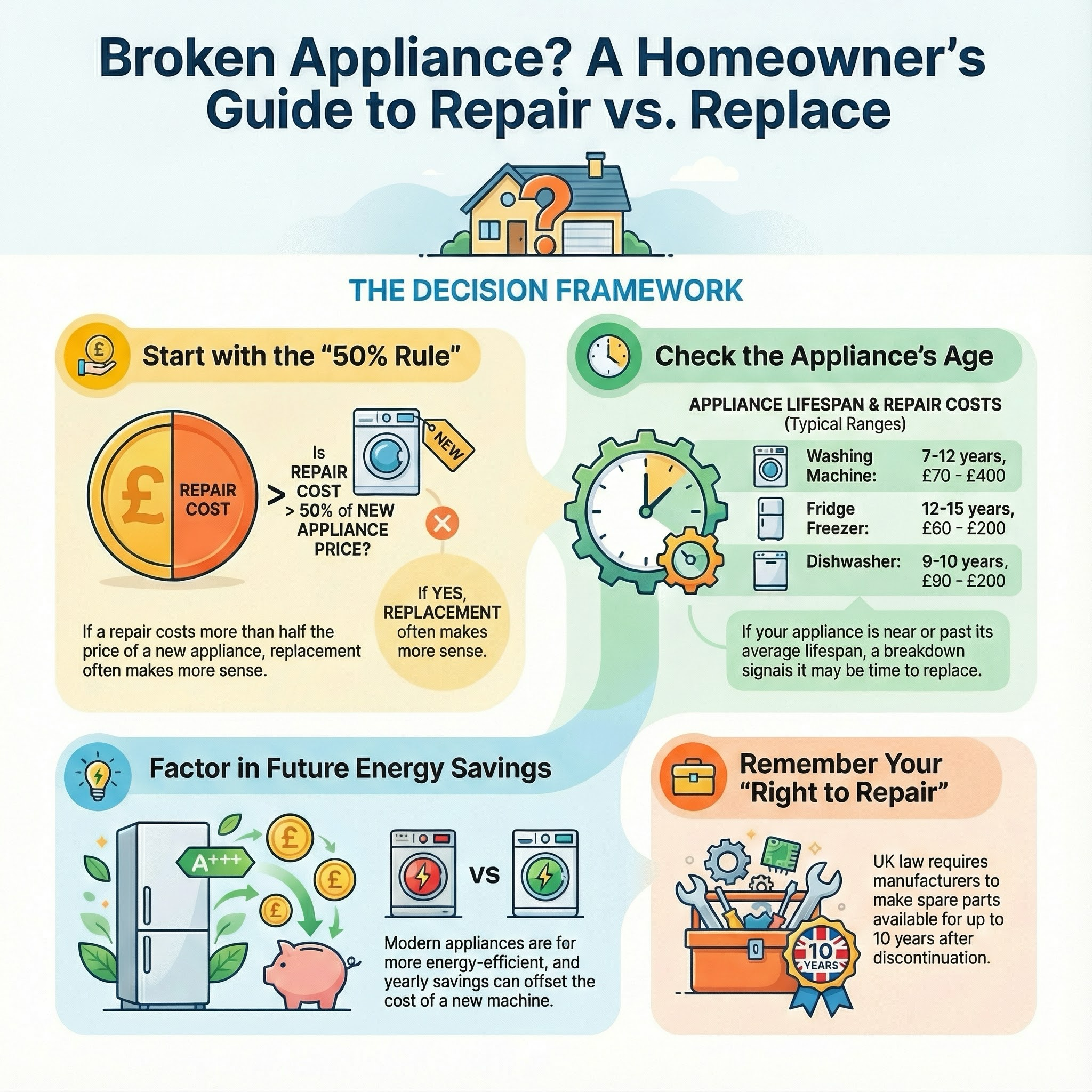
If the repair cost is less than 50% of the price of a new equivalent model, it is generally worth repairing. High-end brands like Dyson, Shark, and Miele are designed to be serviced and can last 10-15 years with proper care.
Odours often get trapped in the internal plastic housing and the HEPA filters. A professional "deep clean" service involves stripping the machine down and using ozone or enzymatic cleaners to neutralise these smells.
Most modern cordless batteries are sealed units. While individual cells can sometimes be replaced by specialists, it is usually more cost-effective to replace the entire battery pack with a genuine manufacturer part.
For a busy household with pets or carpets, a professional service every 18–24 months will keep the motor running efficiently and extend the lifespan of the appliance significantly.
First, check the brush bar for tangled hair and ensure the filters are clean. If the suction at the end of the hose is strong but the floor head isn't picking up, the issue is likely a broken drive belt or a faulty brush bar motor.
This guide was written with AI assistance and is intended for general information only. Prices are estimates based on UK averages and may vary by region. Always get at least three quotes and consult a qualified professional before starting any work.
Ask follow-ups in plain English. The AI explains options, sequencing and what to ask the appliance repair — so you walk in informed.
Microwaves are a staple of the modern UK kitchen, offering convenience for everything from defrosting to full meal preparation. While basic freestanding models ...
READ GUIDE →GuideA faulty fridge or freezer is one of the most urgent domestic repairs, with food safety and waste being the primary concerns. For many UK homeowners, a professi...
READ GUIDE →GuideA cold oven is a major disruption to any UK household, but a failed heating element is one of the most common and cost-effective repairs you can undertake. Inst...
READ GUIDE →GuideScope of Works • inspect appliance and perform diagnostic checks (power, suction, switches, wiring) • clean and test filters, dust bin or bag and airway for blo...
READ GUIDE →GuideA faulty microwave display is a common frustration for UK homeowners. Whether the screen has gone completely dark, is flickering, or showing unintelligible "gho...
READ GUIDE →GuideA faulty oven can bring a UK household to a standstill, turning meal times into a logistical challenge. Whether it is a failed heating element, a noisy fan, or ...
READ GUIDE →