Instant
01 · Ask
Ask the AI a follow-up
Got more questions about washer/dryer door lock repair? Describe the bit you're unsure about — the AI explains options, sequencing and what to ask the appliance repair.

Locked, stuck or won't latch — door interlock or hinge fixed without forcing the door.
You've read the brief on washer/dryer door lock repair. Now lean on us to find the right appliance repair — and stay in control of the job.
Got more questions about washer/dryer door lock repair? Describe the bit you're unsure about — the AI explains options, sequencing and what to ask the appliance repair.
Costs, timelines, pitfalls and the right questions to ask before any appliance repair starts on washer/dryer door lock repair.
Itemised quotes from up to 3 local appliance repairs on washer/dryer door lock repair — so you can compare like-for-like, not lump sums.
Ready when you are
Enter your postcode and get free quotes from local pros.
Four moves that separate a smooth job from a nightmare.
Sometimes the lock isn't broken, but the rubber gasket has become sticky with detergent buildup, preventing the latch from clicking into place.
If the door is pulled too hard while still locked, the plastic internal trigger can snap, making it look like a lock failure when it is actually a handle issue.
In washer/dryers, the high heat of the drying cycle can cause the plastic housing of the lock to warp over time, leading to intermittent "Door Open" errors.
Occasionally, the lock is fine, but the PCB (Printed Circuit Board) is failing to send the "lock" signal, which is a significantly more expensive repair.
Indicative UK ranges and what affects price.
By job type
Quote spread is typically ± 18% — always get 3 quotes.
Appliance Repair quick-view
Appliance Repair explained
The door lock is a critical safety component designed to prevent the machine from opening during a high-speed spin or a high-heat drying cycle. While it may seem like a simple mechanical latch, modern UK appliances use complex electronic actuators that communicate directly with the machine's main control board.
Prices for washer/dryer door lock repairs in the UK vary based on the brand of the appliance and whether it is a freestanding or integrated model. Premium brands like Miele or Siemens often have significantly higher parts costs than budget-friendly brands like Beko or Indesit.
| Item | Low £ | High £ | Notes |
|---|---|---|---|
| Call-out / Diagnostic Fee | £60 | £100 | Usually covers the first 30–60 minutes of labour. |
| Labour (Hourly Rate) | £50 | £90 | Applies if the repair takes longer than the initial hour. |
| Standard Lock Part | £25 | £60 | Common parts for mass-market UK brands. |
| Premium/Specialist Part | £70 | £150 | Rare parts or high-end manufacturer components. |
| Integrated Appliance Surcharge | £20 | £50 | Covers the time taken to remove and refit decor doors. |
| Total Estimated Cost | £145 | £300 | Most UK repairs fall within this range. |
Factors such as your location (London and the South East typically command higher rates) and the urgency of the call-out will also influence the final invoice. If the engineer needs to order a specific part and return a second time, check if they charge a second call-out fee or a fixed "repair total."
While some homeowners attempt a DIY fix by watching online tutorials, washer/dryer repair involves working with mains electricity and delicate plastic components. A common DIY error is snapping the plastic "lug" on the new lock or failing to reseat the door seal correctly, which leads to catastrophic leaks.
Safety Warning: Modern washer/dryers can retain an electrical charge even when unplugged. Professional engineers use specific discharge protocols and testing equipment to ensure the machine is safe to handle.
In the UK, while there is no legal requirement for a "Gas Safe" equivalent for electric appliance repair, the work should be carried out by someone competent in electrical safety to comply with general home insurance requirements.
Questions to ask your engineer:
Most UK machines have a manual release tab located behind the plastic flap at the bottom (near the drain filter). You should only use this once the machine is drained of water and unplugged to avoid flooding your kitchen.
This is a standard safety feature on many older machines using a "thermal lock." A small heater inside the lock must cool down before the mechanism releases; forcing it during this time will break the handle.
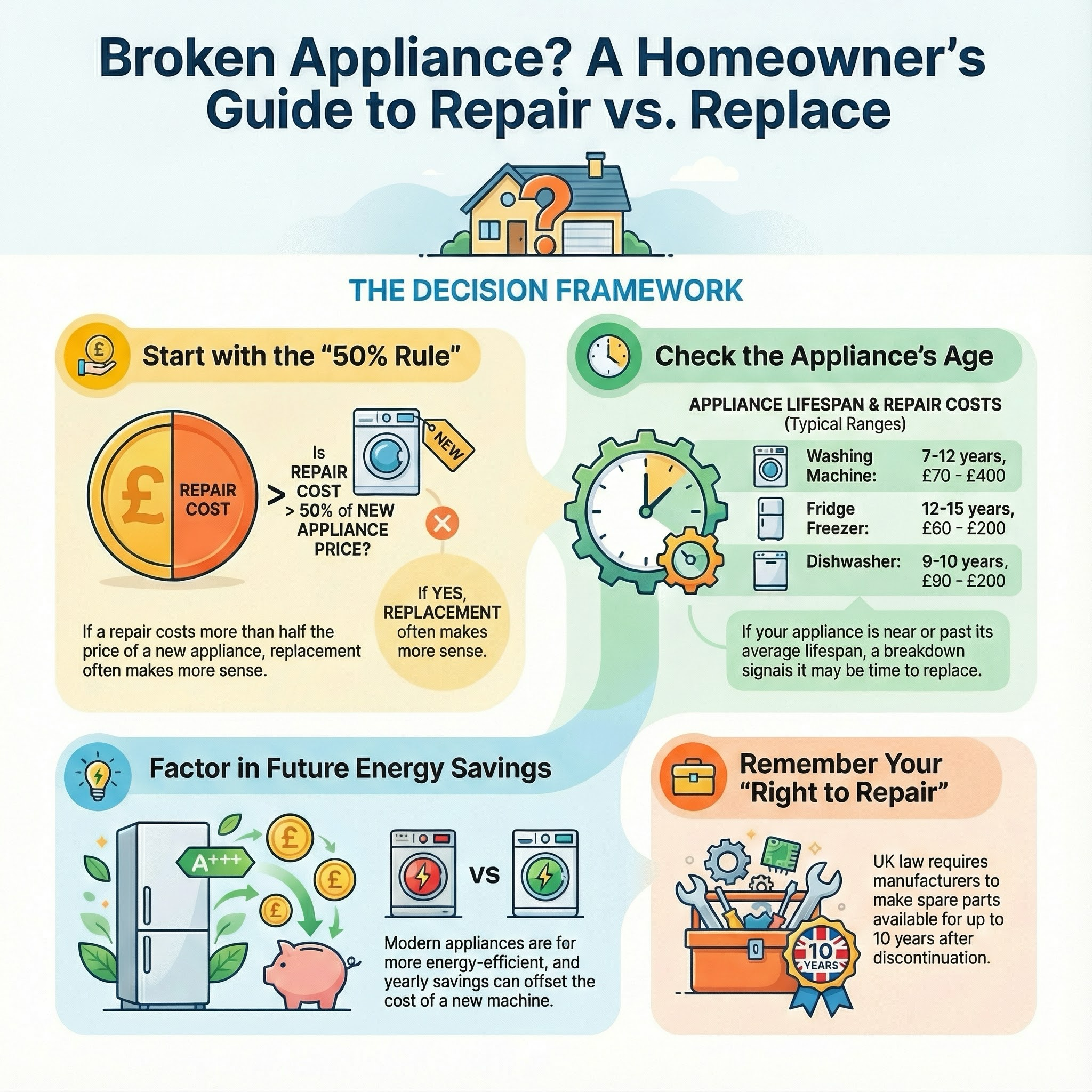
If the machine is otherwise in good condition, a £150 repair is cheaper than a £500 replacement. However, if the bearings are noisy or the drum is sagging, it may be time to invest in a new, more energy-efficient model.
Not necessarily. It can indicate that the door isn't closed firmly enough, the laundry is catching in the seal, or there is a communication error between the lock and the main computer.
Almost never. Door lock repairs are standard "on-site" jobs that are completed in your kitchen or utility room. Only major engine or drum failures usually require a workshop visit.
This guide was written with AI assistance and is intended for general information only. Prices are estimates based on UK averages and may vary by region. Always get at least three quotes and consult a qualified professional before starting any work.
Ask follow-ups in plain English. The AI explains options, sequencing and what to ask the appliance repair — so you walk in informed.
Microwaves are a staple of the modern UK kitchen, offering convenience for everything from defrosting to full meal preparation. While basic freestanding models ...
READ GUIDE →GuideA faulty fridge or freezer is one of the most urgent domestic repairs, with food safety and waste being the primary concerns. For many UK homeowners, a professi...
READ GUIDE →GuideA cold oven is a major disruption to any UK household, but a failed heating element is one of the most common and cost-effective repairs you can undertake. Inst...
READ GUIDE →GuideScope of Works • inspect appliance and perform diagnostic checks (power, suction, switches, wiring) • clean and test filters, dust bin or bag and airway for blo...
READ GUIDE →GuideA faulty microwave display is a common frustration for UK homeowners. Whether the screen has gone completely dark, is flickering, or showing unintelligible "gho...
READ GUIDE →GuideA faulty oven can bring a UK household to a standstill, turning meal times into a logistical challenge. Whether it is a failed heating element, a noisy fan, or ...
READ GUIDE →