Instant
01 · Ask
Ask the AI a follow-up
Got more questions about washing machine repair? Describe the bit you're unsure about — the AI explains options, sequencing and what to ask the appliance repair.

Not draining, not spinning, leaking or noisy — fixed on-site by a local appliance engineer.
You've read the brief on washing machine repair. Now lean on us to find the right appliance repair — and stay in control of the job.
Got more questions about washing machine repair? Describe the bit you're unsure about — the AI explains options, sequencing and what to ask the appliance repair.
Costs, timelines, pitfalls and the right questions to ask before any appliance repair starts on washing machine repair.
Itemised quotes from up to 3 local appliance repairs on washing machine repair — so you can compare like-for-like, not lump sums.
Ready when you are
Enter your postcode and get free quotes from local pros.
Four moves that separate a smooth job from a nightmare.
Caused by bacteria build-up from low-temperature washes; usually solved by a service wash rather than a repair.
Often caused by an unbalanced load, worn motor carbon brushes, or a snapped drive belt.
Usually a blocked filter or a failed drain pump motor—check the filter before calling an engineer.
Typically a torn door bellows (the rubber seal) or a blocked detergent drawer.
Indicative UK ranges and what affects price.
By job type
Quote spread is typically ± 18% — always get 3 quotes.
Appliance Repair quick-view
Appliance Repair explained
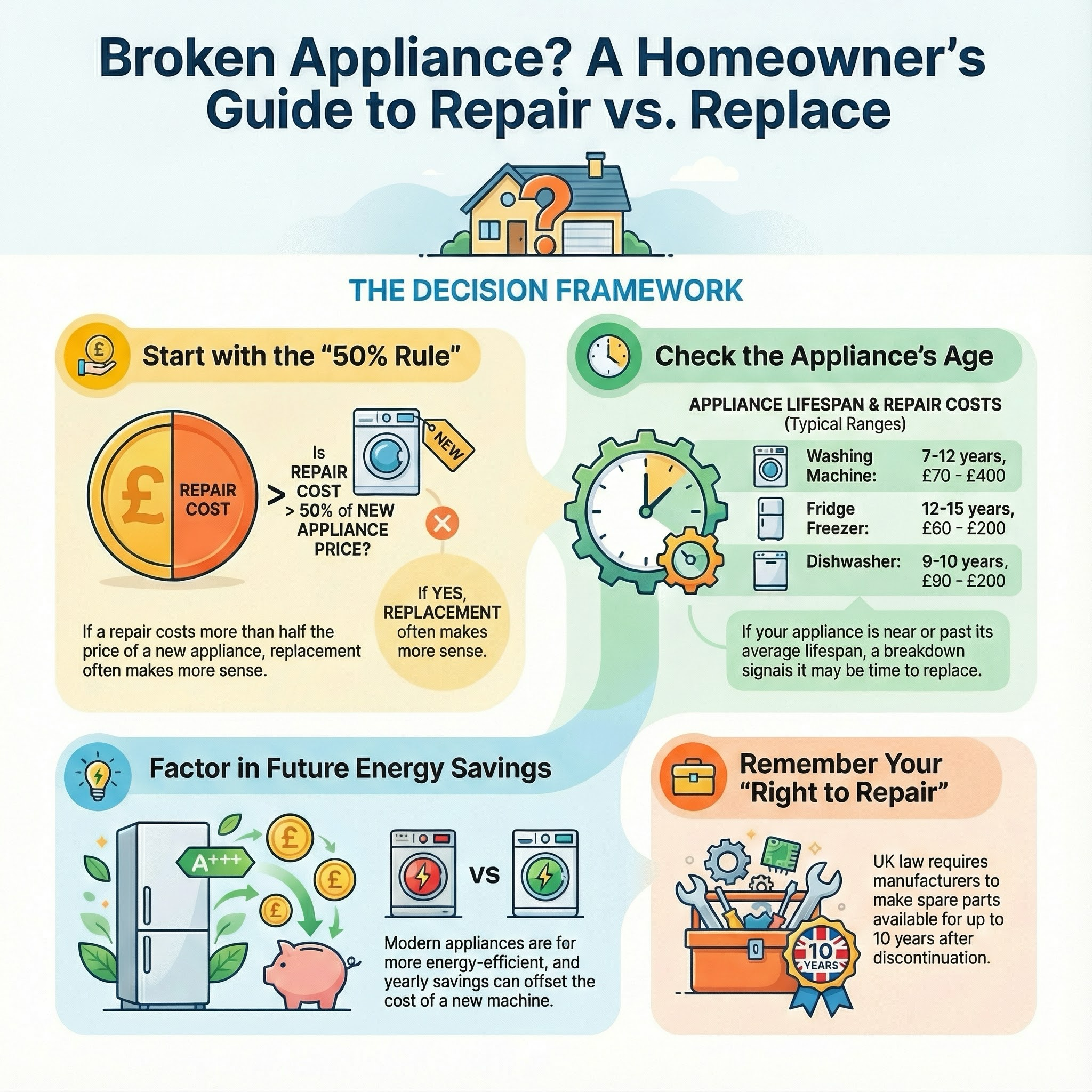
Repairing a high-quality machine is frequently cheaper than replacing it, especially given the "Right to Repair" regulations in the UK which ensure spare parts remain available for years. This guide covers what to expect when hiring an appliance engineer and how to budget for the work.
Most UK appliance engineers charge a fixed diagnostic or "call-out" fee, which may or may not be deducted from the final repair bill. Prices vary based on your location and whether the machine is a budget brand or a premium manufacturer like Miele or Bosch.
| Item | Low £ | High £ | Notes |
|---|---|---|---|
| Diagnostic / Call-out Fee | £65 | £110 | Often covers the first 30-60 minutes of labour. |
| Standard Labour (Hourly) | £55 | £95 | Charged after the initial diagnostic period. |
| Minor Parts (Seal, Pump, Belt) | £25 | £85 | Common mechanical failures. |
| Major Parts (Motor, PCB, Drum) | £130 | £300+ | High-end electronics or structural parts. |
| Total Typical Repair | £110 | £280 | Includes call-out, labour, and mid-range parts. |
Factors affecting the price include the accessibility of the machine (e.g., integrated units are harder to reach) and the cost of genuine manufacturer parts versus high-quality pattern parts.
Homeowners can safely handle basic maintenance, such as cleaning the debris filter or checking the cold water inlet hose for kinks. However, most repairs require opening the casing, which exposes live electrical components and complex mechanical systems.
Professional Tip: If your machine is under a manufacturer's warranty or a domestic appliance insurance policy, attempting a DIY repair will almost certainly void your cover.
Professional engineers have the specialised tools required to pull drums or test circuit boards without causing further damage. For integrated machines, a professional is essential to avoid damaging kitchen cabinetry or flooring during extraction.
Generally, yes. If the repair cost is less than 50% of the price of a new equivalent model, a repair is worthwhile. Quality machines should last 8–12 years with proper maintenance.
This is often caused by a faulty heating element or a blocked pressure switch. If the water doesn't reach the right temperature or the machine can't "sense" it has drained, the timer will stall.
No, you should leave this to the professional to avoid damaging your floor or plumbing. However, clearing the area and emptying the drum of laundry is very helpful.
Some large companies offer a fixed fee that covers all labour and parts. This can be good for major failures (like a PCB), but you may overpay for simple fixes like a new belt.
Check your consumer unit (fuse box) for a tripped circuit and replace the fuse in the wall plug. If it still won't power up, the internal interference filter or PCB may have failed.
This guide was written with AI assistance and is intended for general information only. Prices are estimates based on UK averages and may vary by region. Always get at least three quotes and consult a qualified professional before starting any work.
Ask follow-ups in plain English. The AI explains options, sequencing and what to ask the appliance repair — so you walk in informed.
Microwaves are a staple of the modern UK kitchen, offering convenience for everything from defrosting to full meal preparation. While basic freestanding models ...
READ GUIDE →GuideA faulty fridge or freezer is one of the most urgent domestic repairs, with food safety and waste being the primary concerns. For many UK homeowners, a professi...
READ GUIDE →GuideA cold oven is a major disruption to any UK household, but a failed heating element is one of the most common and cost-effective repairs you can undertake. Inst...
READ GUIDE →GuideScope of Works • inspect appliance and perform diagnostic checks (power, suction, switches, wiring) • clean and test filters, dust bin or bag and airway for blo...
READ GUIDE →GuideA faulty microwave display is a common frustration for UK homeowners. Whether the screen has gone completely dark, is flickering, or showing unintelligible "gho...
READ GUIDE →GuideA faulty oven can bring a UK household to a standstill, turning meal times into a logistical challenge. Whether it is a failed heating element, a noisy fan, or ...
READ GUIDE →