Instant
01 · Ask
Ask the AI a follow-up
Got more questions about brick Repointing? Describe the bit you're unsure about — the AI explains options, sequencing and what to ask the bricklayer.

Lime or cement — old mortar raked out 15–20mm, new joints struck to match the original profile.
You've read the brief on brick Repointing. Now lean on us to find the right bricklayer — and stay in control of the job.
Got more questions about brick Repointing? Describe the bit you're unsure about — the AI explains options, sequencing and what to ask the bricklayer.
Costs, timelines, pitfalls and the right questions to ask before any bricklayer starts on brick Repointing.
Itemised quotes from up to 3 local bricklayers on brick Repointing — so you can compare like-for-like, not lump sums.
Ready when you are
Enter your postcode and get free quotes from local pros.
Four moves that separate a smooth job from a nightmare.
Using a hard cement mix on soft Victorian or Edwardian bricks causes "spalling," where the brick face flakes off.
New mortar often looks bright and patchy if the tradesman hasn't used dyes or specific sands to match the aged original.
Smearing mortar over the edges of the bricks rather than raking out properly; this looks messy and fails quickly.
Repointing in freezing temperatures or heavy rain can cause the mortar to fail before it has cured.
Indicative UK ranges and what affects price.
By job type
Quote spread is typically ± 18% — always get 3 quotes.
Bricklayer quick-view
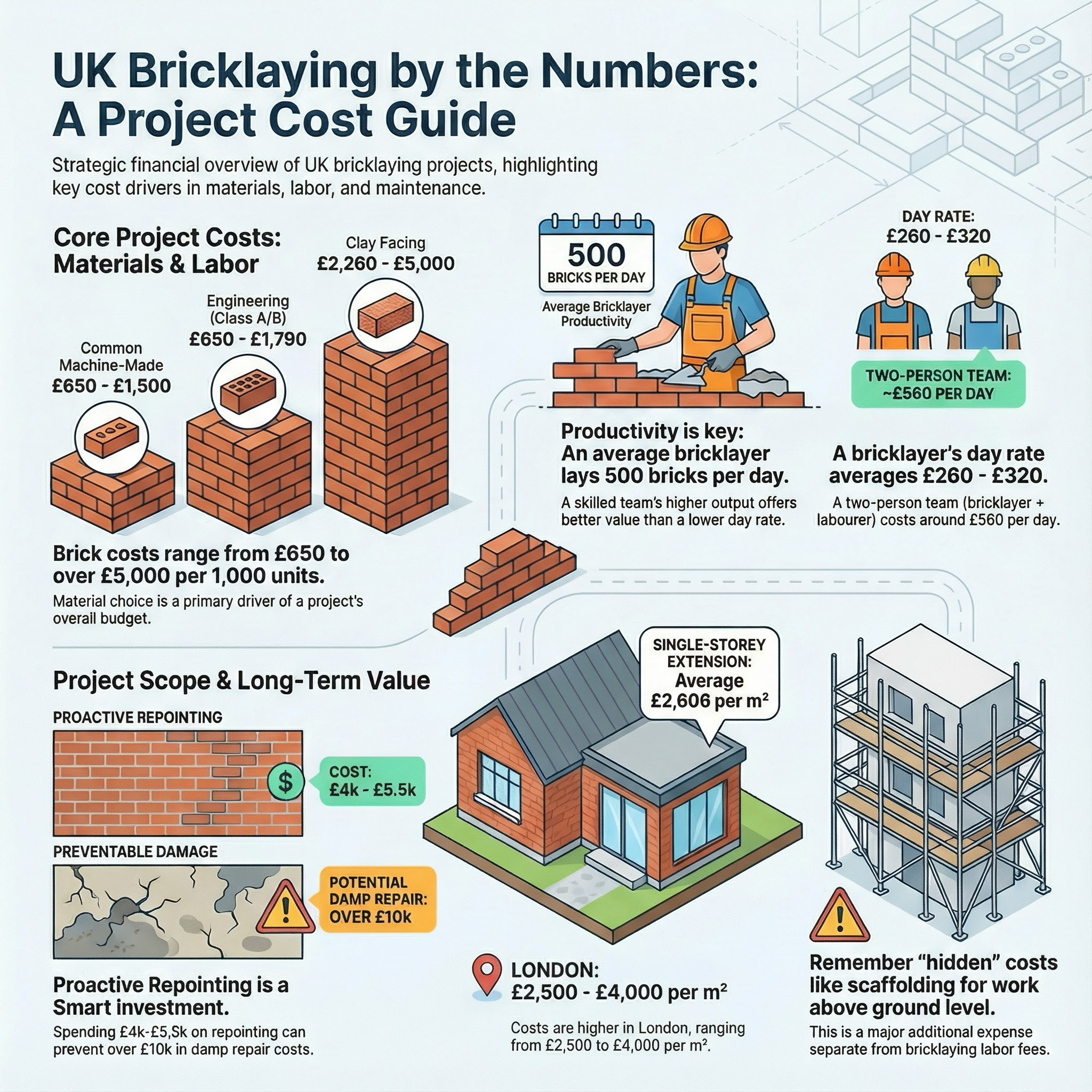
For UK homeowners, maintaining these joints is not just about aesthetics; it is essential preventative maintenance. Properly executed repointing protects your property from frost damage and helps retain the thermal efficiency of your walls.
Repointing costs vary significantly based on the size of the area, the type of mortar required, and whether scaffolding is necessary. Lime mortar, often required for pre-1920s properties, is more expensive and labour-intensive than modern cement mixes.
| Item | Low £ | High £ | Notes |
|---|---|---|---|
| Small Patch Repairs | £250 | £500 | Minimum call-out for minor repairs. |
| Standard Rate (per m²) | £35 | £65 | Excludes scaffolding and VAT. |
| Full Gable End | £1,800 | £3,200 | Includes basic access/tower. |
| Full Semi-Detached House | £4,500 | £8,000 | Includes full scaffolding and cleanup. |
| Lime Mortar Surcharge | +20% | +40% | Higher material costs and slower application. |
Pro Tip: Always check if the quote includes scaffolding. For two-storey properties or higher, scaffolding can add £800 to £1,500 to the total project cost.
While DIY repointing is possible for low-level garden walls, it is rarely recommended for the main structure of a home. Incorrect mortar mixes—specifically using hard cement on soft historic bricks—can cause permanent damage by forcing moisture to escape through the brick face rather than the joint.
Professional bricklayers have the equipment to suppress dust and the skill to ensure the "profile" of the joint sheds water effectively. If your home was built before 1920, you should almost certainly hire a specialist who understands lime-based mortars.
Look for visible gaps in the mortar, sandy deposits on the ground below the wall, or damp patches appearing on internal walls. If you can easily scrape the mortar out with a fingernail or a screwdriver, it is time to call a professional.
Cement is rigid and waterproof, whereas lime is flexible and "breathable." Older UK homes were designed to let moisture move through the joints; blocking this with cement leads to damp and structural decay.
If your damp is caused by "penetrating" moisture through cracked or missing mortar, then yes. However, it will not fix rising damp or condensation issues caused by poor ventilation.
It is risky. Mortar must not freeze before it has dried, or it will crumble. Most UK bricklayers will avoid repointing in mid-winter unless they use frost additives or protective sheeting and heaters.
Raking out old mortar is incredibly dusty. Professional tradespeople use dust-extraction shrouds on their grinders and should use debris netting on scaffolding to protect your garden and neighbours.
A high-quality professional job using the correct materials should last between 30 and 50 years. Poorly applied DIY patches may only last 2–5 years before cracking.
This guide was written with AI assistance and is intended for general information only. Prices are estimates based on UK averages and may vary by region. Always get at least three quotes and consult a qualified professional before starting any work.
Ask follow-ups in plain English. The AI explains options, sequencing and what to ask the bricklayer — so you walk in informed.
Brickwork is the backbone of most UK homes, providing structural integrity and protection against our unpredictable weather. Over time, exposure to rain, frost,...
READ GUIDE →GuideYour front steps are more than just a functional entrance; they are a vital part of your home’s kerb appeal and structural safety. For UK homeowners, replacing ...
READ GUIDE →GuideCracks in brickwork are a common sight for UK homeowners, often triggered by seasonal temperature changes, heavy clay soils, or historical settlement. While man...
READ GUIDE →GuideGarden walls are more than just boundaries; they provide security, privacy, and kerb appeal to UK homes. However, constant exposure to the British weather—parti...
READ GUIDE →GuideHistoric dry stone walls are a defining feature of the British countryside and many period properties. Unlike modern masonry, these structures rely on gravity a...
READ GUIDE →GuideFlint walls are a hallmark of the British landscape, particularly across the South Downs, East Anglia, and the Home Counties. These structures are not just func...
READ GUIDE →