Instant
01 · Ask
Ask the AI a follow-up
Got more questions about bed frame repair? Describe the bit you're unsure about — the AI explains options, sequencing and what to ask the carpenter.

Broken slat, split rail or wobble — fixed on-site in an hour without replacing the whole bed.
You've read the brief on bed frame repair. Now lean on us to find the right carpenter — and stay in control of the job.
Got more questions about bed frame repair? Describe the bit you're unsure about — the AI explains options, sequencing and what to ask the carpenter.
Costs, timelines, pitfalls and the right questions to ask before any carpenter starts on bed frame repair.
Itemised quotes from up to 3 local carpenters on bed frame repair — so you can compare like-for-like, not lump sums.
Ready when you are
Enter your postcode and get free quotes from local pros.
Four moves that separate a smooth job from a nightmare.
Usually caused by timber-on-timber friction. A professional will often use wax or felt padding between joints to silence the frame.
Often caused by a failing central support rail or the "feet" of the central rail not touching the floor.
Occurs when the plastic "shoes" holding the slats perish. These need replacing rather than just being taped back into place.
Common in flat-pack furniture. This requires "plugging" the hole with new timber and redrilling to create a secure anchor.
Indicative UK ranges and what affects price.
By job type
Quote spread is typically ± 18% — always get 3 quotes.
Carpenter quick-view
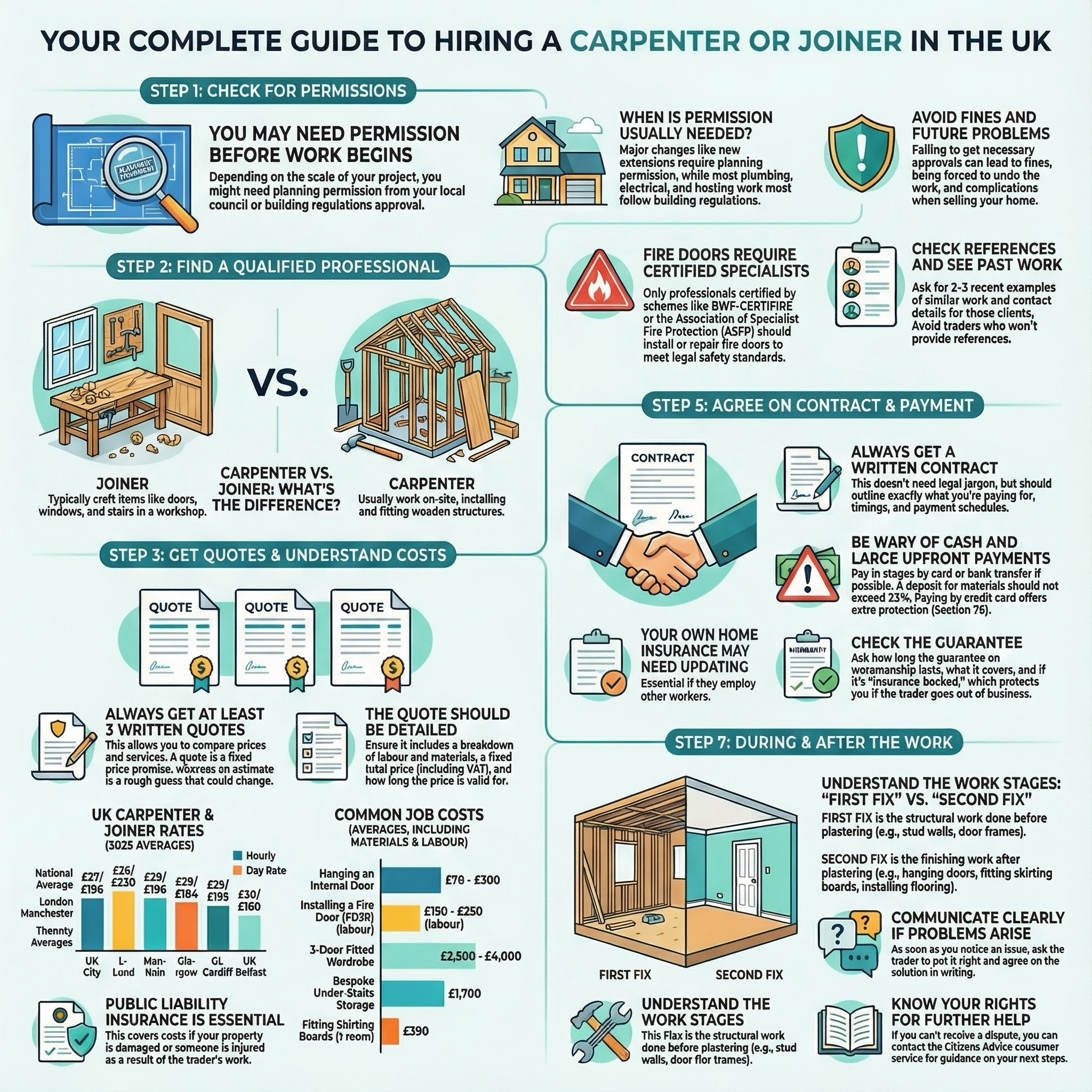
Carpenter explained
Repairing a frame ensures your mattress is properly supported, which is vital for both sleep quality and the longevity of the mattress itself. From antique wooden frames to modern Ottoman storage beds, most structural issues can be resolved with the right tools and expertise.
| Item | Low £ | High £ | Notes |
|---|---|---|---|
| Call-out / Minimum Charge | £70 | £130 | Covers travel and the first hour of labour. |
| Labour (Hourly Rate) | £50 | £85 | Variation based on location (London/SE is higher). |
| Replacement Slats & Fittings | £20 | £100 | Standard pine slats vs. bespoke hardwoods. |
| Ottoman Gas Strut Replacement | £60 | £120 | Specialist parts for lifting mechanisms. |
| Total Project Average | £130 | £450 | Most common structural repairs fall here. |
Costs are primarily driven by the material of the frame and the complexity of the repair. While a simple slat replacement is inexpensive, repairing a split hardwood side rail requires specialist adhesives and significant clamping time, which increases the labour fee.
Tightening loose bolts or replacing a single standard slat is a manageable DIY task for most homeowners. However, if the timber has split along the grain or the bed is an antique with complex joinery, a professional carpenter is essential. They use specific industrial clamps and heavy-duty fixings that are required to make the bed safe for weight-bearing again.
Warning: Never attempt to DIY repair an Ottoman lifting mechanism without experience. The gas struts are under high pressure and can cause serious injury if mishandled.
Questions to ask your carpenter:
In 95% of cases, yes. Squeaks are caused by friction between two surfaces. A carpenter will identify the moving joint, tighten the fixings, and often apply a lubricant or buffer (like felt) to stop the noise permanently.
If the frame is made of low-grade MDF or chipboard, the repair cost might exceed the value of the bed. However, if the damage is just a broken slat or a loose bolt, it is still cheaper to fix than to replace.
Yes, though metal frames often use plastic "caps" to hold the slats. A carpenter can source these specific caps and provide new timber slats that are cut to the precise width of your metal frame.
Splits usually occur due to "point loading" (jumping on the bed) or because the bolts were over-tightened during original assembly, causing the wood grain to stress and eventually fail.
Most will help, but it is best to ask in advance. Heavy memory foam or king-size mattresses often require two people to lift safely, so they may ask you to have someone available to assist.
This guide was written with AI assistance and is intended for general information only. Prices are estimates based on UK averages and may vary by region. Always get at least three quotes and consult a qualified professional before starting any work.
Ask follow-ups in plain English. The AI explains options, sequencing and what to ask the carpenter — so you walk in informed.
Joinery and Metalwork Installation Guide Scope of Works Survey & design brief – site measure‑up, discuss timber/steel grade, produce sketches/CAD. Workshop ...
READ GUIDE →GuideAssembling a chest of drawers is one of the most common yet frustrating home improvement tasks. Whether you have purchased a flat-pack unit from a high-street r...
READ GUIDE →GuideCustom carpentry is the hallmark of a well-finished UK home. Unlike flat-pack furniture, bespoke joinery is designed to fit the unique, often irregular dimensio...
READ GUIDE →GuideLetterbox Repair Guide Scope of Works Initial inspection & measure‑up – check door thickness, sleeve length and draught issues. Remove interior trim & o...
READ GUIDE →GuideFrom squeaky floorboards and sticking doors to more serious issues like timber rot or structural joist damage, carpentry repairs are a staple of UK home mainten...
READ GUIDE →GuideA wobbly or broken dining chair leg doesn't mean your furniture set is destined for the skip. Professional repair restores the structural integrity and aestheti...
READ GUIDE →