Instant
01 · Ask
Site or bench joinery?
First-fix, second-fix, bespoke joinery — different skills. Describe what you need and the AI tells you which kind of carpenter to look for.

Sticking, broken flap or worn brush — fixed in 30 minutes by a local carpenter.
From a sticking door to a bespoke staircase — read the brief, then let Three local carpenters quote.
First-fix, second-fix, bespoke joinery — different skills. Describe what you need and the AI tells you which kind of carpenter to look for.
Timber grades, acclimatisation, MDF vs solid, hinge types and shadow-gap details. Know what 'quality' looks like before you accept the work.
Three local carpenters quote on the same spec — timber, ironmongery, fixings, finishing — so the cheapest isn't accidentally the rough one.
Ready when you are
Enter your postcode and get free quotes from local pros.
Four moves that separate a smooth job from a nightmare.
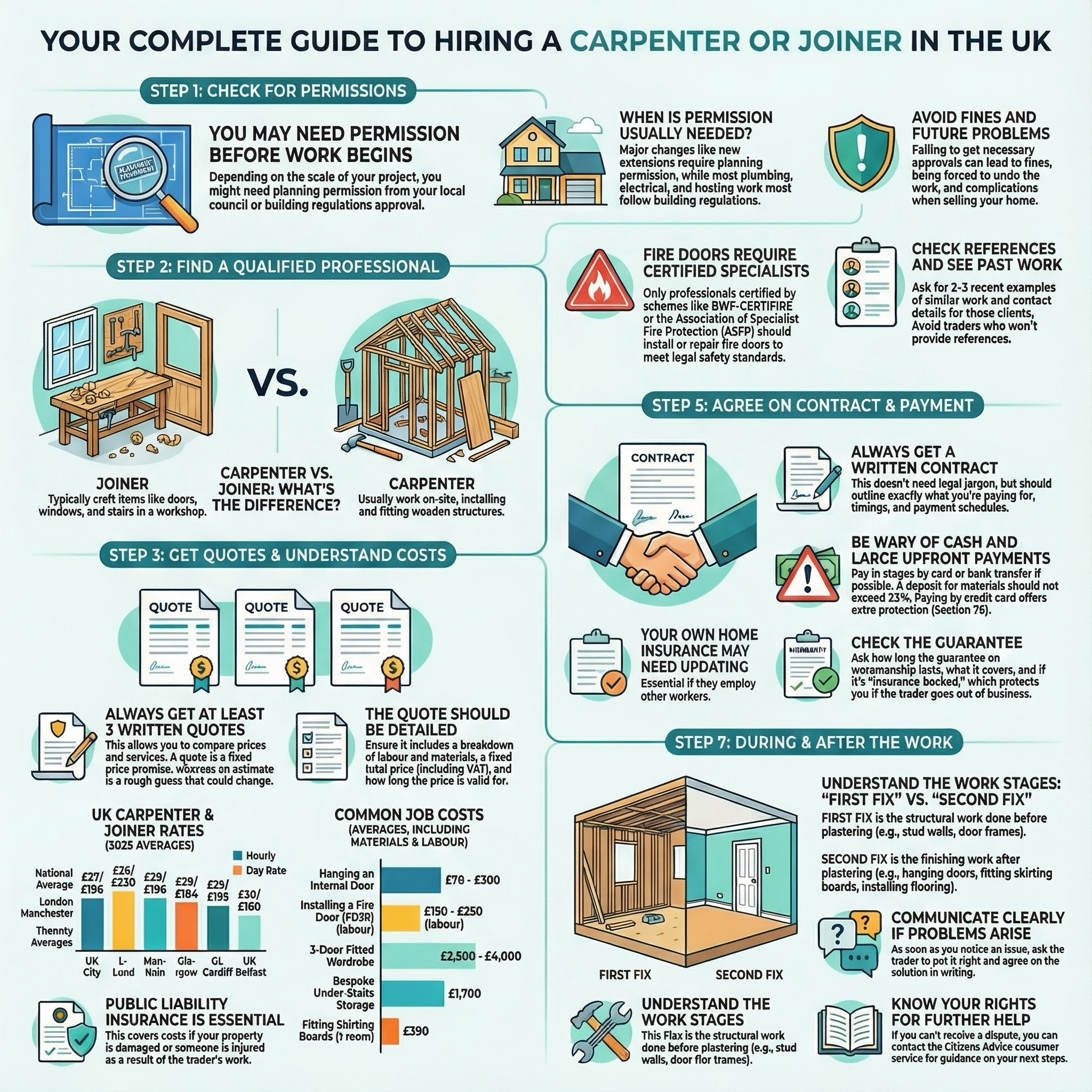
Joinery skills don't transfer between disciplines. A site carpenter doing first-fix isn't the same as a bench joiner doing bespoke wardrobes. Match the trade to the job.
Once the gaps are filled and painted, you can't see the work. Inspect joints, hinges and shadow-gaps before the decorator arrives.
Solid hardwood doors and skirtings expand and contract. Insist on acclimatisation in the house before fitting — or live with future warping.
Pine, redwood, oak, MDF — wildly different prices and lifespans. Don't accept 'wood' as a quote line; insist on grade and source.
Indicative UK ranges and what affects price.
By job type
Quote spread is typically ± 18% — always get 3 quotes.
Carpenter quick-view
Carpenter explained
A letterbox repair in the UK typically costs £60–£180 for the most common faults — sagging flaps, broken springs, draughty brushes, or a sticking inner cover. A full replacement letterbox runs £40–£120 for the part plus £60–£140 labour for fitting, depending on whether the door is timber, composite, or uPVC.
Letterboxes wear out faster than the door itself — the spring fatigues, the brush fills with dust and debris, and the flap rattles in the wind. A 5-minute inspection now saves a £180 callout if you catch wear early.
| Job | Typical price |
|---|---|
| Spring replacement | £40–£90 |
| Brush draught insert fitted | £40–£80 |
| Full letterbox replacement (timber door) | £100–£220 |
| Full letterbox replacement (uPVC door) | £120–£250 |
| Full letterbox replacement (composite door) | £140–£280 |
| Anti-fish security insert | £40–£90 fitted |
| TS008 secure letterbox (insurance compliant) | £100–£250 fitted |
Each door material has its own letterbox approach:
If you're replacing a front-door letterbox, consider a TS008-rated unit. TS008 is the British Standard for "letterbox aperture protection" — designed to prevent key-fishing, hand-reaching, and arson attacks. Many home insurance policies discount premiums for compliant front doors. £100–£250 supplied and fitted.
For period homes where TS008 looks too modern, anti-fish bars or restrictor plates fitted behind the existing letterbox are a discreet alternative — £40–£90 installed.
For timber doors with standard letterbox cut-outs, yes — straightforward DIY job, £30–£60 in parts, half an hour with a screwdriver. For composite or uPVC doors, the manufacturer-specific replacement is recommended; a carpenter or door-fitter avoids cut-out damage.
Replace the brush insert first (£10–£20). If brushes are missing entirely, fit a draught-excluder kit (£20–£40) which adds an inner flap with a foam seal. For severe drafts, the whole letterbox may need replacing with a modern unit that has integrated brushes.
TS008 is the British Standard for letterbox security — anti-fish, anti-arson, anti-grab. Required by some insurance policies (check yours), and increasingly expected on new front doors. If your front door letterbox is more than 10 years old, upgrading to TS008 is worth considering.
Either the spring has weakened, or the pivot bearing is worn. Springs cost £10–£25 to replace and slot in with a screwdriver. If the entire flap rattles or wobbles, the whole letterbox usually needs replacing — pivots wear faster than springs.
For timber doors — yes, with a router and new letterbox sized to the wider aperture. For composite or uPVC — usually no, the door's reinforcement won't allow it. Better solution for parcels: a wall-mounted parcel box outside.
Hooded letterboxes prevent rain ingress and add a small security benefit. Sleeve letterboxes (chuted into a basket inside) prevent grab attacks. Both are good; pick based on your priority. Don't fit a hood that obstructs the postman's typical handful of A4 mail.
Want a local pro to handle this? A carpenter or door-fitter will diagnose the issue, source the right replacement (especially important for composite/uPVC), and fit cleanly without damaging the door. Quick job, modest cost.
This guide was written with AI assistance and is intended for general information only. Prices are estimates based on UK averages and may vary by region. Always get at least three quotes and consult a qualified professional before starting any work.
Ask follow-ups in plain English. The AI explains options, sequencing and what to ask the carpenter — so you walk in informed.
Joinery and Metalwork Installation Guide Scope of Works Survey & design brief – site measure‑up, discuss timber/steel grade, produce sketches/CAD. Workshop ...
READ GUIDE →GuideAssembling a chest of drawers is one of the most common yet frustrating home improvement tasks. Whether you have purchased a flat-pack unit from a high-street r...
READ GUIDE →GuideCustom carpentry is the hallmark of a well-finished UK home. Unlike flat-pack furniture, bespoke joinery is designed to fit the unique, often irregular dimensio...
READ GUIDE →GuideFrom squeaky floorboards and sticking doors to more serious issues like timber rot or structural joist damage, carpentry repairs are a staple of UK home mainten...
READ GUIDE →GuideA wobbly or broken dining chair leg doesn't mean your furniture set is destined for the skip. Professional repair restores the structural integrity and aestheti...
READ GUIDE →GuideA bespoke staircase is more than just a functional link between floors; it is often the architectural centrepiece of a UK home. Whether you are replacing a date...
READ GUIDE →