Instant
01 · Ask
Ask the AI a follow-up
Got more questions about carpentry Repair Cost & Work? Describe the bit you're unsure about — the AI explains options, sequencing and what to ask the carpenter.

Doors, frames, skirting, joinery and built-ins — what an honest carpentry bill should itemise.
You've read the brief on carpentry Repair Cost & Work. Now lean on us to find the right carpenter — and stay in control of the job.
Got more questions about carpentry Repair Cost & Work? Describe the bit you're unsure about — the AI explains options, sequencing and what to ask the carpenter.
Costs, timelines, pitfalls and the right questions to ask before any carpenter starts on carpentry Repair Cost & Work.
Itemised quotes from up to 3 local carpenters on carpentry Repair Cost & Work — so you can compare like-for-like, not lump sums.
Ready when you are
Enter your postcode and get free quotes from local pros.
Four moves that separate a smooth job from a nightmare.
Wet or dry rot often extends much further than the visible surface damage. A pro will "chase" the rot back to healthy wood.
Using "green" (unseasoned) wood for repairs can lead to warping and gaps as the timber dries out in a heated home.
Using standard steel screws for external repairs will lead to rust streaks; stainless steel or brass is required for longevity.
Carpentry is messy. Ensure your tradesperson uses HEPA-filtered extraction to prevent fine sawdust from coating your home.
Indicative UK ranges and what affects price.
By job type
Quote spread is typically ± 18% — always get 3 quotes.
Carpenter quick-view
Carpenter explained
Professional carpentry repairs not only restore the aesthetic appeal of your home but also ensure safety and longevity. Whether you are dealing with a historic Victorian property or a modern build, high-quality timber work maintains your property's value and structural integrity.
Carpentry costs vary significantly based on your location (London and the South East typically command a 20-30% premium) and the complexity of the timber involved. Most carpenters charge a minimum call-out fee to cover travel and the first hour of work.
| Item / Service | Low £ | High £ | Notes |
|---|---|---|---|
| Minimum Call-out Fee | £60 | £120 | Covers travel and first hour. |
| Labour Rate (Hourly) | £40 | £70 | Varies by experience and region. |
| Daily Rate | £280 | £450 | More cost-effective for larger projects. |
| Internal Door Adjustment | £50 | £100 | Trimming a door after new carpet fitting. |
| Floorboard Repair (per sq m) | £80 | £200 | Includes lifting and replacing sections. |
| Window Frame Rot Repair | £150 | £400 | Per window; depends on extent of rot. |
| Materials Surcharge | 10% | 20% | Markup on timber and specialist fixings. |
Pro Tip: Always ask if the quote includes "making good." Some carpenters will repair the wood but leave the painting or staining to you or a decorator.
Small tasks like filling minor cracks, sanding, or oiling a worktop are well within the reach of a confident DIYer. However, precision tasks like hanging a new door or repairing a staircase require specialist tools and years of experience to get right.
Any work involving structural timbers (joists, roof rafters, or load-bearing lintels) must be handled by a professional. Incorrectly cutting into a joist can compromise the safety of your entire home and may violate UK Building Regulations.
Timber is hygroscopic, meaning it absorbs moisture from the air. In the damp UK winter, wood swells, causing doors to stick. A carpenter can plane the edges, but care must be taken not to remove too much, or you will have large gaps when the wood shrinks in summer.
Often, yes. Squeaks are usually caused by boards rubbing against each other or nails loosening. This can often be fixed by using specialist "cleat" screws or by injecting wood glue into the joints, though some access may still be needed.
Generally, yes. Dry rot (Serpula lacrymans) is more aggressive and can spread through masonry to find more wood. It requires extensive chemical treatment and the removal of timber well beyond the visible damage.
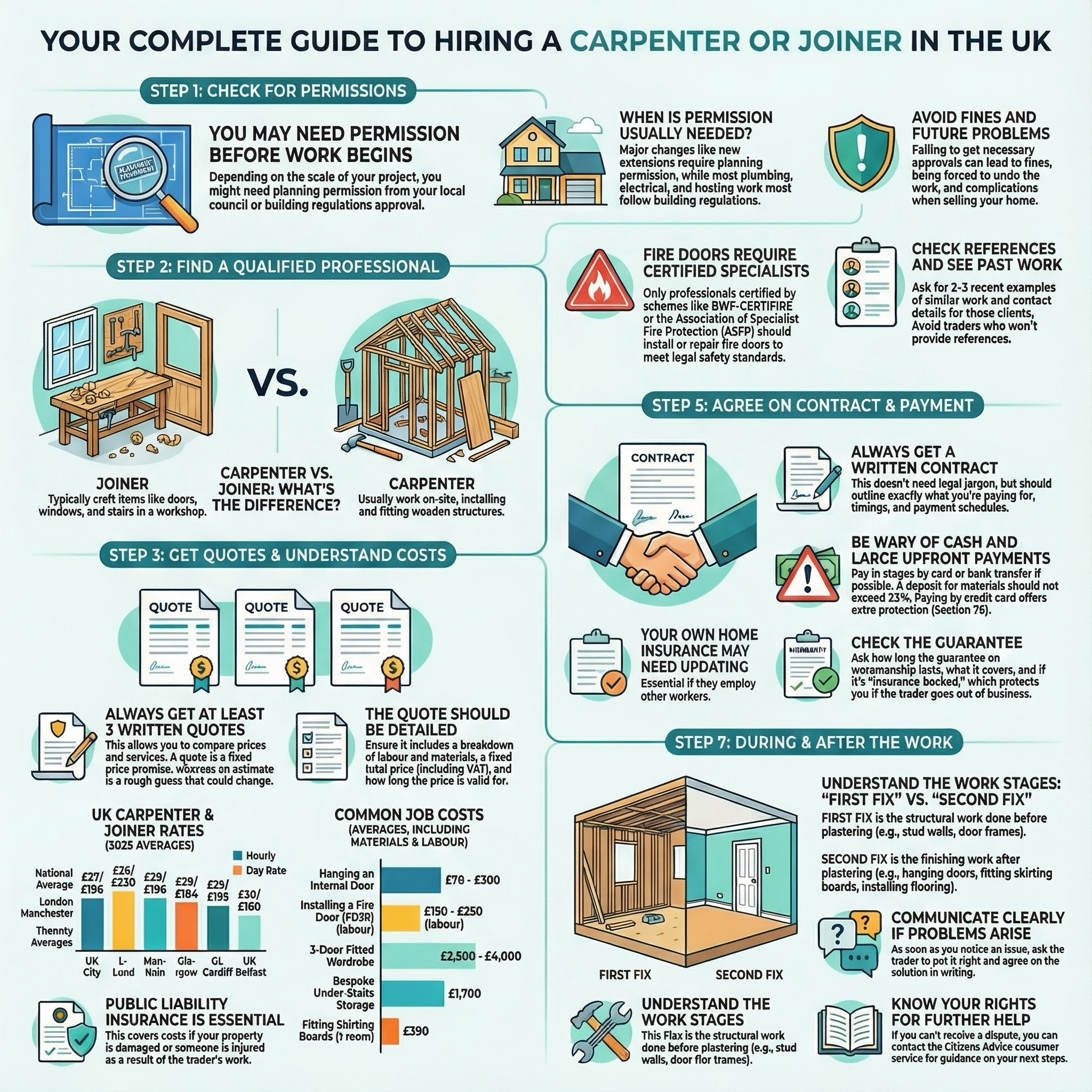
In the UK, a joiner usually works in a workshop "joining" pieces of wood together (making windows, doors, stairs). A carpenter typically works on-site, installing those items and handling structural repairs.
A skilled carpenter can make most repairs nearly invisible. By using matching wood grain, high-quality fillers, and professional sanding techniques, the repair should disappear once the final finish (paint, stain, or wax) is applied.
This guide was written with AI assistance and is intended for general information only. Prices are estimates based on UK averages and may vary by region. Always get at least three quotes and consult a qualified professional before starting any work.
Ask follow-ups in plain English. The AI explains options, sequencing and what to ask the carpenter — so you walk in informed.
Joinery and Metalwork Installation Guide Scope of Works Survey & design brief – site measure‑up, discuss timber/steel grade, produce sketches/CAD. Workshop ...
READ GUIDE →GuideAssembling a chest of drawers is one of the most common yet frustrating home improvement tasks. Whether you have purchased a flat-pack unit from a high-street r...
READ GUIDE →GuideCustom carpentry is the hallmark of a well-finished UK home. Unlike flat-pack furniture, bespoke joinery is designed to fit the unique, often irregular dimensio...
READ GUIDE →GuideLetterbox Repair Guide Scope of Works Initial inspection & measure‑up – check door thickness, sleeve length and draught issues. Remove interior trim & o...
READ GUIDE →GuideA wobbly or broken dining chair leg doesn't mean your furniture set is destined for the skip. Professional repair restores the structural integrity and aestheti...
READ GUIDE →GuideA bespoke staircase is more than just a functional link between floors; it is often the architectural centrepiece of a UK home. Whether you are replacing a date...
READ GUIDE →