Instant
01 · Ask
Ask the AI a follow-up
Got more questions about chest of drawers assembly? Describe the bit you're unsure about — the AI explains options, sequencing and what to ask the carpenter.

Flatpack or solid timber — assembled, levelled and wall-fixed if needed, in 45 minutes to a couple of hours.
You've read the brief on chest of drawers assembly. Now lean on us to find the right carpenter — and stay in control of the job.
Got more questions about chest of drawers assembly? Describe the bit you're unsure about — the AI explains options, sequencing and what to ask the carpenter.
Costs, timelines, pitfalls and the right questions to ask before any carpenter starts on chest of drawers assembly.
Itemised quotes from up to 3 local carpenters on chest of drawers assembly — so you can compare like-for-like, not lump sums.
Ready when you are
Enter your postcode and get free quotes from local pros.
Four moves that separate a smooth job from a nightmare.
Often caused by the carcass not being perfectly square before the back panel was nailed on.
Caused by overloading or failing to use the reinforcement clips provided in many modern kits.
Using the wrong rawlplugs for the wall type can lead to the unit pulling away or damaging the plaster.
Usually due to screws not being driven fully flush, causing the wheels to catch.
Indicative UK ranges and what affects price.
By job type
Quote spread is typically ± 18% — always get 3 quotes.
Carpenter quick-view
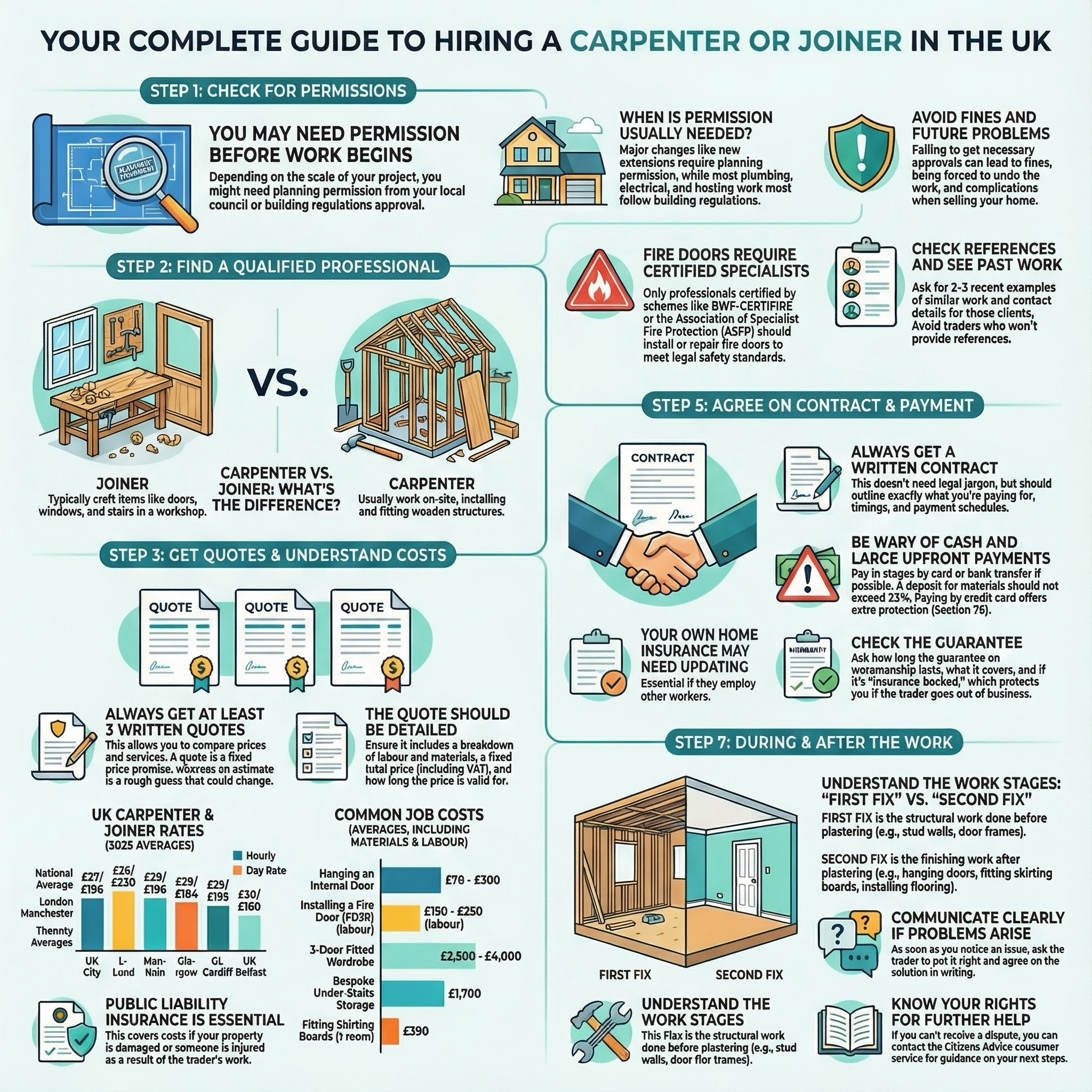
Carpenter explained
For UK homeowners, hiring a professional carpenter or skilled handyman saves hours of labour and avoids the common pitfalls of misaligned drawers or unstable frames. A professional finish not only looks better but extends the lifespan of your furniture by ensuring every cam-lock and dowel is fitted correctly.
Prices for furniture assembly in the UK are typically based on a minimum call-out fee or a fixed price per item. Complex units with many drawers or integrated lighting will sit at the higher end of the scale.
| Item | Low £ | High £ | Notes |
|---|---|---|---|
| Small Chest (2-3 drawers) | £50 | £85 | Basic flat-pack units. |
| Large Chest (6+ drawers) | £90 | £160 | Includes double-width or "tallboy" styles. |
| Minimum Call-out Fee | £45 | £80 | Often covers the first hour of work. |
| Wall Anchoring (Safety) | £10 | £25 | Per unit, including heavy-duty fixings. |
| Packaging Disposal | £15 | £35 | Removal of all cardboard and polystyrene. |
Labour rates vary by region, with London and the South East typically seeing prices 20-30% higher than the national average. If you have multiple items to assemble, most tradespeople will offer a discounted day or half-day rate.
While flat-pack assembly is a popular DIY task, it is deceptively difficult to get "perfect." A professional carpenter brings precision tools, such as spirit levels and impact drivers, and understands how to reinforce joints for longevity.
Pro Tip: If your chest of drawers is taller than 60cm, professional wall anchoring is highly recommended. In the UK, many older homes have "dot and dab" or lath and plaster walls that require specific heavy-duty fixings that standard DIY kits don't include.
Yes. You should clear a floor space at least twice the size of the finished unit to allow the tradesperson to lay out parts and work safely without tripping.
Absolutely. A professional will use a stud finder to locate the timber frame or use specialized hollow-wall anchors like "Umbrella" or "Snaptoggle" fixings to ensure a secure hold.
Most tradespeople will stop work immediately and show you the damage. You will likely still be liable for their minimum call-out fee, so it is always worth checking the panels for major cracks before they arrive.
No. A professional tradesperson will bring their own high-quality screwdrivers, drills, levels, and mallets. They often use their own high-grade wood glue to reinforce the dowel joints for extra stability.
It is always best to assemble the unit in its final position. Moving fully assembled chests of drawers can stress the joints and cause the frame to go "out of square," especially with cheaper MDF units.
This guide was written with AI assistance and is intended for general information only. Prices are estimates based on UK averages and may vary by region. Always get at least three quotes and consult a qualified professional before starting any work.
Ask follow-ups in plain English. The AI explains options, sequencing and what to ask the carpenter — so you walk in informed.
Joinery and Metalwork Installation Guide Scope of Works Survey & design brief – site measure‑up, discuss timber/steel grade, produce sketches/CAD. Workshop ...
READ GUIDE →GuideCustom carpentry is the hallmark of a well-finished UK home. Unlike flat-pack furniture, bespoke joinery is designed to fit the unique, often irregular dimensio...
READ GUIDE →GuideLetterbox Repair Guide Scope of Works Initial inspection & measure‑up – check door thickness, sleeve length and draught issues. Remove interior trim & o...
READ GUIDE →GuideFrom squeaky floorboards and sticking doors to more serious issues like timber rot or structural joist damage, carpentry repairs are a staple of UK home mainten...
READ GUIDE →GuideA wobbly or broken dining chair leg doesn't mean your furniture set is destined for the skip. Professional repair restores the structural integrity and aestheti...
READ GUIDE →GuideA bespoke staircase is more than just a functional link between floors; it is often the architectural centrepiece of a UK home. Whether you are replacing a date...
READ GUIDE →