Instant
01 · Ask
Ask the AI a follow-up
Got more questions about to Bespoke Staircase Design and Installation? Describe the bit you're unsure about — the AI explains options, sequencing and what to ask the carpenter.

Oak, glass or steel — designed, made off-site and installed in 1–2 days, with full structural sign-off.
You've read the brief on to Bespoke Staircase Design and Installation. Now lean on us to find the right carpenter — and stay in control of the job.
Got more questions about to Bespoke Staircase Design and Installation? Describe the bit you're unsure about — the AI explains options, sequencing and what to ask the carpenter.
Costs, timelines, pitfalls and the right questions to ask before any carpenter starts on to Bespoke Staircase Design and Installation.
Itemised quotes from up to 3 local carpenters on to Bespoke Staircase Design and Installation — so you can compare like-for-like, not lump sums.
Ready when you are
Enter your postcode and get free quotes from local pros.
Four moves that separate a smooth job from a nightmare.
Often caused by poor gluing or failing to use wedges and glue blocks during assembly.
Failing to account for the thickness of the new floor structure when measuring for a loft conversion staircase.
Using timber with high moisture content can lead to gaps opening up as the wood dries out in a centrally heated home.
Installing decorative balustrades that look great but violate the 100mm safety rule.
Indicative UK ranges and what affects price.
By job type
Quote spread is typically ± 18% — always get 3 quotes.
Carpenter quick-view
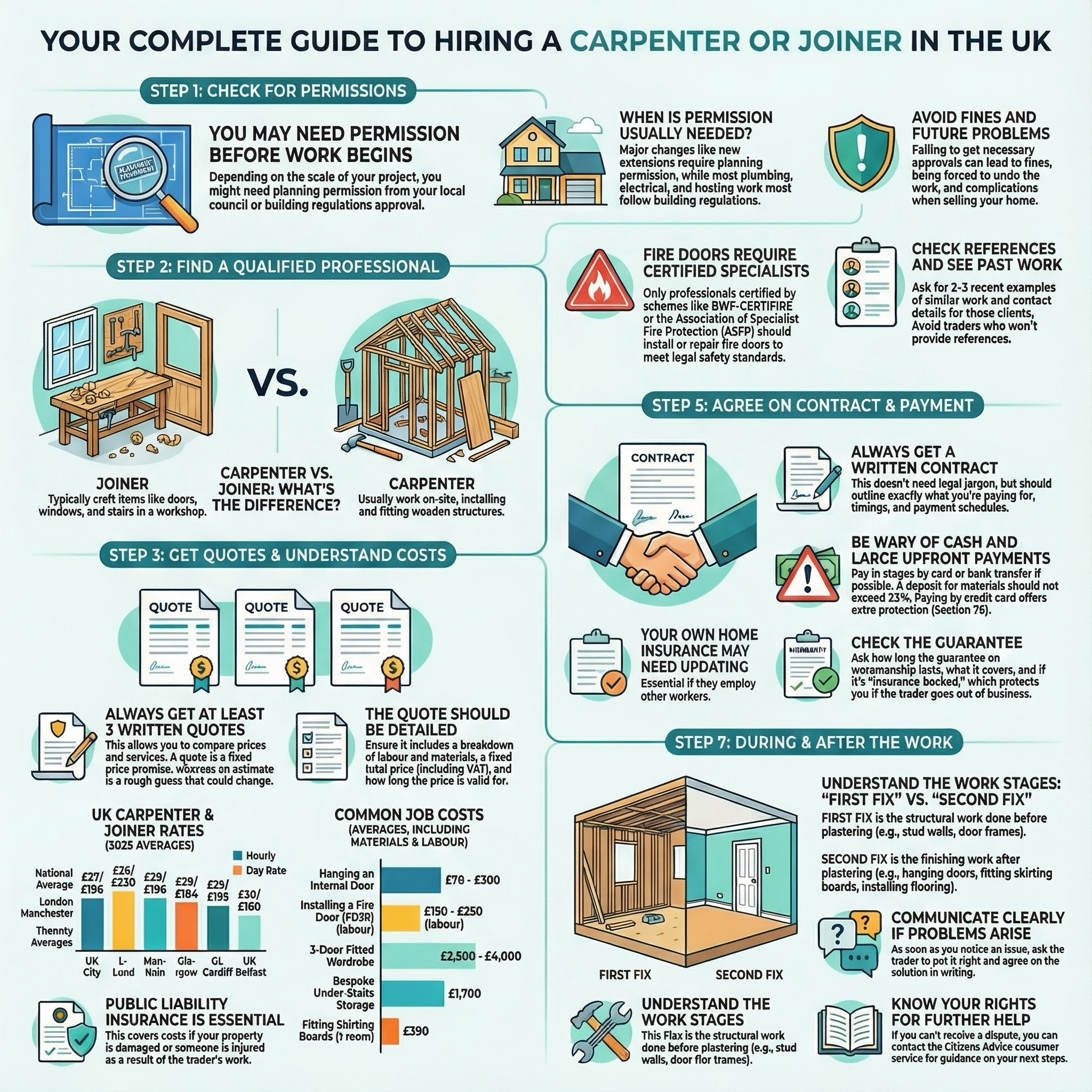
Carpenter explained
Investing in a bespoke solution ensures that every millimetre of your hallway is utilised, often incorporating clever storage or modern glass balustrades that a standard "off-the-shelf" flight simply cannot offer. This guide covers everything from UK Building Regulations to realistic 2025 pricing for your carpentry project.
Prices for bespoke staircases vary significantly based on the timber species and the complexity of the turn (e.g., winders or landings). All prices below include professional installation and VAT at 20%.
| Item | Low £ | High £ | Notes |
|---|---|---|---|
| Straight Flight (Softwood/Pine) | £2,500 | £4,500 | Ideal for painting; includes basic balustrade. |
| Winder Staircase (Oak) | £6,000 | £12,000 | Includes turns and premium hardwood finish. |
| Glass & Oak Contemporary | £8,000 | £15,000+ | Toughened glass panels with oak handrails. |
| Staircase Renovation (Cladding) | £1,500 | £3,500 | Updating existing structure with new treads/facings. |
| Under-Stairs Storage Units | £800 | £2,500 | Custom pull-out drawers or cupboards. |
The primary cost drivers are material choice and the number of "winders" (tapered steps). Hardwoods like Oak or Walnut can triple the material cost compared to Pine, while glass balustrades require specialist fixings that increase labour time.
Building a staircase is not a DIY task. It is one of the most technically demanding aspects of carpentry, requiring precise mathematical calculations to ensure the flight is safe and legal.
Failure to comply with UK Building Regulations (Part K) can lead to a staircase that is physically dangerous and will cause significant issues when you eventually try to sell your property.
A professional carpenter or joiner will ensure the structural integrity of the flight and provide the necessary certification that the installation meets all safety standards regarding pitch, rise, and guarding.
All new and replacement staircases in the UK must adhere to Approved Document K. Your carpenter should be intimately familiar with these rules:
Generally, no. Internal staircase replacements fall under Permitted Development. However, if you are in a Listed Building or if the staircase is part of a major extension, you will need specific consents and Building Regulations approval.
Yes, this is known as a staircase renovation. You can replace the newel posts, handrails, and spindles, and even "clad" the existing treads with oak veneers to give the appearance of a brand-new solid wood staircase at a lower cost.
Oak is the most popular choice in the UK due to its durability, beautiful grain, and timeless appeal. For a more budget-friendly option that you intend to paint, Scandinavian Pine or MDF (for treads that will be carpeted) are excellent choices.
You can use anti-slip lacquers, inset carborundum strips, or a central carpet runner. If you choose a natural oil finish, it often provides more "grip" than a high-gloss polyurethane varnish.
Yes, provided it is toughened or laminated safety glass (usually 10mm or 12mm thick) that meets BS EN 12600 standards. It is incredibly strong and designed to withstand significant impact without shattering into dangerous shards.
This guide was written with AI assistance and is intended for general information only. Prices are estimates based on UK averages and may vary by region. Always get at least three quotes and consult a qualified professional before starting any work.
Ask follow-ups in plain English. The AI explains options, sequencing and what to ask the carpenter — so you walk in informed.
Joinery and Metalwork Installation Guide Scope of Works Survey & design brief – site measure‑up, discuss timber/steel grade, produce sketches/CAD. Workshop ...
READ GUIDE →GuideAssembling a chest of drawers is one of the most common yet frustrating home improvement tasks. Whether you have purchased a flat-pack unit from a high-street r...
READ GUIDE →GuideCustom carpentry is the hallmark of a well-finished UK home. Unlike flat-pack furniture, bespoke joinery is designed to fit the unique, often irregular dimensio...
READ GUIDE →GuideLetterbox Repair Guide Scope of Works Initial inspection & measure‑up – check door thickness, sleeve length and draught issues. Remove interior trim & o...
READ GUIDE →GuideFrom squeaky floorboards and sticking doors to more serious issues like timber rot or structural joist damage, carpentry repairs are a staple of UK home mainten...
READ GUIDE →GuideA wobbly or broken dining chair leg doesn't mean your furniture set is destined for the skip. Professional repair restores the structural integrity and aestheti...
READ GUIDE →