Instant
01 · Ask
Ask the AI a follow-up
Got more questions about door hanging? Describe the bit you're unsure about — the AI explains options, sequencing and what to ask the carpenter.

Supplied, planed to opening, hinged, latched and finished to a clean reveal.
You've read the brief on door hanging. Now lean on us to find the right carpenter — and stay in control of the job.
Got more questions about door hanging? Describe the bit you're unsure about — the AI explains options, sequencing and what to ask the carpenter.
Costs, timelines, pitfalls and the right questions to ask before any carpenter starts on door hanging.
Itemised quotes from up to 3 local carpenters on door hanging — so you can compare like-for-like, not lump sums.
Ready when you are
Enter your postcode and get free quotes from local pros.
Four moves that separate a smooth job from a nightmare.
The door rubs against the frame or floor. This is usually caused by the frame being out of square or the door expanding due to humidity.
If hinge recesses are cut too deep, the door will "spring" back when you try to close it, putting stress on the screws.
The door won't stay shut because the latch bolt doesn't line up with the strike plate on the frame.
Using blunt tools on modern veneered doors can cause the finish to chip or "blow," which is nearly impossible to repair invisibly.
Indicative UK ranges and what affects price.
By job type
Quote spread is typically ± 18% — always get 3 quotes.
Carpenter quick-view
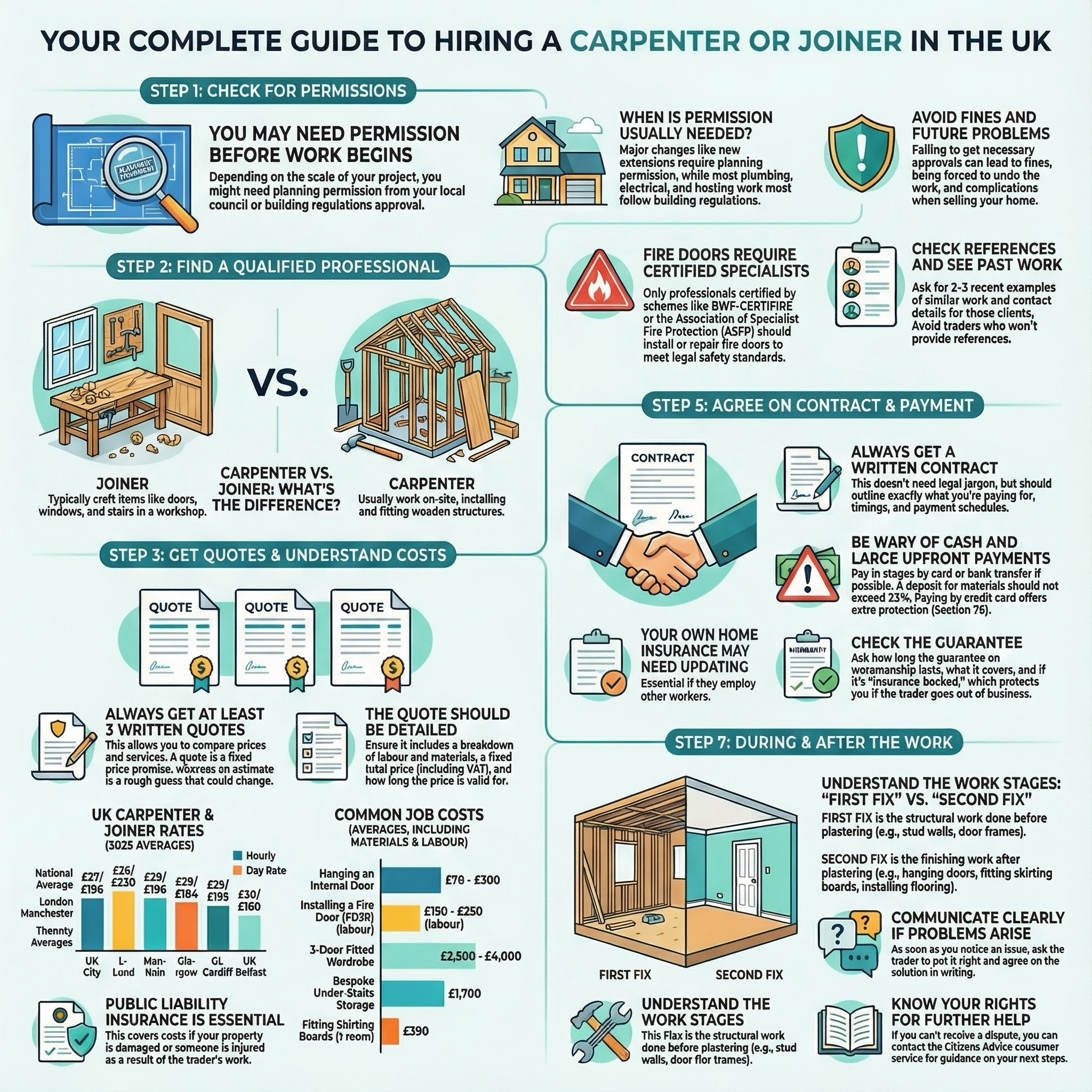
Carpenter explained
For UK homeowners, professionally hung doors are essential for privacy, draughtproofing, and fire safety. Whether you are upgrading to solid oak for aesthetic reasons or installing fire-rated doors to meet building regulations, a skilled carpenter ensures the finish is seamless and the operation is effortless.
Costs for door hanging vary based on the door type and your location in the UK. Labour rates in London and the South East are typically 20-30% higher than the national average.
| Item | Low £ | High £ | Notes |
|---|---|---|---|
| Labour (per internal door) | £80 | £160 | Price reduces per door for multiple installations. |
| Standard Hollow Core Door | £40 | £90 | Basic moulded or flush doors. |
| Solid Oak / Veneer Door | £150 | £500+ | Premium materials requiring careful handling. |
| FD30 Fire Door | £120 | £350 | Heavy doors requiring three hinges and intumescent strips. |
| Ironmongery (Handles/Hinges) | £25 | £120 | Basic chrome to high-end brass or matte black. |
| Waste Disposal | £20 | £50 | Per door, or included in a skip for larger renovations. |
The total price is heavily influenced by the door's material; solid wood doors take longer to plane and mortise than lightweight honeycomb doors. If the door frame (lining) also needs replacing, expect to add £150–£250 per opening for labour and materials.
While hanging a door is a popular DIY project, it is notoriously difficult to master. A single over-zealous plane stroke can ruin an expensive door, leaving a permanent gap. Professional carpenters have the specialized jigs, routers, and sharp chisels required for a "factory finish."
Note: If you are installing fire doors (FD30 or FD60), professional installation is highly recommended to ensure the door meets life-safety standards. Incorrectly fitted fire doors may invalidate your home insurance.
Look for a qualified carpenter or joiner with a proven track record. While door hanging is a bread-and-butter task, the quality of finish varies significantly between a general handyman and a specialist joiner.
It is best to "fit" the door first (trimming and cutting hinge recesses), then remove it to paint or stain all six sides (including the top and bottom edges) before final hanging. This seals the door against moisture and prevents warping.
Yes, but old frames are rarely square. The carpenter will "scribe" the door to the unique shape of your frame. If the frame is severely twisted, it may need to be replaced for the door to function correctly.
Standard lightweight internal doors usually require two 3-inch hinges. However, heavy solid wood doors and all fire-rated doors require three 4-inch hinges to prevent warping and support the weight.
Gaps are often left to allow for thick carpets or to facilitate airflow in houses with MVHR (Mechanical Ventilation with Heat Recovery) systems. If the gap is unintentional, a "drop seal" or a hardwood threshold can be added.
Most carpenters expect the homeowner to supply the doors and ironmongery, though they can provide them for an extra fee. Always confirm this beforehand to ensure the carpenter has the correct hardware on the day.
FD30 stands for Fire Door 30 minutes. It is a door designed to resist fire and smoke for a minimum of half an hour. These are thicker (usually 44mm) than standard doors (35mm) and require specific intumescent seals.
This guide was written with AI assistance and is intended for general information only. Prices are estimates based on UK averages and may vary by region. Always get at least three quotes and consult a qualified professional before starting any work.
Ask follow-ups in plain English. The AI explains options, sequencing and what to ask the carpenter — so you walk in informed.
Joinery and Metalwork Installation Guide Scope of Works Survey & design brief – site measure‑up, discuss timber/steel grade, produce sketches/CAD. Workshop ...
READ GUIDE →GuideAssembling a chest of drawers is one of the most common yet frustrating home improvement tasks. Whether you have purchased a flat-pack unit from a high-street r...
READ GUIDE →GuideCustom carpentry is the hallmark of a well-finished UK home. Unlike flat-pack furniture, bespoke joinery is designed to fit the unique, often irregular dimensio...
READ GUIDE →GuideLetterbox Repair Guide Scope of Works Initial inspection & measure‑up – check door thickness, sleeve length and draught issues. Remove interior trim & o...
READ GUIDE →GuideFrom squeaky floorboards and sticking doors to more serious issues like timber rot or structural joist damage, carpentry repairs are a staple of UK home mainten...
READ GUIDE →GuideA wobbly or broken dining chair leg doesn't mean your furniture set is destined for the skip. Professional repair restores the structural integrity and aestheti...
READ GUIDE →