Instant
01 · Ask
Ask the AI a follow-up
Got more questions about internal door hanging? Describe the bit you're unsure about — the AI explains options, sequencing and what to ask the carpenter.

Pre-hung or slab door — planed to opening, hinged and finished with a clean reveal.
You've read the brief on internal door hanging. Now lean on us to find the right carpenter — and stay in control of the job.
Got more questions about internal door hanging? Describe the bit you're unsure about — the AI explains options, sequencing and what to ask the carpenter.
Costs, timelines, pitfalls and the right questions to ask before any carpenter starts on internal door hanging.
Itemised quotes from up to 3 local carpenters on internal door hanging — so you can compare like-for-like, not lump sums.
Ready when you are
Enter your postcode and get free quotes from local pros.
Four moves that separate a smooth job from a nightmare.
The door rubs against the frame or floor, often caused by seasonal wood expansion or poor trimming.
The door springs open because the hinges are recessed too deeply into the frame.
The door doesn't stay shut because the strike plate on the frame doesn't line up with the latch.
Failing to account for the thickness of a new, plush carpet, resulting in the door getting stuck.
Indicative UK ranges and what affects price.
By job type
Quote spread is typically ± 18% — always get 3 quotes.
Carpenter quick-view
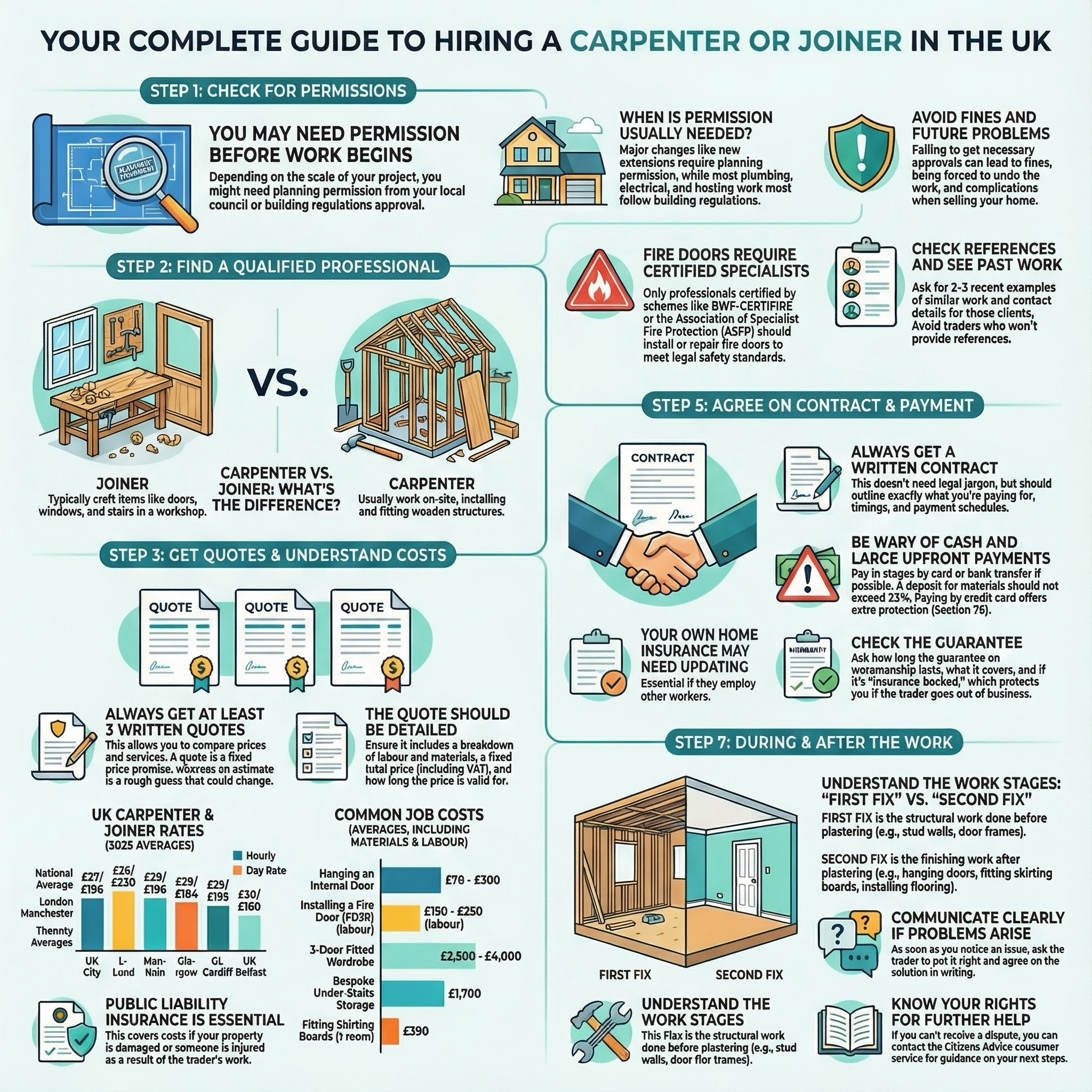
Carpenter explained
Poorly fitted doors can lead to draughts, rattling, and damage to your flooring or frames. Hiring a skilled carpenter ensures that even in older British homes where door frames are rarely perfectly square, your new doors will have a precise, uniform gap and a satisfying "click" when closed.
Prices for door hanging vary significantly based on whether you are supplying the doors yourself and the material of the door (e.g., lightweight moulded vs. heavy solid oak). Most carpenters charge a day rate for multiple doors or a fixed price per "leaf."
| Item | Low £ | High £ | Notes |
|---|---|---|---|
| Labour Only (Per Door) | £80 | £130 | Client supplies door and all ironmongery. |
| Standard Hollow Core (Supply & Fit) | £150 | £220 | Includes basic door, hinges, and handles. |
| Solid Oak/Hardwood (Supply & Fit) | £350 | £650+ | Premium doors and high-quality hardware. |
| Fire Door FD30 (Supply & Fit) | £280 | £450 | Includes intumescent strips and fire-rated hinges. |
| Disposal Fee | £20 | £45 | Per door for removal and commercial recycling. |
Note: Costs in London and the South East typically sit 15-20% higher than the national average. Prices include VAT where applicable.
Hanging a door is a classic "deceptively difficult" task. While a DIYer can attempt it, achieving a consistent 2-3mm gap (the "penny gap") around the entire perimeter requires specialist tools like electric planes, sharp chisels, and routers. Professional carpenters also understand "leading edges"—angling the side of the door so it doesn't bind as it swings shut.
Expert Tip: If you are installing fire doors, professional installation is vital to ensure the door meets legal safety standards and insurance requirements.
No. Most modern hollow-core doors have a narrow timber "lipping" (usually 10-20mm). If you cut beyond this, you will expose the honeycomb core and ruin the door's structural integrity.
It is best to "dry fit" the door first, doing all the trimming and morticing. Then, remove the door to paint or seal all six sides (including top and bottom edges) before final installation to prevent moisture ingress.
A door is just the "slab" or leaf. A door set comes pre-hung in its own frame with hinges already attached, which is often easier for new-build extensions but more expensive.
Standard lightweight doors only require two hinges. However, heavy solid wood doors or fire doors must have at least three hinges to prevent warping and to support the extra weight.
This usually means the door or the frame is not perfectly "plumb" (vertical). A professional carpenter can often fix this by slightly adjusting the depth of the hinges.
This guide was written with AI assistance and is intended for general information only. Prices are estimates based on UK averages and may vary by region. Always get at least three quotes and consult a qualified professional before starting any work.
Ask follow-ups in plain English. The AI explains options, sequencing and what to ask the carpenter — so you walk in informed.
Joinery and Metalwork Installation Guide Scope of Works Survey & design brief – site measure‑up, discuss timber/steel grade, produce sketches/CAD. Workshop ...
READ GUIDE →GuideAssembling a chest of drawers is one of the most common yet frustrating home improvement tasks. Whether you have purchased a flat-pack unit from a high-street r...
READ GUIDE →GuideCustom carpentry is the hallmark of a well-finished UK home. Unlike flat-pack furniture, bespoke joinery is designed to fit the unique, often irregular dimensio...
READ GUIDE →GuideLetterbox Repair Guide Scope of Works Initial inspection & measure‑up – check door thickness, sleeve length and draught issues. Remove interior trim & o...
READ GUIDE →GuideFrom squeaky floorboards and sticking doors to more serious issues like timber rot or structural joist damage, carpentry repairs are a staple of UK home mainten...
READ GUIDE →GuideA wobbly or broken dining chair leg doesn't mean your furniture set is destined for the skip. Professional repair restores the structural integrity and aestheti...
READ GUIDE →