Instant
01 · Ask
Ask the AI a follow-up
Got more questions about internal door trimming? Describe the bit you're unsure about — the AI explains options, sequencing and what to ask the carpenter.

Catching on carpet or carpet underlay change — planed down, sealed and re-hung.
You've read the brief on internal door trimming. Now lean on us to find the right carpenter — and stay in control of the job.
Got more questions about internal door trimming? Describe the bit you're unsure about — the AI explains options, sequencing and what to ask the carpenter.
Costs, timelines, pitfalls and the right questions to ask before any carpenter starts on internal door trimming.
Itemised quotes from up to 3 local carpenters on internal door trimming — so you can compare like-for-like, not lump sums.
Ready when you are
Enter your postcode and get free quotes from local pros.
Four moves that separate a smooth job from a nightmare.
Using the wrong saw blade can cause the veneer to "chip" or "splinter," ruining the look of the door.
If the bottom raw edge isn't sealed, it will absorb moisture from mopped floors or humidity, causing the door to stick within months.
Cutting too deep into a cheap door exposes the cardboard honeycomb interior, requiring a new timber block to be glued inside.
Trimming the bottom doesn't always solve the problem if the hinges have sagged; a professional will check the "swing" before cutting.
Indicative UK ranges and what affects price.
By job type
Quote spread is typically ± 18% — always get 3 quotes.
Carpenter quick-view
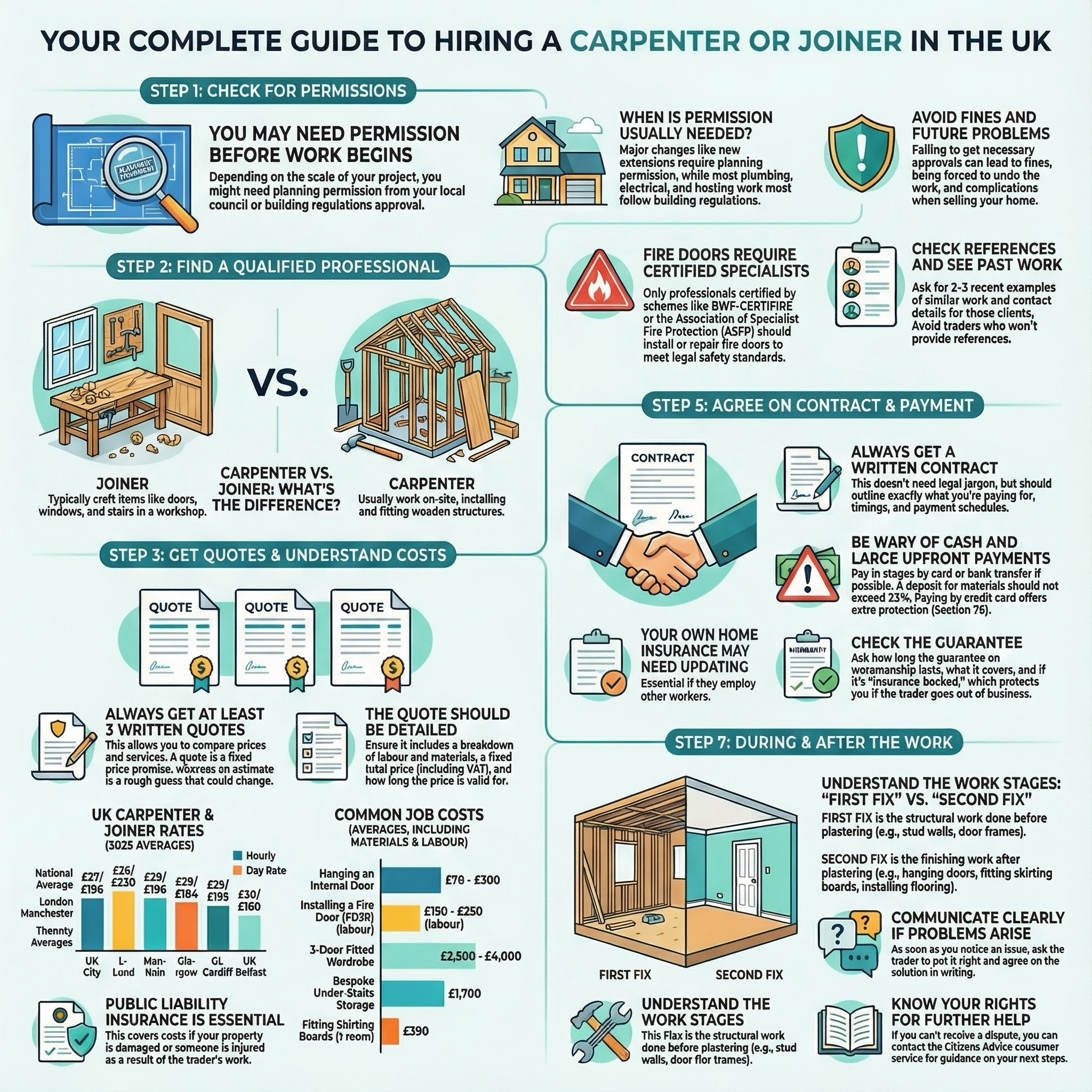
Carpenter explained
Professional carpenters use specialised track saws and planes to ensure a perfectly straight edge without splintering the veneer. This guide outlines what to expect when hiring a professional to adjust your doors, the costs involved, and the critical safety considerations regarding fire-rated doors.
Most carpenters charge a minimum call-out fee to cover travel and setup, which usually covers the first hour of work. For multiple doors, you will likely be quoted a day rate or a fixed price per door.
| Item | Low £ | High £ | Notes |
|---|---|---|---|
| Minimum Call-out Fee | £80 | £130 | Covers travel and first 60 mins. |
| Labour per Standard Door | £40 | £70 | Price reduces for multiple doors. |
| Fire Door Trimming | £60 | £100 | Requires specialist handling and certification. |
| Materials & Sundries | £5 | £20 | Sandpaper, sealant, and wood screws. |
| Total (Single Door) | £125 | £220 | Inc. VAT and call-out. |
Prices vary based on your location (London and the South East are typically 20% higher) and the material of the door. Solid oak doors take longer to trim than lightweight hollow-core doors and require sharper, more expensive blades.
Trimming a door is a high-stakes DIY task. Modern hollow-core doors have a very thin internal timber frame (the "rail"); if you cut more than 10-20mm off the bottom, you may remove the structural support entirely, causing the door to fall apart. Professionals have the tools to "re-rail" a door if a deep cut is necessary. Furthermore, fire doors should never be trimmed by an amateur, as removing too much material voids the fire certification and compromises your home's safety and insurance.
Ask your carpenter: "Do you use a track saw to ensure the cut is perfectly straight, and will you seal the bottom edge to prevent the door from absorbing moisture and swelling?"
It is possible but rarely recommended. Trimming the top requires moving the hinges and potentially the lock/latch height, which is significantly more labour-intensive and leaves visible holes in the frame.
Most UK fire doors (FD30) allow for 3mm to 10mm of trimming from the bottom. You must check the manufacturer’s data sheet (often found on a label on the top edge of the door) to be certain.
Sawing wood creates significant fine dust. Professional carpenters use vacuum extraction, but it is still wise to cover nearby furniture and remove rugs before they arrive.
Yes. This is usually caused by "hinge spread" or the house settling. A carpenter can "lead" the door by planing the hinge side or the leading edge to restore the correct 2-3mm gap.
Absolutely. Even if it isn't visible, the raw wood must be primed or sealed to prevent it from absorbing atmospheric moisture, which leads to warping and sticking.
This guide was written with AI assistance and is intended for general information only. Prices are estimates based on UK averages and may vary by region. Always get at least three quotes and consult a qualified professional before starting any work.
Ask follow-ups in plain English. The AI explains options, sequencing and what to ask the carpenter — so you walk in informed.
Joinery and Metalwork Installation Guide Scope of Works Survey & design brief – site measure‑up, discuss timber/steel grade, produce sketches/CAD. Workshop ...
READ GUIDE →GuideAssembling a chest of drawers is one of the most common yet frustrating home improvement tasks. Whether you have purchased a flat-pack unit from a high-street r...
READ GUIDE →GuideCustom carpentry is the hallmark of a well-finished UK home. Unlike flat-pack furniture, bespoke joinery is designed to fit the unique, often irregular dimensio...
READ GUIDE →GuideLetterbox Repair Guide Scope of Works Initial inspection & measure‑up – check door thickness, sleeve length and draught issues. Remove interior trim & o...
READ GUIDE →GuideFrom squeaky floorboards and sticking doors to more serious issues like timber rot or structural joist damage, carpentry repairs are a staple of UK home mainten...
READ GUIDE →GuideA wobbly or broken dining chair leg doesn't mean your furniture set is destined for the skip. Professional repair restores the structural integrity and aestheti...
READ GUIDE →