Instant
01 · Ask
Ask the AI a follow-up
Got more questions about self-closer fitting on toilet doors? Describe the bit you're unsure about — the AI explains options, sequencing and what to ask the carpenter.

DDA-compliant self-closer on a bathroom or toilet door — fitted and tested for proper close.
You've read the brief on self-closer fitting on toilet doors. Now lean on us to find the right carpenter — and stay in control of the job.
Got more questions about self-closer fitting on toilet doors? Describe the bit you're unsure about — the AI explains options, sequencing and what to ask the carpenter.
Costs, timelines, pitfalls and the right questions to ask before any carpenter starts on self-closer fitting on toilet doors.
Itemised quotes from up to 3 local carpenters on self-closer fitting on toilet doors — so you can compare like-for-like, not lump sums.
Ready when you are
Enter your postcode and get free quotes from local pros.
Four moves that separate a smooth job from a nightmare.
Usually caused by the "latch action" valve being too open. This can be fixed with a minor adjustment screw.
Often occurs if the closer doesn't have enough power to overcome the resistance of the latch or the air pressure in a small bathroom.
Hydraulic closers contain oil. If you see oily residue on the door, the internal seal has failed and the unit must be replaced.
If the door starts to open on its own before the closer engages, the door hinges may be out of plumb, requiring more than just a closer fix.
Indicative UK ranges and what affects price.
By job type
Quote spread is typically ± 18% — always get 3 quotes.
Carpenter quick-view
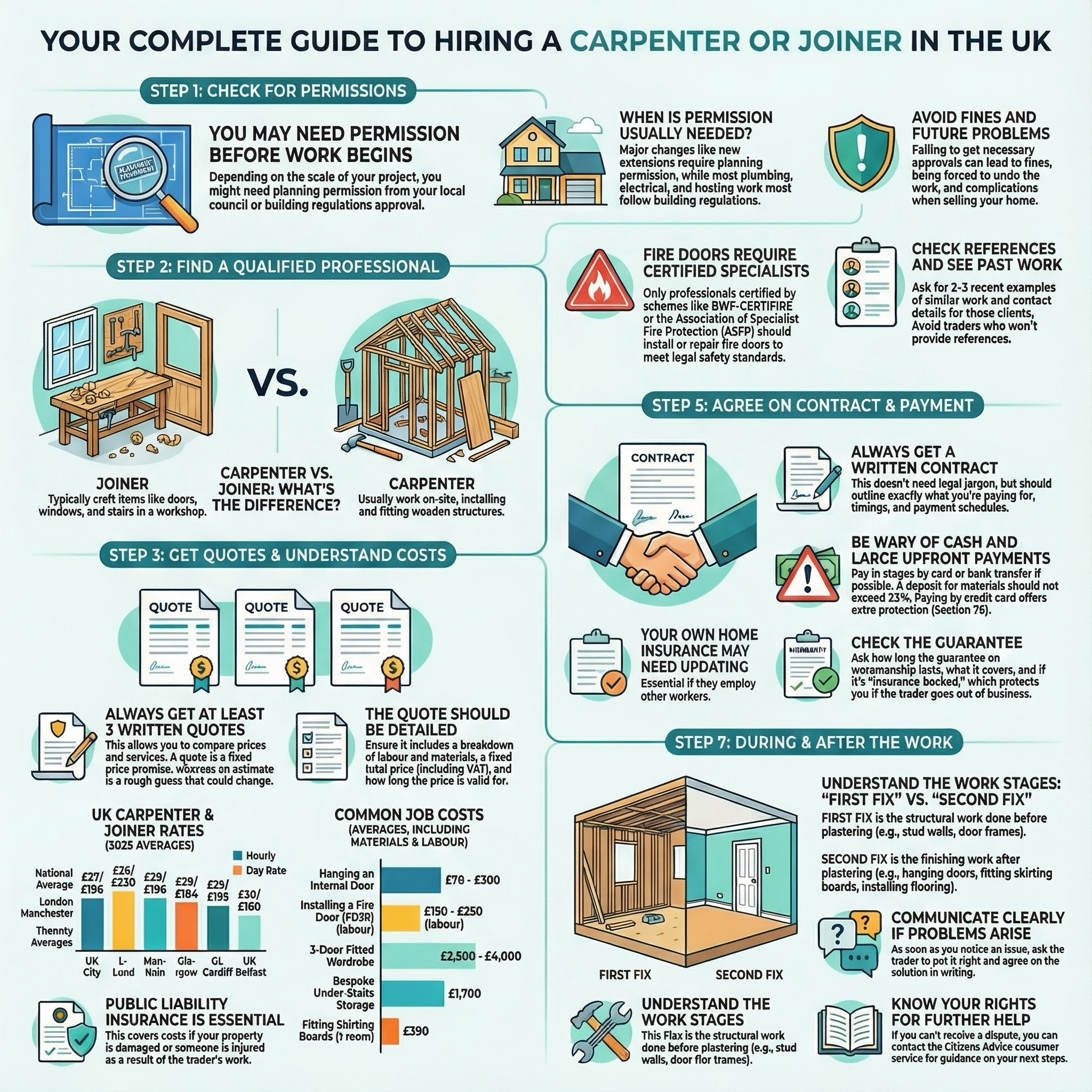
Carpenter explained
While the task might seem straightforward, it requires precision. A poorly installed closer can strain hinges, damage the door frame, or fail to latch properly, rendering it useless. Professional installation by a carpenter ensures the door operates smoothly and meets all relevant British standards.
| Item | Low £ | High £ | Notes |
|---|---|---|---|
| Standard Surface Closer (Supply & Fit) | £120 | £190 | Includes basic silver/white hydraulic closer. |
| Concealed Jamb Closer (Supply & Fit) | £150 | £240 | Requires morticing into the door edge. |
| Labour Only (Customer Supplies Part) | £60 | £110 | Based on a 1-2 hour visit. |
| Fire-Rated Heavy Duty Closer | £180 | £350 | High-traffic commercial or HMO specification. |
| Call-out / Minimum Charge | £80 | £150 | Standard for small carpentry call-outs. |
Prices include VAT and are based on 2025/26 UK averages. Costs vary depending on your location—expect to pay 20-30% more in London and the South East. The primary price driver is the quality of the hardware; premium architectural finishes (like polished brass or matte black) will significantly increase the material cost.
Fitting a basic spring closer is a common DIY task, but caution is required. If you have a hollow-core door, standard screws will likely pull out over time; a professional will know to use specialized fixings or backing plates. Furthermore, if the door is a certified fire door, any modifications must be done precisely to maintain the door’s integrity and compliance.
Expert Tip: Incorrectly tensioned closers can "rack" a door frame, pulling it out of alignment over several months. A professional carpenter ensures the torque is balanced to prevent structural damage.
Yes, but it requires care. Standard screws won't hold in the thin veneer. A carpenter will usually use "sex bolts" (sleeved bolts that go all the way through the door) or ensure the closer is mounted into the solid timber rail at the top of the door.
A Perko is a concealed spring closer hidden in the door's edge—ideal for aesthetics. An overhead closer is a visible box with a metal arm; these are generally more durable and offer better control over closing speeds.
The "power size" of the closer might be too high for the door weight, or the spring tension is wound too tight. This can often be adjusted, but if the closer is the wrong size for the door, it may need replacing.
In a standard single-family rental, usually no. However, in an HMO (House in Multiple Occupation), toilet doors that open onto shared hallways are often required to be fire doors with self-closers. Check with your local council's licensing team.
Most modern hydraulic closers have a built-in "backcheck" or "dampening" feature. Adding a secondary external dampener is usually unnecessary and can actually prevent the door from latching correctly.
This guide was written with AI assistance and is intended for general information only. Prices are estimates based on UK averages and may vary by region. Always get at least three quotes and consult a qualified professional before starting any work.
Ask follow-ups in plain English. The AI explains options, sequencing and what to ask the carpenter — so you walk in informed.
Joinery and Metalwork Installation Guide Scope of Works Survey & design brief – site measure‑up, discuss timber/steel grade, produce sketches/CAD. Workshop ...
READ GUIDE →GuideAssembling a chest of drawers is one of the most common yet frustrating home improvement tasks. Whether you have purchased a flat-pack unit from a high-street r...
READ GUIDE →GuideCustom carpentry is the hallmark of a well-finished UK home. Unlike flat-pack furniture, bespoke joinery is designed to fit the unique, often irregular dimensio...
READ GUIDE →GuideLetterbox Repair Guide Scope of Works Initial inspection & measure‑up – check door thickness, sleeve length and draught issues. Remove interior trim & o...
READ GUIDE →GuideFrom squeaky floorboards and sticking doors to more serious issues like timber rot or structural joist damage, carpentry repairs are a staple of UK home mainten...
READ GUIDE →GuideA wobbly or broken dining chair leg doesn't mean your furniture set is destined for the skip. Professional repair restores the structural integrity and aestheti...
READ GUIDE →