Instant
01 · Ask
Site or bench joinery?
First-fix, second-fix, bespoke joinery — different skills. Describe what you need and the AI tells you which kind of carpenter to look for.

Flooring laid, skirting removed and refitted, mitres clean and gaps filled.
From a sticking door to a bespoke staircase — read the brief, then let Three local carpenters quote.
First-fix, second-fix, bespoke joinery — different skills. Describe what you need and the AI tells you which kind of carpenter to look for.
Timber grades, acclimatisation, MDF vs solid, hinge types and shadow-gap details. Know what 'quality' looks like before you accept the work.
Three local carpenters quote on the same spec — timber, ironmongery, fixings, finishing — so the cheapest isn't accidentally the rough one.
Ready when you are
Enter your postcode and get free quotes from local pros.
Four moves that separate a smooth job from a nightmare.
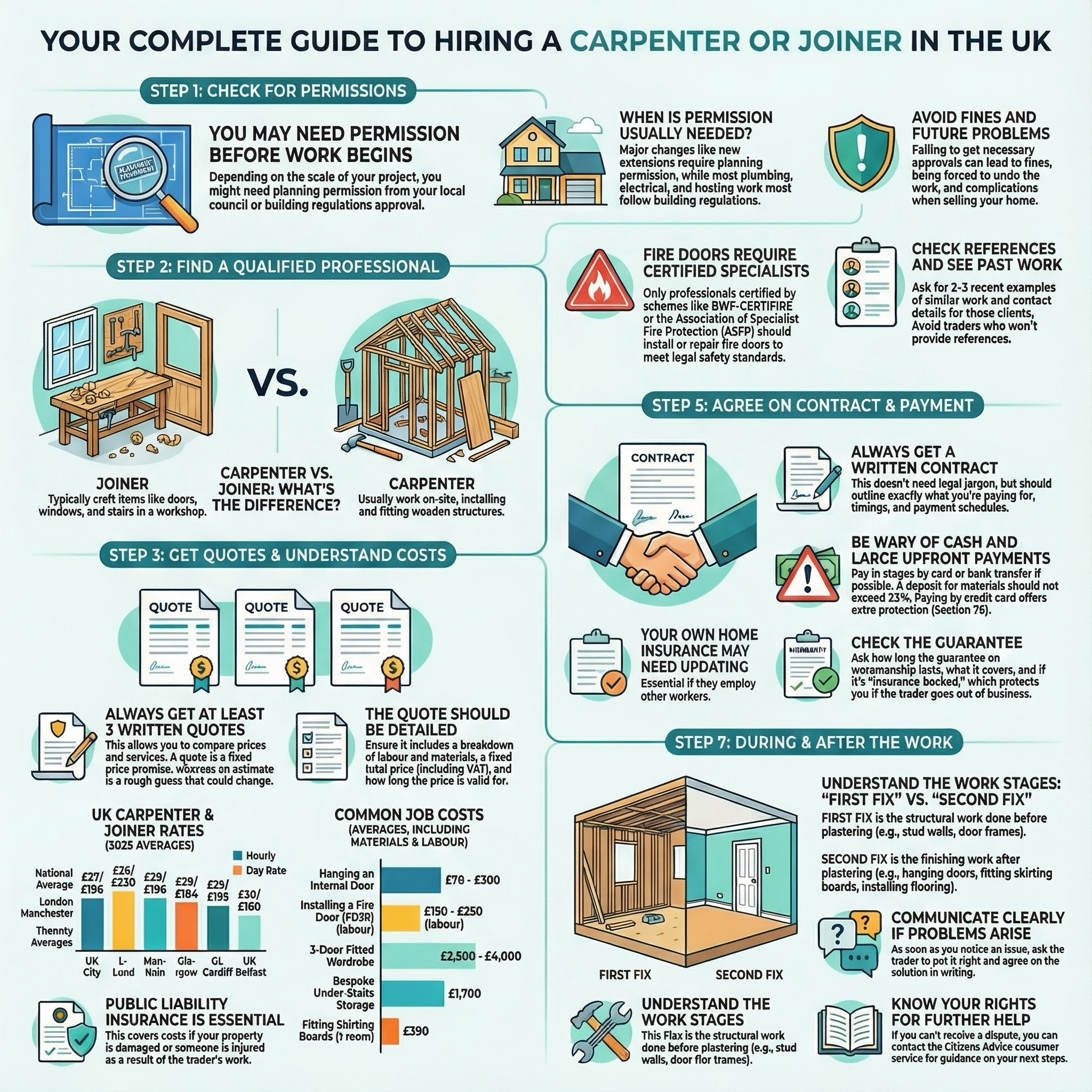
Joinery skills don't transfer between disciplines. A site carpenter doing first-fix isn't the same as a bench joiner doing bespoke wardrobes. Match the trade to the job.
Once the gaps are filled and painted, you can't see the work. Inspect joints, hinges and shadow-gaps before the decorator arrives.
Solid hardwood doors and skirtings expand and contract. Insist on acclimatisation in the house before fitting — or live with future warping.
Pine, redwood, oak, MDF — wildly different prices and lifespans. Don't accept 'wood' as a quote line; insist on grade and source.
Indicative UK ranges and what affects price.
By job type
Quote spread is typically ± 18% — always get 3 quotes.
Carpenter quick-view
Carpenter explained
Skirting and flooring are typically fitted in sequence — flooring first (engineered, laminate, LVT or solid timber), then skirting installed on top of the new floor with a small expansion gap hidden behind the skirting. Typical UK cost for a 25 m² lounge: £600–£2,500 for the flooring (depending on material) plus £250–£550 for skirting supplied and fitted.
Getting the order right and the gaps correct prevents the most common DIY problems — squeaky floors, peaking joints, and skirting that pulls away from the wall when the timber settles.
| Floor type | Material £/m² | Fitted £/m² |
|---|---|---|
| Laminate (mid-range) | £10–£30 | £25–£55 |
| LVT / vinyl plank | £15–£50 | £35–£75 |
| Engineered oak | £25–£80 | £55–£110 |
| Solid oak | £40–£120 | £80–£170 |
| Wide-board reclaimed timber | £60–£200 | £120–£280 |
| Profile / material | Material £/m | Fitted £/m |
|---|---|---|
| MDF pre-primed (chamfer / pencil round) | £3–£8 | £12–£25 |
| MDF Ogee / Torus profile | £5–£12 | £15–£28 |
| Solid pine (period style) | £8–£20 | £18–£35 |
| Solid oak / hardwood | £12–£30 | £25–£50 |
| Bespoke / period reproduction | £20–£60 | £35–£85 |
The right sequence prevents 90% of finishing problems:
Heights: 70–90 mm for contemporary, 145–180 mm for period properties, 220 mm+ for very tall ceilings or large rooms. Match to the door architrave style for visual cohesion.
Flooring first, skirting after — almost always. The skirting then covers the floor's expansion gap. The exception is renovations where you're keeping existing skirting; in that case you fit the floor up to the existing skirting and use beading to hide any gap.
Measure the perimeter of the room (length of all walls excluding door openings), add 10% for cuts and waste. A typical 4×5 m bedroom needs about 17 m of skirting.
Yes, but you'll need beading (a small quadrant moulding) to hide the expansion gap between the new floor and the existing skirting. Slightly less tidy than removing and refitting, but quicker and cheaper. £8–£15 per metre supplied and fitted.
For a 20 m² room: strip-out half a day, subfloor prep half a day, flooring 1 day, skirting half a day, decoration half a day. Total: 2.5–3.5 days for one room. Multi-room jobs can be sequenced and run faster per room.
Yes, but skirting will be slightly proud of any newly papered area later. Better to remove the wallpaper down to where the skirting will sit. If you must fit over paper, glue and nail rather than just nail — the paper layer can compress and create gaps.
Pre-primed MDF is fine for most rooms — stable, doesn't cup, accepts paint well. Use solid timber for period homes where the joins between skirting and door architrave need to be jointed in traditional ways, or where you want to stain/oil rather than paint.
Want a local pro to handle this? A carpenter or experienced flooring fitter will get the sequence, the expansion gaps, and the corner cuts right. The difference between a DIY laminate fit and a professional one is rarely the material — it's the prep, the gaps, and the finishing details.
This guide was written with AI assistance and is intended for general information only. Prices are estimates based on UK averages and may vary by region. Always get at least three quotes and consult a qualified professional before starting any work.
Ask follow-ups in plain English. The AI explains options, sequencing and what to ask the carpenter — so you walk in informed.
Joinery and Metalwork Installation Guide Scope of Works Survey & design brief – site measure‑up, discuss timber/steel grade, produce sketches/CAD. Workshop ...
READ GUIDE →GuideAssembling a chest of drawers is one of the most common yet frustrating home improvement tasks. Whether you have purchased a flat-pack unit from a high-street r...
READ GUIDE →GuideCustom carpentry is the hallmark of a well-finished UK home. Unlike flat-pack furniture, bespoke joinery is designed to fit the unique, often irregular dimensio...
READ GUIDE →GuideLetterbox Repair Guide Scope of Works Initial inspection & measure‑up – check door thickness, sleeve length and draught issues. Remove interior trim & o...
READ GUIDE →GuideFrom squeaky floorboards and sticking doors to more serious issues like timber rot or structural joist damage, carpentry repairs are a staple of UK home mainten...
READ GUIDE →GuideA wobbly or broken dining chair leg doesn't mean your furniture set is destined for the skip. Professional repair restores the structural integrity and aestheti...
READ GUIDE →