Instant
01 · Ask
Ask the AI a follow-up
Got more questions about stair Railing Installation? Describe the bit you're unsure about — the AI explains options, sequencing and what to ask the carpenter.

Hardwood, painted, glass or steel — supplied, fitted and torqued to current Building Regs.
You've read the brief on stair Railing Installation. Now lean on us to find the right carpenter — and stay in control of the job.
Got more questions about stair Railing Installation? Describe the bit you're unsure about — the AI explains options, sequencing and what to ask the carpenter.
Costs, timelines, pitfalls and the right questions to ask before any carpenter starts on stair Railing Installation.
Itemised quotes from up to 3 local carpenters on stair Railing Installation — so you can compare like-for-like, not lump sums.
Ready when you are
Enter your postcode and get free quotes from local pros.
Four moves that separate a smooth job from a nightmare.
Often caused by poor anchoring to the joists. A "wobbly" post undermines the entire safety of the railing.
If the angles aren't cut perfectly, gaps will appear as the timber naturally expands and contracts, leading to a "scratchy" or uneven handrail.
Visible screw heads or poorly filled holes can ruin the look of a premium hardwood rail.
Spindles that aren't perfectly vertical or evenly spaced are immediately noticeable to the eye.
Indicative UK ranges and what affects price.
By job type
Quote spread is typically ± 18% — always get 3 quotes.
Carpenter quick-view
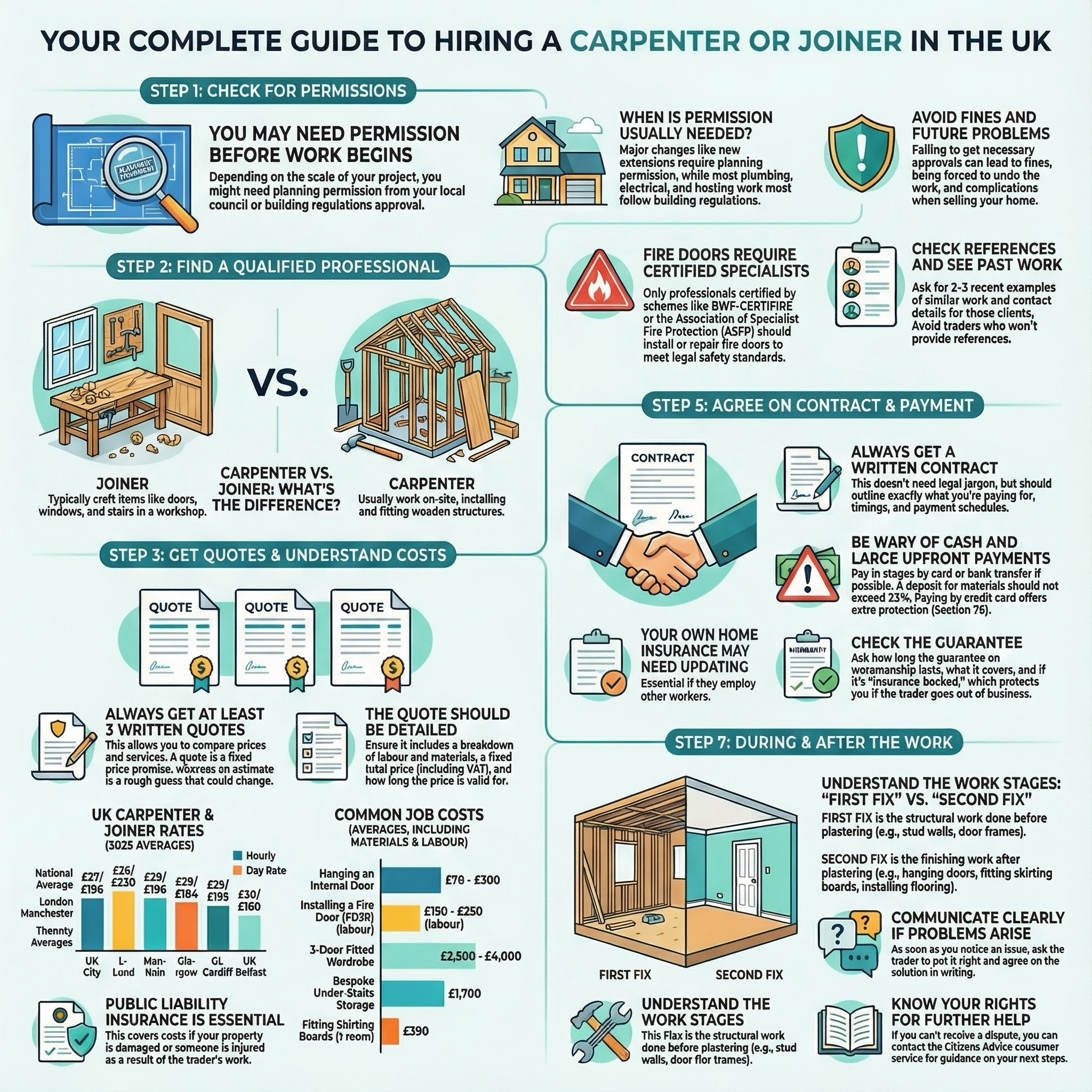
Carpenter explained
Upgrading your stair railing not only refreshes your hallway but also ensures your home remains compliant with UK safety standards. Professional installation by a qualified carpenter guarantees that the handrails can withstand significant force and that the spacing prevents accidents involving children or pets.
| Item | Low £ | High £ | Notes |
|---|---|---|---|
| Basic Softwood Kit (Materials) | £250 | £550 | Standard pine handrail and spindles for a straight flight. |
| Oak or Hardwood (Materials) | £800 | £1,800 | Premium timber, often pre-finished or requiring oiling. |
| Glass Balustrade (Materials) | £1,200 | £3,500 | Toughened glass panels with chrome or oak fixings. |
| Labour (per day) | £250 | £450 | Rates vary by region; London and SE are typically higher. |
| Waste Disposal | £50 | £150 | Removal of old timber and packaging. |
Total costs are primarily driven by the choice of material and the complexity of the staircase. A simple wall-mounted handrail is a quick, low-cost job, whereas a full balustrade replacement with "turned" landings and hardwood components requires significantly more precision and time.
While a confident DIYer can install a basic wall-mounted rail, a full balustrade replacement is a complex structural task. Getting the angles wrong on a handrail mitre or failing to secure a newel post correctly can result in a railing that is dangerous and non-compliant with Part K of the Building Regulations.
Professional carpenters use specialised jigs and heavy-duty fixings to ensure the railing can support the weight of an adult losing their balance. If your project involves structural changes to the stairs, professional installation is essential.
According to Building Regulations Part K, the handrail height on a staircase must be between 900mm and 1000mm, measured from the pitch line (the imaginary line connecting the nosings of the treads).
Yes, this is a common "refresh" project. However, the new spindles must fit the existing grooves in the handrail and baserail. If they don't, you may need to use "infills" or replace the rails entirely.
Aesthetically, glass requires more frequent cleaning to remove fingerprints. Structurally, modern toughened glass is incredibly durable, but it must be installed with specific gaskets to prevent rattling or cracking.
If the stairs are less than 1 metre wide, a handrail on one side is sufficient. If the stairs are wider than 1 metre, UK regulations require a handrail on both sides.
Squeaks are usually caused by timber rubbing against timber. A professional will use a combination of mechanical fixings (screws/bolts) and high-quality wood glue or silicone in the joints to prevent movement.
Technically yes, but it is generally discouraged. Oak is a premium hardwood with a beautiful grain. If you want a painted finish, it is much more cost-effective to use pine or MDF components.
This guide was written with AI assistance and is intended for general information only. Prices are estimates based on UK averages and may vary by region. Always get at least three quotes and consult a qualified professional before starting any work.
Ask follow-ups in plain English. The AI explains options, sequencing and what to ask the carpenter — so you walk in informed.
Joinery and Metalwork Installation Guide Scope of Works Survey & design brief – site measure‑up, discuss timber/steel grade, produce sketches/CAD. Workshop ...
READ GUIDE →GuideAssembling a chest of drawers is one of the most common yet frustrating home improvement tasks. Whether you have purchased a flat-pack unit from a high-street r...
READ GUIDE →GuideCustom carpentry is the hallmark of a well-finished UK home. Unlike flat-pack furniture, bespoke joinery is designed to fit the unique, often irregular dimensio...
READ GUIDE →GuideLetterbox Repair Guide Scope of Works Initial inspection & measure‑up – check door thickness, sleeve length and draught issues. Remove interior trim & o...
READ GUIDE →GuideFrom squeaky floorboards and sticking doors to more serious issues like timber rot or structural joist damage, carpentry repairs are a staple of UK home mainten...
READ GUIDE →GuideA wobbly or broken dining chair leg doesn't mean your furniture set is destined for the skip. Professional repair restores the structural integrity and aestheti...
READ GUIDE →