Instant
01 · Ask
Ask the AI a follow-up
Got more questions about wooden stool repair? Describe the bit you're unsure about — the AI explains options, sequencing and what to ask the carpenter.

Wobble, split or broken rung — re-glued, doweled, re-finished by a furniture carpenter.
You've read the brief on wooden stool repair. Now lean on us to find the right carpenter — and stay in control of the job.
Got more questions about wooden stool repair? Describe the bit you're unsure about — the AI explains options, sequencing and what to ask the carpenter.
Costs, timelines, pitfalls and the right questions to ask before any carpenter starts on wooden stool repair.
Itemised quotes from up to 3 local carpenters on wooden stool repair — so you can compare like-for-like, not lump sums.
Ready when you are
Enter your postcode and get free quotes from local pros.
Four moves that separate a smooth job from a nightmare.
Using brittle glues on joints that need to "breathe" with the wood can cause the repair to fail within months.
Previous "botched" repairs often involve hidden screws or nails that can damage a carpenter's tools or cause the wood to split during disassembly.
Stools kept too close to radiators often suffer from "dry shrinkage," where the wood contracts and joints pop out.
Sometimes a "wobble" is actually caused by structural internal damage from beetles, requiring chemical treatment before repair.
Indicative UK ranges and what affects price.
By job type
Quote spread is typically ± 18% — always get 3 quotes.
Carpenter quick-view
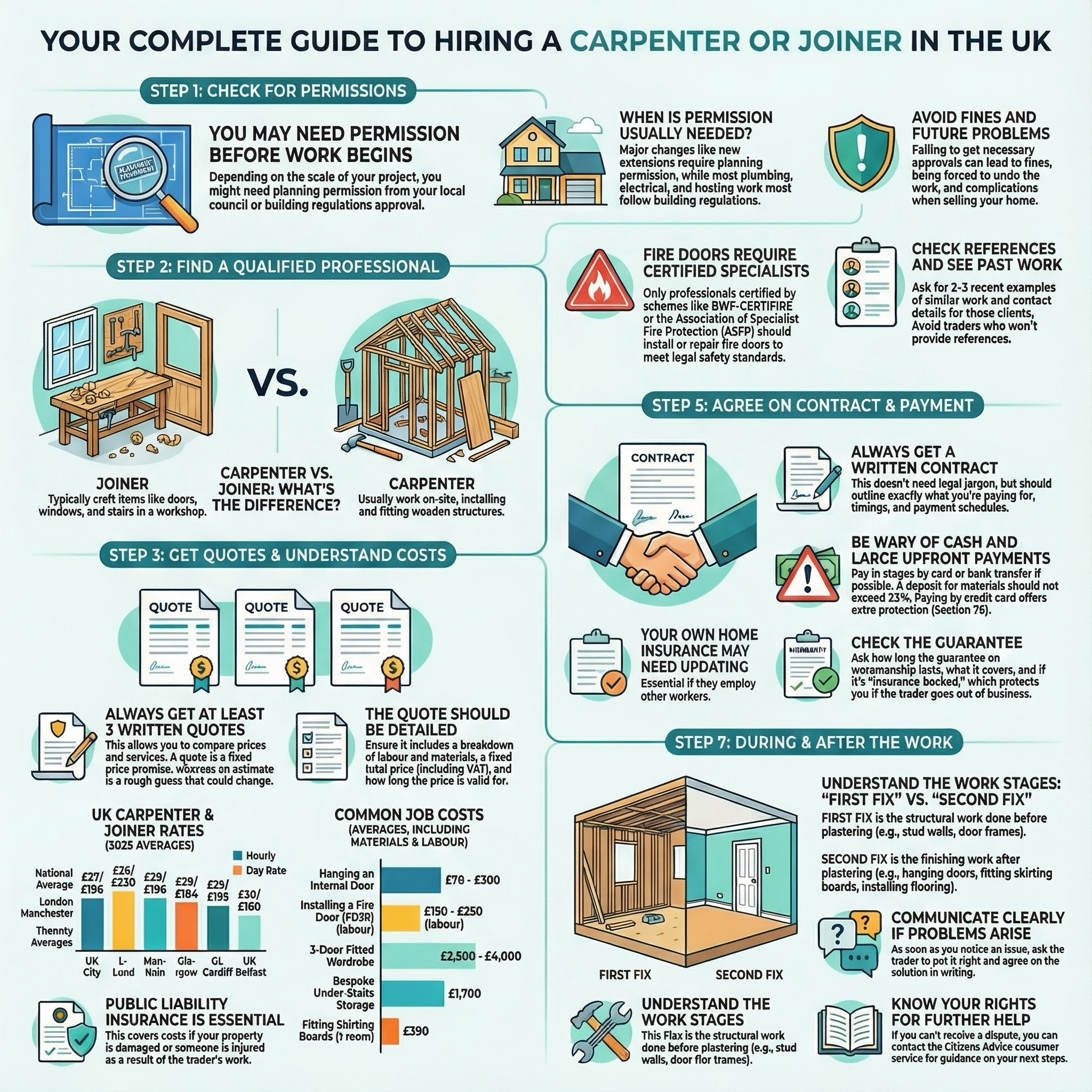
Carpenter explained
Repairing a high-quality wooden stool is almost always more cost-effective and sustainable than replacing it, especially if it belongs to a matching set. A professional carpenter or furniture restorer can return structural integrity to a piece, ensuring it remains safe and beautiful for decades to come.
The cost of repairing a wooden stool depends heavily on whether the work is a simple "tighten up" or a full structural restoration. Prices in London and the South East typically sit at the higher end of these ranges.
| Item | Low £ | High £ | Notes |
|---|---|---|---|
| Call-out / Minimum Charge | £60 | £110 | Covers travel and the first hour of assessment/minor repair. |
| Basic Joint Re-glue | £50 | £90 | Per stool; assumes no replacement parts are needed. |
| Replacement Spindle/Rung | £40 | £80 | Cost per custom-turned or shaped component. |
| Full Stripping & Refinishing | £100 | £250 | Labour-intensive process for high-end or antique pieces. |
| Upholstery (Labour only) | £45 | £120 | Excludes the cost of premium top-cover fabrics. |
| Total Project Average | £130 | £280 | Typical range for a single stool restoration. |
Materials such as specialist hide glues, bespoke stains, and high-density foam will add to the final invoice. If you have a set of four or six stools, most carpenters will offer a discounted "per item" rate for the batch.
While a homeowner can easily apply a bit of wood filler or wax, structural repairs are best left to a professional. A common DIY mistake is using "super glue" or metal brackets to fix a wobbly joint, which often causes permanent damage to the timber and makes future professional repair much harder.
If the stool is used at height (like a bar stool), structural integrity is a safety issue. A professional carpenter ensures the joints can handle lateral pressure, preventing a collapse that could cause injury. Furthermore, any reupholstery work must comply with UK fire safety standards, which a professional will be well-versed in.
For modern furniture, a general carpenter is usually sufficient. For antiques, look for a specialist furniture restorer or cabinet maker.
While general carpentry isn't heavily regulated, specific rules apply if the repair involves certain materials or environments.
If the break is "clean" along the grain, a professional can often perform a "rubbed joint" repair using internal dowels or biscuits to make it stronger than the original wood. If the wood is shattered or rotten, a new leg will need to be turned on a lathe to match.
You likely didn't remove the old glue first. New wood glue cannot bond to old, dried glue; it needs to penetrate the raw wood fibres. A professional will completely clean the joint before re-gluing and use high-pressure clamps to ensure a tight bond.
Generally, if the stool is made of solid wood, it is worth repairing. However, if it is made of MDF or particle board (common in budget flat-pack), the "timber" often disintegrates when joints fail, making a lasting repair difficult and often more expensive than a new stool.
Yes. If the stool is being stripped for a structural repair, this is the perfect time to re-stain it. A carpenter can move from a light pine to a dark oak or walnut finish, though it is much harder to go from dark to light.
Avoid "rocking" on the back legs, as this puts immense pressure on the joints. Also, try to keep wooden furniture away from direct heat sources like radiators or underfloor heating manifolds, which can dry out the timber and the glue.
This guide was written with AI assistance and is intended for general information only. Prices are estimates based on UK averages and may vary by region. Always get at least three quotes and consult a qualified professional before starting any work.
Ask follow-ups in plain English. The AI explains options, sequencing and what to ask the carpenter — so you walk in informed.
Joinery and Metalwork Installation Guide Scope of Works Survey & design brief – site measure‑up, discuss timber/steel grade, produce sketches/CAD. Workshop ...
READ GUIDE →GuideAssembling a chest of drawers is one of the most common yet frustrating home improvement tasks. Whether you have purchased a flat-pack unit from a high-street r...
READ GUIDE →GuideCustom carpentry is the hallmark of a well-finished UK home. Unlike flat-pack furniture, bespoke joinery is designed to fit the unique, often irregular dimensio...
READ GUIDE →GuideLetterbox Repair Guide Scope of Works Initial inspection & measure‑up – check door thickness, sleeve length and draught issues. Remove interior trim & o...
READ GUIDE →GuideFrom squeaky floorboards and sticking doors to more serious issues like timber rot or structural joist damage, carpentry repairs are a staple of UK home mainten...
READ GUIDE →GuideA wobbly or broken dining chair leg doesn't mean your furniture set is destined for the skip. Professional repair restores the structural integrity and aestheti...
READ GUIDE →