Instant
01 · Ask
Site or bench joinery?
First-fix, second-fix, bespoke joinery — different skills. Describe what you need and the AI tells you which kind of carpenter to look for.

Pergolas, gazebos, frames and garden buildings — designed, supplied and fitted by a carpenter team.
From a sticking door to a bespoke staircase — read the brief, then let Three local carpenters quote.
First-fix, second-fix, bespoke joinery — different skills. Describe what you need and the AI tells you which kind of carpenter to look for.
Timber grades, acclimatisation, MDF vs solid, hinge types and shadow-gap details. Know what 'quality' looks like before you accept the work.
Three local carpenters quote on the same spec — timber, ironmongery, fixings, finishing — so the cheapest isn't accidentally the rough one.
Ready when you are
Enter your postcode and get free quotes from local pros.
Four moves that separate a smooth job from a nightmare.
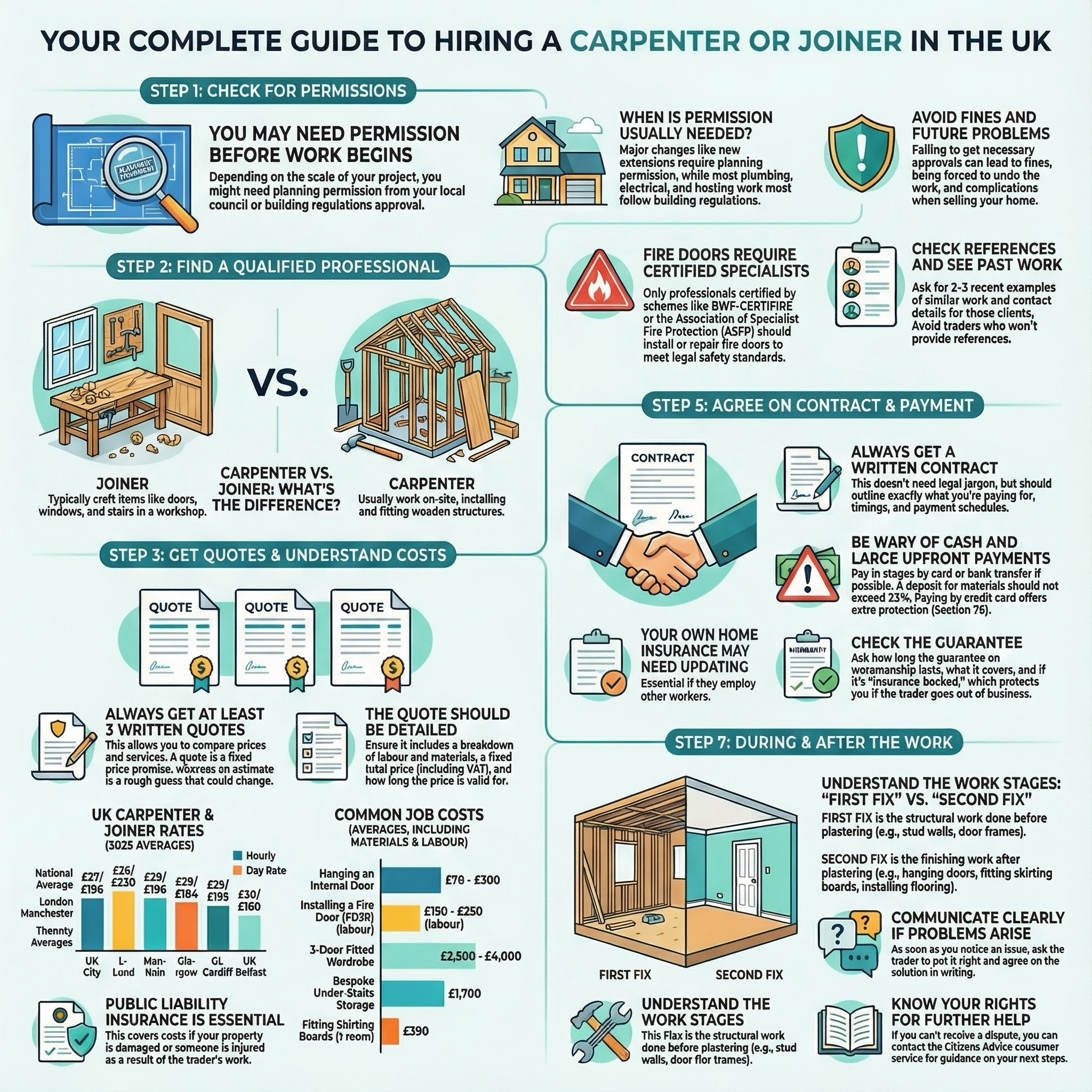
Joinery skills don't transfer between disciplines. A site carpenter doing first-fix isn't the same as a bench joiner doing bespoke wardrobes. Match the trade to the job.
Once the gaps are filled and painted, you can't see the work. Inspect joints, hinges and shadow-gaps before the decorator arrives.
Solid hardwood doors and skirtings expand and contract. Insist on acclimatisation in the house before fitting — or live with future warping.
Pine, redwood, oak, MDF — wildly different prices and lifespans. Don't accept 'wood' as a quote line; insist on grade and source.
Indicative UK ranges and what affects price.
By job type
Quote spread is typically ± 18% — always get 3 quotes.
Carpenter quick-view
Carpenter explained
Building a timber structure in the UK — a garden room, log cabin, summerhouse, pergola, or framed annexe — typically costs £3,000–£35,000, depending on size, whether it's habitable, and the level of insulation and finishes. Smaller decorative pieces (pergolas, lean-tos) start at £800; insulated garden offices in the £15,000–£25,000 bracket are now the most common ask.
Timber structures in domestic gardens often fall under permitted development, but only if they're outbuildings (no residential use), under 2.5 m at the eaves if within 2 m of a boundary, and don't cover more than 50% of the garden area.
| Structure | Typical UK cost |
|---|---|
| Pergola (3×3 m, basic timber) | £800–£2,200 |
| Summerhouse (uninsulated, 2.5×2.5 m) | £2,500–£6,000 |
| Log cabin (uninsulated, 4×3 m) | £4,500–£9,000 |
| Garden office / studio (insulated, 4×3 m) | £12,000–£22,000 |
| Garden office (insulated + plumbed, 5×4 m) | £18,000–£32,000 |
| Granny annexe / habitable structure | £35,000–£80,000+ |
| Carport (timber, 2-car) | £3,500–£7,000 |
| Decking and pergola combo (15 m²) | £3,000–£6,500 |
For a non-habitable summerhouse, no insulation is fine — it's a fair-weather space. For a year-round garden office, insulation makes the difference between usable and miserable. Options:
Target U-values: walls 0.20 W/m²K, roof 0.15 W/m²K, floor 0.20 W/m²K. Hitting these allows a small electric heater to keep the room warm with low running costs.
Usually no, if it stays within permitted development limits (under 2.5 m eaves within 2 m of boundary, under 50% garden coverage, no residential use). Conservation areas, listed buildings, and sites of designated scenic beauty have stricter rules; check with your council planning officer.
4–8 weeks total, including foundations (1 week), structure (2–3 weeks), cladding/roof (1–2 weeks), interior fit-out (1–2 weeks), electrics and decoration (1 week). Off-site modular builds can be quicker if your access permits crane delivery.
Concrete pad foundations are traditional but slow and messy. Ground screws (helical steel piles screwed into the ground) are faster, cleaner, no concrete cure time, and reversible. Paved bases work for very light structures only. For an insulated garden office, ground screws or pad foundations are the right choice.
If you work from home full-time and have £15k+ to spend, often yes — separates work from living space, adds property value (typically 5–10% of the build cost), and removes the daily commute friction. For occasional WFH, a dedicated room in the house is usually a better investment.
A well-built insulated garden office typically adds 60–80% of its build cost to the property value. A decorative summerhouse or pergola usually adds little. Habitable annexes (with planning + BR) often add more than they cost, particularly in expensive areas.
Off-the-shelf cabin kits are cheaper (£3,000–£10,000) but often poorly insulated and limited in spec. Bespoke garden offices from local timber-frame specialists cost more (£15k+) but are properly insulated, weatherproofed, and tailored to your garden. Pick based on use case: occasional summer use → kit; year-round office → bespoke.
Want a local pro to handle this? A timber-frame specialist or experienced carpenter will deliver a structure that lasts 25+ years rather than 10. Check their portfolio for the type of build you want — a garden office is a different skill from a pergola or carport.
This guide was written with AI assistance and is intended for general information only. Prices are estimates based on UK averages and may vary by region. Always get at least three quotes and consult a qualified professional before starting any work.
Ask follow-ups in plain English. The AI explains options, sequencing and what to ask the carpenter — so you walk in informed.
Joinery and Metalwork Installation Guide Scope of Works Survey & design brief – site measure‑up, discuss timber/steel grade, produce sketches/CAD. Workshop ...
READ GUIDE →GuideAssembling a chest of drawers is one of the most common yet frustrating home improvement tasks. Whether you have purchased a flat-pack unit from a high-street r...
READ GUIDE →GuideCustom carpentry is the hallmark of a well-finished UK home. Unlike flat-pack furniture, bespoke joinery is designed to fit the unique, often irregular dimensio...
READ GUIDE →GuideLetterbox Repair Guide Scope of Works Initial inspection & measure‑up – check door thickness, sleeve length and draught issues. Remove interior trim & o...
READ GUIDE →GuideFrom squeaky floorboards and sticking doors to more serious issues like timber rot or structural joist damage, carpentry repairs are a staple of UK home mainten...
READ GUIDE →GuideA wobbly or broken dining chair leg doesn't mean your furniture set is destined for the skip. Professional repair restores the structural integrity and aestheti...
READ GUIDE →