Instant
01 · Ask
Ask the AI a follow-up
Got more questions about laminate Floor Installation? Describe the bit you're unsure about — the AI explains options, sequencing and what to ask the carpets.

Click-lock laminate — sub-floor prepped, expansion gaps right and skirting refit clean.
You've read the brief on laminate Floor Installation. Now lean on us to find the right carpets — and stay in control of the job.
Got more questions about laminate Floor Installation? Describe the bit you're unsure about — the AI explains options, sequencing and what to ask the carpets.
Costs, timelines, pitfalls and the right questions to ask before any carpets starts on laminate Floor Installation.
Itemised quotes from up to 3 local carpetss on laminate Floor Installation — so you can compare like-for-like, not lump sums.
Ready when you are
Enter your postcode and get free quotes from local pros.
Four moves that separate a smooth job from a nightmare.
Usually caused by an uneven subfloor. If the "humps and hollows" aren't fixed first, the click-joints will eventually snap under foot traffic.
This happens when no expansion gap was left. As the boards naturally expand, they hit the wall and have nowhere to go but up.
If the boards weren't acclimated to the room's temperature, they may shrink after installation, leaving unsightly gaps between planks.
Using an underlay that is too thick or "spongy" can cause the floor to feel unstable and put stress on the locking mechanism.
Indicative UK ranges and what affects price.
By job type
Quote spread is typically ± 18% — always get 3 quotes.
Carpets quick-view
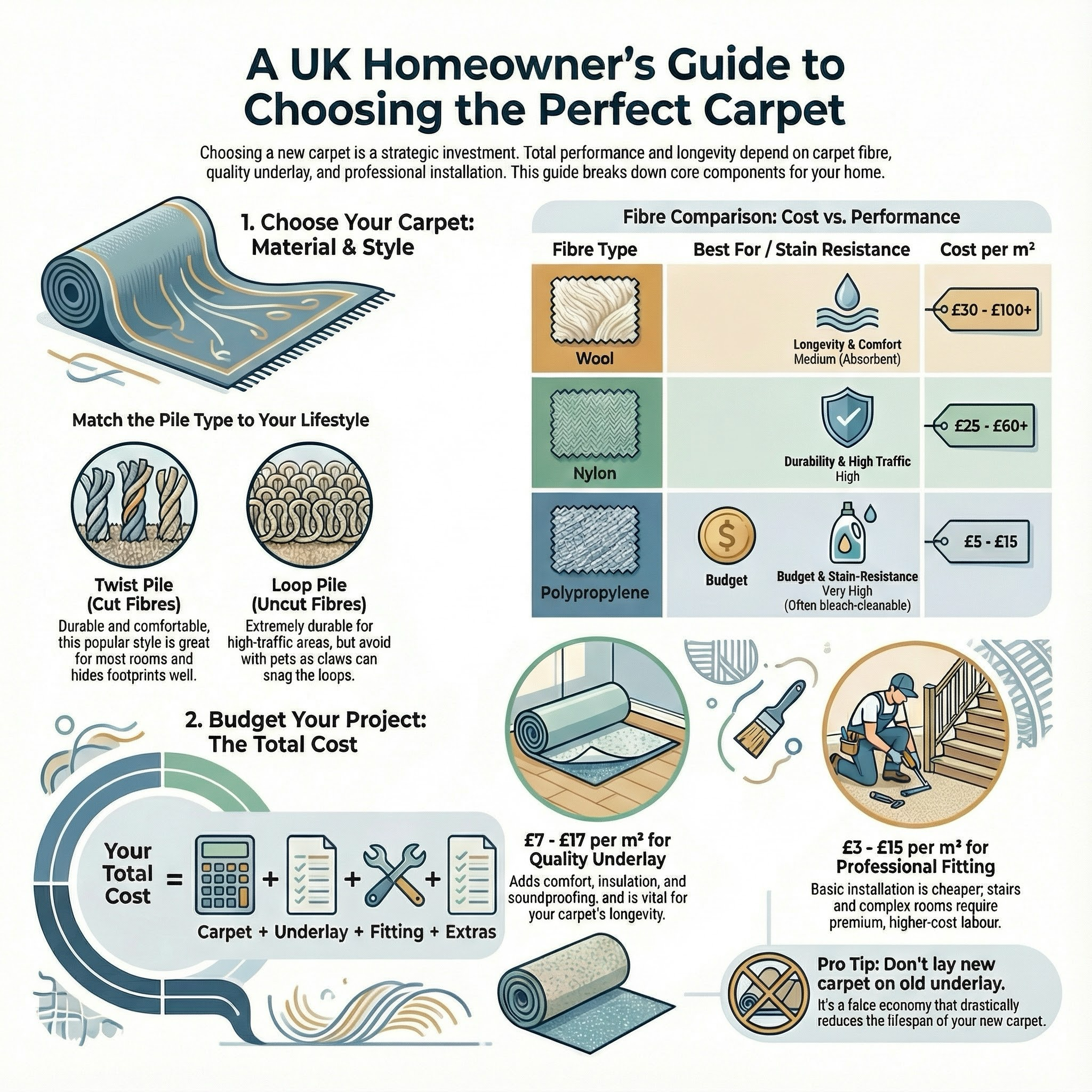
Carpets explained
A professional installation is about more than just clicking planks together; it ensures the longevity of the product through meticulous subfloor preparation and correct expansion allowances. This guide outlines what to expect during the process, the current market rates in the UK, and how to ensure a high-quality finish that lasts for decades.
The cost of laminate installation varies based on the quality of the material and the complexity of the room shape. Prices below include VAT and represent 2025/26 UK averages.
| Item | Low £ | High £ | Notes |
|---|---|---|---|
| Labour (per m²) | £15 | £30 | Higher for herringbone or complex patterns. |
| Mid-Range Laminate (Material) | £12 | £25 | 8mm - 10mm thickness, AC4 rated. |
| Premium Laminate (Material) | £25 | £50 | 12mm thickness, integrated underlay or waterproof. |
| Underlay (per m²) | £4 | £10 | Acoustic or gold-foil vapour barrier types. |
| Beading & Thresholds (per room) | £40 | £100 | Matching MDF or solid wood trims. |
| Subfloor Levelling (per room) | £150 | £400 | Includes materials (latex compound) and labour. |
Price Factors: Total costs are influenced by the "wastage" factor (usually 10%), the need for furniture removal, and whether you choose to replace skirting boards entirely rather than using beading.
Professional fitters often have a minimum day rate of £200–£300, even for very small rooms, to cover their travel and setup time.
While laminate is marketed as a DIY-friendly "click" product, the difference between a DIY job and a professional finish is usually found at the edges. Amateurs often struggle with undercutting door frames and maintaining consistent expansion gaps, which can lead to the floor "peaking" or buckling within six months.
If you are laying floor in a flat or apartment, professional installation is highly recommended to ensure compliance with acoustic regulations. A pro will also have the heavy-duty cutters required for thicker 12mm boards, which can quickly blunt standard DIY tools.
Questions to ask your fitter:
No. Carpet is too soft and will cause the laminate joints to flex and eventually break. Carpet must be removed, and the subfloor cleaned before installation.
Most standard laminate is water-resistant but not waterproof. However, many modern ranges (often labelled "Aqua") are designed for bathrooms and kitchens with sealed joints that can withstand standing water for 24–72 hours.
Yes. Laminate is made of wood fibres which expand and contract. Skipping acclimation is the leading cause of floor failure and will usually void your manufacturer's warranty.
Scotia is a small decorative trim used to cover the expansion gap against existing skirting boards. If you want a cleaner look, you can remove the skirting boards, fit the floor, and then install new skirting on top.
Yes, but you must check the manufacturer's specifications. You will also need a specific low-tog underlay that allows heat to pass through efficiently without damaging the boards.
Use a microfiber mop and a specialist laminate cleaner. Never use a steam mop or soaking wet mop, as excessive moisture can seep into the joints and cause the core to swell.
This guide was written with AI assistance and is intended for general information only. Prices are estimates based on UK averages and may vary by region. Always get at least three quotes and consult a qualified professional before starting any work.
Ask follow-ups in plain English. The AI explains options, sequencing and what to ask the carpets — so you walk in informed.
New flooring is one of the most impactful upgrades you can make to a UK home. Beyond the immediate aesthetic boost, high-quality flooring improves insulation, r...
READ GUIDE →GuideLaminate flooring remains one of the most popular choices for UK homeowners, offering the aesthetic of real hardwood with significantly higher durability and ea...
READ GUIDE →GuideInstalling new carpet is one of the most effective ways to instantly improve the comfort and insulation of your home. Whether you are opting for a durable wool-...
READ GUIDE →GuideFloor screeding is the process of applying a blended mixture of cement and graded sand (or a specialized liquid compound) to a structural concrete subfloor. For...
READ GUIDE →GuideModern vinyl flooring has evolved far beyond the basic "lino" of the past. Today, UK homeowners can choose from high-end sheet vinyl, Luxury Vinyl Tiles (LVT), ...
READ GUIDE →GuideRefinishing a wooden floor is one of the most effective ways to restore character and add significant value to a UK home. Whether you have discovered original V...
READ GUIDE →