Instant
01 · Ask
Ask the AI a follow-up
Got more questions about woodwork Painting? Describe the bit you're unsure about — the AI explains options, sequencing and what to ask the decorator.

Skirting, architrave, doors and frames — sanded, primed and finished in eggshell or satinwood.
You've read the brief on woodwork Painting. Now lean on us to find the right decorator — and stay in control of the job.
Got more questions about woodwork Painting? Describe the bit you're unsure about — the AI explains options, sequencing and what to ask the decorator.
Costs, timelines, pitfalls and the right questions to ask before any decorator starts on woodwork Painting.
Itemised quotes from up to 3 local decorators on woodwork Painting — so you can compare like-for-like, not lump sums.
Ready when you are
Enter your postcode and get free quotes from local pros.
Four moves that separate a smooth job from a nightmare.
Untreated pine knots leak yellow-brown stain through paint within months. Always shellac-prime knots.
Wrong brush or thick paint. Use synthetic brush for water-based paint; thin paint with a small amount of Floetrol.
Oil-based gloss yellows fast. Use water-based satinwood or eggshell for non-yellowing white finish.
Paint runs onto floor and walls. Quality decorators mask everything.
Indicative UK ranges and what affects price.
By job type
Quote spread is typically ± 18% — always get 3 quotes.
Decorator quick-view
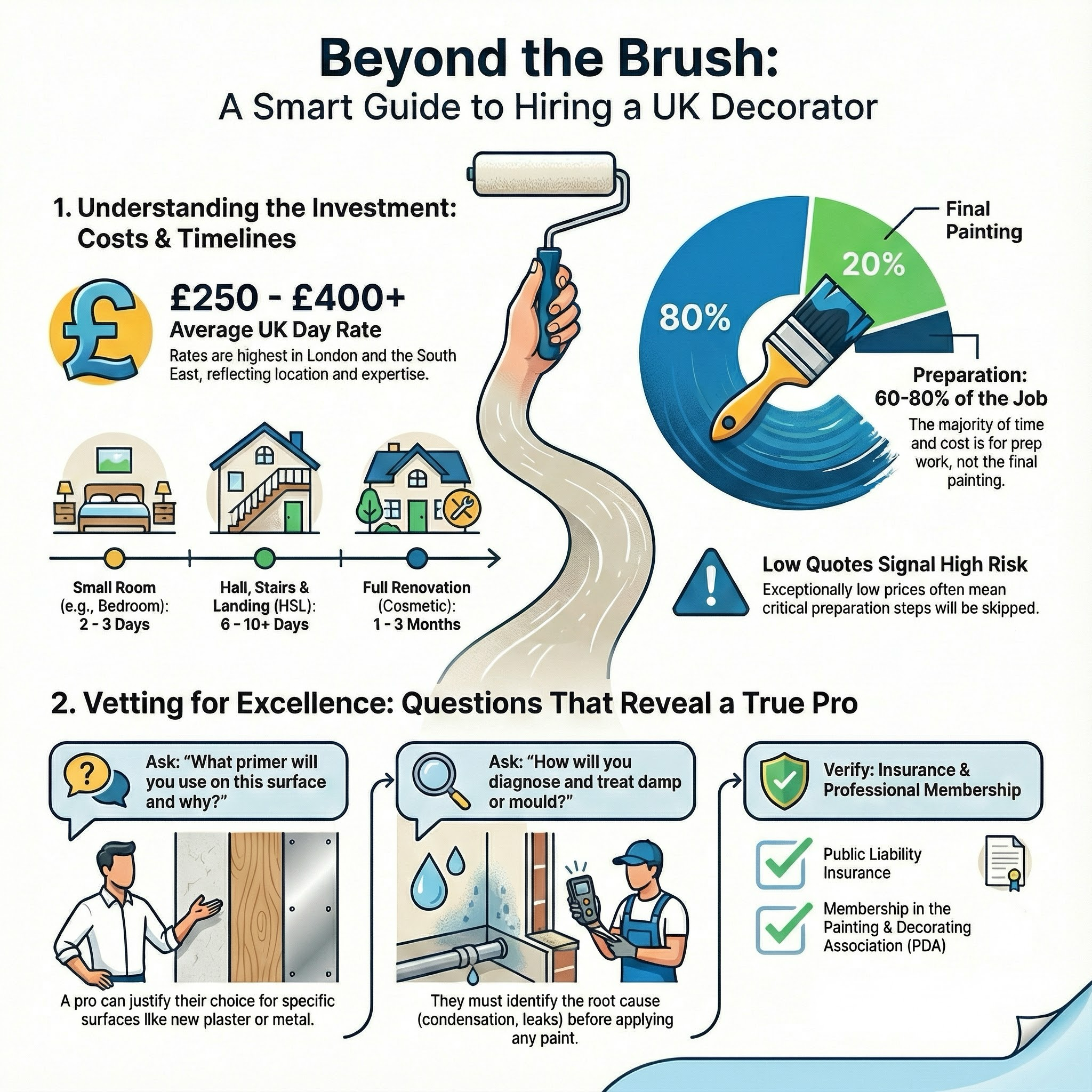
Decorator explained
Skirting, architrave and doors are 30–40% of any decoration job, and the difference between a quality finish and a cheap one is most visible here. Expect to pay £80–£350 per room for UK woodwork painting depending on amount of trim and finish.
Existing finish is sanded with 180-grit to break the surface. Cracks and nail holes filled with caulk or fine filler. Knot blockers (shellac-based) applied to any visible pine knots. Primer coat (water-based primer-undercoat) applied to bare wood. Two top coats of eggshell or satinwood, laying off in long parallel strokes for a brush-mark-free finish. Spray-finished for higher-spec projects.
| Item | Low (£) | High (£) | Notes |
|---|---|---|---|
| Skirting and architrave per metre | 4 | 15 | Brush, two coats |
| Single internal door, both sides | 40 | 120 | Including prep, two coats |
| Stair spindles per spindle | 10 | 30 | Fiddly, time-consuming |
| Bedroom woodwork (door + skirting) | 80 | 200 | Full room |
| Living room woodwork | 120 | 300 | Including window frames |
| Staircase + landing woodwork | 300 | 900 | Newels, spindles, handrail |
| Whole-house woodwork | 800 | 3,000 | Doors, skirting, architrave |
Single door both sides: 3–4 hours. Bedroom woodwork: half a day. Living room: 1 day. Staircase and landing: 2 days. Whole-house woodwork: 4–7 days.
DIY-able with patience. Brush-mark-free finish requires good brush (Wooster, Purdy), correct paint consistency, and laying-off technique. Spindles especially are professional work — too much fiddly detail.
A painter and decorator. Ask about brushes — Wooster Pro Nylox or Purdy XL are the pro standards. Confirm the paint brand and finish (eggshell, satinwood). Insist on knot-block primer on any visible knots.
Lead-paint regulations on pre-1960s woodwork. Listed buildings: original woodwork retention.
Gloss: shiniest, shows dirt, oil-based versions yellow. Satinwood: medium sheen, modern standard. Eggshell: lowest sheen, hides imperfections best.
Synthetic brush (Wooster, Purdy) for water-based paint. Natural bristle for oil-based. A 50mm/2-inch flat brush is the workhorse.
Water-based modern paints (Dulux Quick Dry, Crown Trade Fastflow) — non-yellowing, low-VOC, faster cure. Oil-based is increasingly old-school.
Yes — light 320-grit between top coats for the smoothest finish. Removes any dust nibs from the previous coat.
Touch-dry: 1–2 hours. Hard-dry: 24 hours (no leaning furniture). Fully cured: 7 days.
Traditional: white woodwork (or off-white in heritage homes), coloured walls. Modern: woodwork matches walls (tonal) or contrasts boldly (dark wall + lighter trim).
This guide was written with AI assistance and is intended for general information only. Prices are estimates based on UK averages and may vary by region. Always get at least three quotes and consult a qualified professional before starting any work.
Ask follow-ups in plain English. The AI explains options, sequencing and what to ask the decorator — so you walk in informed.
Interior painting transforms a room more than any other upgrade. UK costs per room, prep work and what professionals actually charge in 2026.
READ GUIDE →GuideExterior paint protects the building and refreshes the look. UK costs by house size, masonry vs render and what survives UK weather.
READ GUIDE →GuideWallpaper transforms rooms with pattern, texture and colour. UK costs per roll, prep work and matching pattern repeats.
READ GUIDE →GuideAirless spray gives a factory finish on woodwork and walls. UK costs, equipment and when spray beats brush-and-roller.
READ GUIDE →GuidePainting kitchen units transforms the kitchen at a fraction of replacement cost. UK costs, methods and what survives daily use.
READ GUIDE →GuideNew plaster needs proper prep before paint. UK costs, mist coats, and why this is the step cheap decorators skip.
READ GUIDE →