Instant
01 · Ask
Ask the AI a follow-up
Got more questions about fuseboard Upgrade Cost & Work? Describe the bit you're unsure about — the AI explains options, sequencing and what to ask the electrician.

Old wired fuse box swapped for 18th-edition RCBO consumer unit — Part P certified.
You've read the brief on fuseboard Upgrade Cost & Work. Now lean on us to find the right electrician — and stay in control of the job.
Got more questions about fuseboard Upgrade Cost & Work? Describe the bit you're unsure about — the AI explains options, sequencing and what to ask the electrician.
Costs, timelines, pitfalls and the right questions to ask before any electrician starts on fuseboard Upgrade Cost & Work.
Itemised quotes from up to 3 local electricians on fuseboard Upgrade Cost & Work — so you can compare like-for-like, not lump sums.
Ready when you are
Enter your postcode and get free quotes from local pros.
Four moves that separate a smooth job from a nightmare.
Modern RCDs are highly sensitive; they often detect tiny "leaks" in old wiring that the old fuseboard ignored, requiring further investigative work.
Many older UK homes lack sufficient bonding to gas and water pipes, which must be corrected before a new board can be commissioned.
If your fusebox is in a tight cupboard or under stairs, it may need to be moved to meet modern access and clearance regulations.
Occasionally, the main "tails" (the heavy cables coming from your meter) are too thin for modern loads and must be upgraded.
Indicative UK ranges and what affects price.
By job type
Quote spread is typically ± 18% — always get 3 quotes.
Electrician quick-view
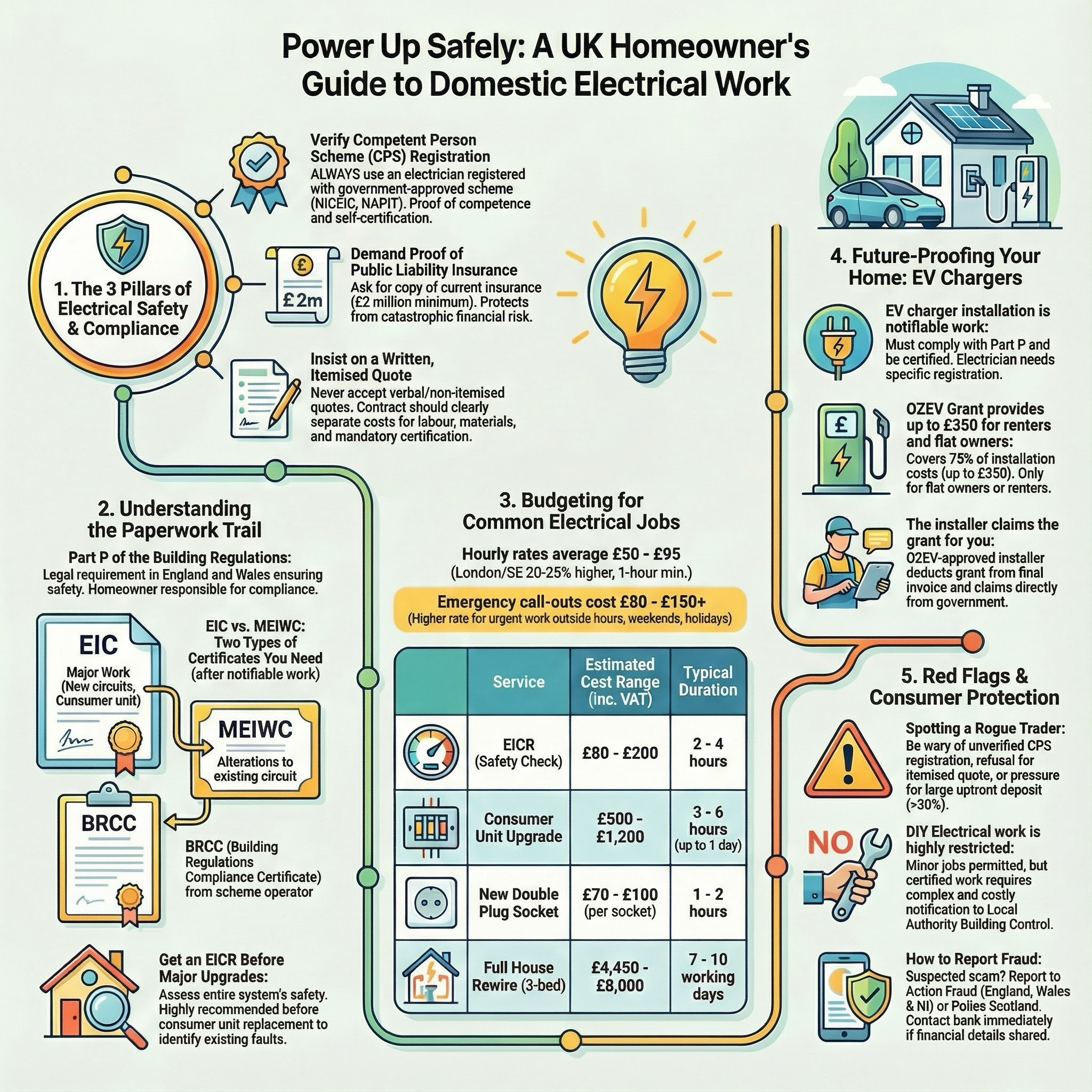
Electrician explained
If your current board has wooden backing, cast-iron switches, or replaceable fuse wire, it likely fails to meet current UK safety standards. A professional upgrade ensures your home complies with the latest 18th Edition Wiring Regulations, providing peace of mind for your family and satisfying insurance requirements.
| Item | Low £ | High £ | Notes |
|---|---|---|---|
| Standard 10-Way Consumer Unit | £550 | £850 | Includes basic RCBO protection and labour. |
| Premium Unit (SPD & AFDD) | £800 | £1,300 | Includes Surge Protection and Arc Fault detection. |
| Main Earthing/Bonding Upgrade | £150 | £350 | Often required to bring old systems to code. |
| Fault Finding (per hour) | £60 | £95 | Required if the new board detects existing leaks. |
| Total Project Average | £650 | £1,200 | Inclusive of VAT and certification. |
The primary drivers of cost are the number of circuits in your home and the specific components used. Modern regulations often recommend Surge Protection Devices (SPD) and Arc Fault Detection Devices (AFDD), which increase material costs but significantly enhance safety.
This is strictly a job for a qualified professional. In England and Wales, a consumer unit upgrade is "notifiable work" under Part P of the Building Regulations.
Attempting this yourself is not only life-threateningly dangerous but also illegal without building control notification. It will likely invalidate your home insurance and cause significant issues when you try to sell your property.
Questions to ask:
Old-style fuses only protect against massive overloads. They do not protect you from electrocution or small "leaks" of electricity. A modern unit with RCD protection can disconnect power in milliseconds, literally saving lives.
A Surge Protection Device (SPD) protects your electronics (TVs, computers, boilers) from voltage spikes caused by lightning or grid switching. Under the 18th Edition regulations, they are now mandatory in most domestic installations unless a specific risk assessment proves otherwise.
Yes, the main power will be isolated for the duration of the physical swap and the majority of the testing. Expect to be without power for 4 to 8 hours depending on the complexity of the job.
An RCD protects a group of circuits; if one fault occurs, the whole group loses power. An RCBO combines the functions of a circuit breaker and an RCD for a single circuit, meaning a fault in the kitchen won't turn off the lights in the hallway.
The installation itself won't "fail," but the electrician cannot sign off the work if the underlying house wiring is dangerous. Any serious faults found during testing must be fixed before the new board is fully commissioned.
This guide was written with AI assistance and is intended for general information only. Prices are estimates based on UK averages and may vary by region. Always get at least three quotes and consult a qualified professional before starting any work.
Ask follow-ups in plain English. The AI explains options, sequencing and what to ask the electrician — so you walk in informed.
What Is Emergency Lighting? Emergency lighting is a safety system designed to illuminate escape routes, exits, and high-risk areas when the normal mains power f...
READ GUIDE →GuideA full house rewire or a consumer unit (fuse box) upgrade is one of the most critical safety investments a UK homeowner can make. As our reliance on electrical ...
READ GUIDE →GuideWhile many floor lamps are marketed as simple flat-pack items, high-end designer models, heavy arched lamps, and vintage restorations often require professional...
READ GUIDE →GuideGeneral electrical work encompasses everything from minor repairs and socket additions to installing new circuits for home improvements. For UK homeowners, ensu...
READ GUIDE →GuideElectric boilers are an increasingly popular choice for UK homeowners, particularly in modern flats or properties without a mains gas connection. While they are...
READ GUIDE →GuideReplacing a bathroom light switch is a common home improvement task that balances aesthetics with vital safety requirements. Given the high levels of moisture a...
READ GUIDE →