Instant
01 · Ask
Spot the warning signs
Buzzing fuse box, hot sockets, lights flickering when you boil the kettle. Describe it in plain English — the AI tells you if it's a 30-min fix or a rewire.

Pendants, downlights, LED strips — designed, installed and dimmer-set by a Part P electrician.
From a single dodgy socket to a full rewire — read the brief, then let Three local electricians quote.
Buzzing fuse box, hot sockets, lights flickering when you boil the kettle. Describe it in plain English — the AI tells you if it's a 30-min fix or a rewire.
Part P, EIC vs EICR, C1/C2/C3 ratings, when Building Control gets involved. Know the lingo before the quote arrives.
Up to Three local electricians come back with itemised quotes — call-out, materials, labour, certificate fee. No flat-rate guesses.
Ready when you are
Enter your postcode and get free quotes from local pros.
Four moves that separate a smooth job from a nightmare.
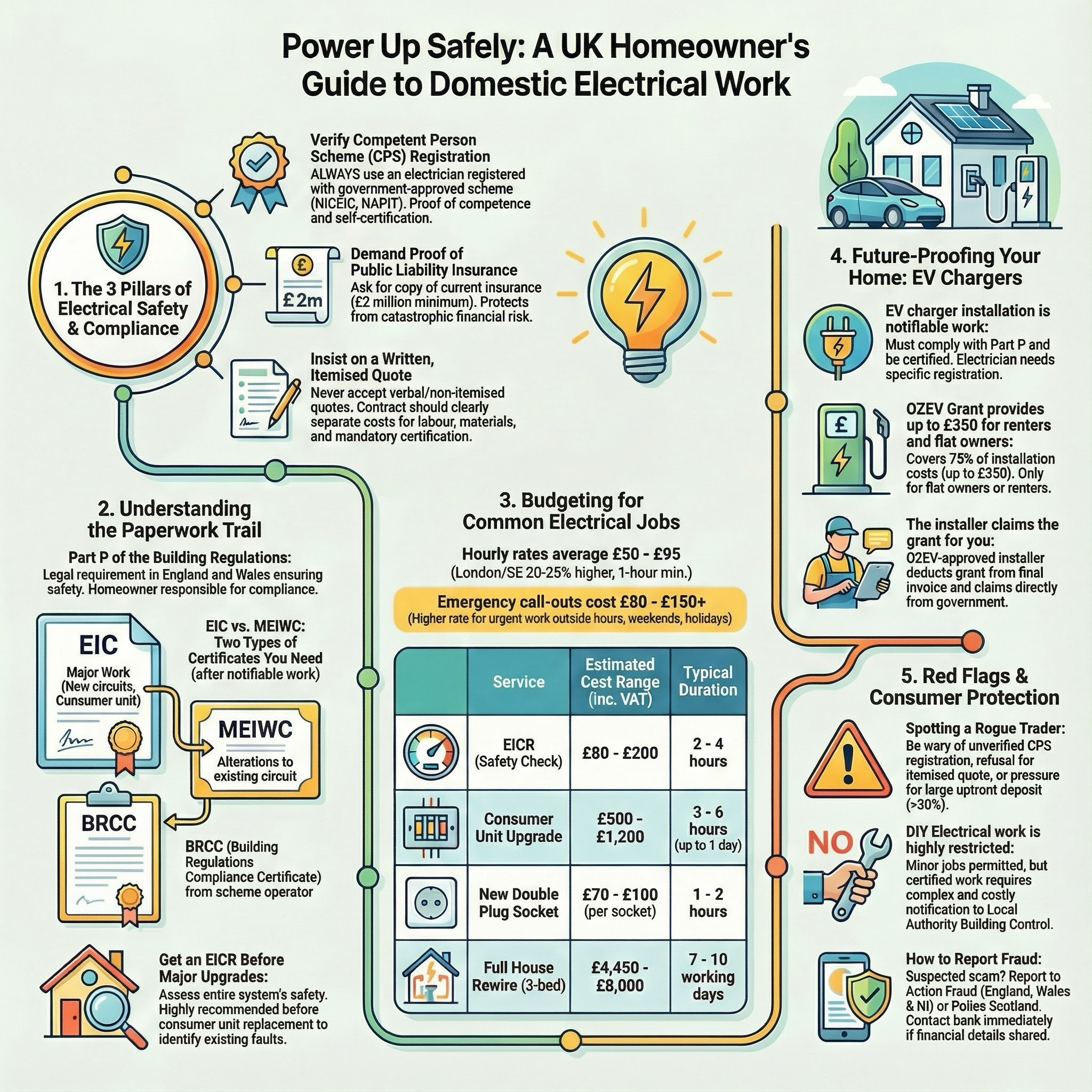
Part P electrical work must be certified by a registered electrician. NICEIC and NAPIT are the two big ones — verify online before they start.
Any new circuit or consumer unit change needs an Electrical Installation Certificate (EIC). Without it, you can't sell the house cleanly.
An Electrical Installation Condition Report on a house you're buying flags hidden rewire jobs. A C1 or C2 finding is a £2k–£8k negotiation lever.
Honest electricians lift a few floorboards before quoting a rewire. Anyone quoting a flat rate over the phone is guessing.
Indicative UK ranges and what affects price.
By job type
Quote spread is typically ± 18% — always get 3 quotes.
Electrician quick-view
Electrician explained
Lighting work in a UK home — installing new fittings, replacing pendants with downlights, adding circuits to a kitchen island, or wiring smart switches — typically costs £60–£250 per light point, depending on whether it's a like-for-like swap, a new tap-off the existing circuit, or a new circuit run from the consumer unit.
Like-for-like replacements (changing a pendant to a different pendant) are the cheapest. Adding a new light position to an existing room means chasing cables, channelling plaster and patching back — that's where the cost climbs.
| Job | Typical price |
|---|---|
| Like-for-like pendant swap | £40–£90 per fitting |
| New downlight (in existing void) | £60–£120 per fitting |
| New downlight (cutting/coring ceiling) | £90–£180 per fitting |
| New light point — chase + patch | £150–£280 per fitting |
| Smart switch / dimmer (replace existing) | £60–£140 per switch |
| Wired LED strip (kitchen plinth or shelf) | £180–£450 per run |
| Outdoor / garden light point | £140–£320 per fitting |
| New lighting circuit (e.g. for extension) | £250–£500 + per-fitting cost |
Most lighting work in 2026 specifies LED fittings. Things to get right:
Like-for-like swap of a pendant or wall light: yes, if you're confident with electrics, isolate the circuit at the consumer unit and follow standard practice. New circuits, new positions, or anything in special locations (bathrooms, kitchens, gardens) is notifiable under Part P and should be done by a registered electrician.
Rule of thumb: one downlight per square metre of room area for general lighting, more if it's a task area (kitchen worktop, desk). A 4×5 m living room typically needs 6–8 downlights spaced evenly. Use a layout plan rather than guessing.
For any new circuit, consumer unit replacement, or work in special locations (bathroom, kitchen, garden), yes — Part P notification is required and the electrician issues a Building Regulations Compliance Certificate. Like-for-like replacements outside special locations don't need certification.
Almost always a leading-edge dimmer (designed for incandescent or halogen) trying to dim LEDs. Replace with a trailing-edge or LED-compatible dimmer (£15–£30) and the flicker stops. Some cheap LEDs simply aren't dimmable; check the spec.
Often yes, if cables can be threaded through the existing ceiling void. The electrician fishes cables between joists. If not — typically ground floor with a void above, or where joists run wrong way — partial floor lifting may be needed.
Fire-rated fittings have intumescent material that expands in heat, sealing the cut hole and maintaining ceiling compartmentation. Required where the ceiling forms a fire boundary (between flats, under loft conversions). Non-fire-rated fittings cost less but are only legal where compartmentation isn't a requirement.
Want a local pro to handle this? A Part P registered electrician will plan the layout, choose the right fittings for each location, and certify the work. Don't skimp on lighting design — it's the single biggest determinant of how a finished room feels.
This guide was written with AI assistance and is intended for general information only. Prices are estimates based on UK averages and may vary by region. Always get at least three quotes and consult a qualified professional before starting any work.
Ask follow-ups in plain English. The AI explains options, sequencing and what to ask the electrician — so you walk in informed.
What Is Emergency Lighting? Emergency lighting is a safety system designed to illuminate escape routes, exits, and high-risk areas when the normal mains power f...
READ GUIDE →GuideA full house rewire or a consumer unit (fuse box) upgrade is one of the most critical safety investments a UK homeowner can make. As our reliance on electrical ...
READ GUIDE →GuideWhile many floor lamps are marketed as simple flat-pack items, high-end designer models, heavy arched lamps, and vintage restorations often require professional...
READ GUIDE →GuideGeneral electrical work encompasses everything from minor repairs and socket additions to installing new circuits for home improvements. For UK homeowners, ensu...
READ GUIDE →GuideElectric boilers are an increasingly popular choice for UK homeowners, particularly in modern flats or properties without a mains gas connection. While they are...
READ GUIDE →GuideReplacing a bathroom light switch is a common home improvement task that balances aesthetics with vital safety requirements. Given the high levels of moisture a...
READ GUIDE →