Instant
01 · Ask
Ask the AI a follow-up
Got more questions about concrete Soffit Replacement? Describe the bit you're unsure about — the AI explains options, sequencing and what to ask the fascia & soffits.

Old concrete or asbestos soffits stripped (where licensed) and replaced with uPVC or aluminium.
You've read the brief on concrete Soffit Replacement. Now lean on us to find the right fascia & soffits — and stay in control of the job.
Got more questions about concrete Soffit Replacement? Describe the bit you're unsure about — the AI explains options, sequencing and what to ask the fascia & soffits.
Costs, timelines, pitfalls and the right questions to ask before any fascia & soffits starts on concrete Soffit Replacement.
Itemised quotes from up to 3 local fascia & soffitss on concrete Soffit Replacement — so you can compare like-for-like, not lump sums.
Ready when you are
Enter your postcode and get free quotes from local pros.
Four moves that separate a smooth job from a nightmare.
Brown streaks appearing on the concrete indicate the internal steel is rusting and expanding.
Using standard mortar instead of specialist repair compounds leads to the patch falling out within 12-24 months.
Painting over damp concrete can cause the new finish to bubble and peel almost immediately.
Failing to use a proper bonding agent (like SBR) results in a "cold joint" where the new and old concrete meet, leading to cracks.
Indicative UK ranges and what affects price.
By job type
Quote spread is typically ± 18% — always get 3 quotes.
Fascia & Soffits quick-view
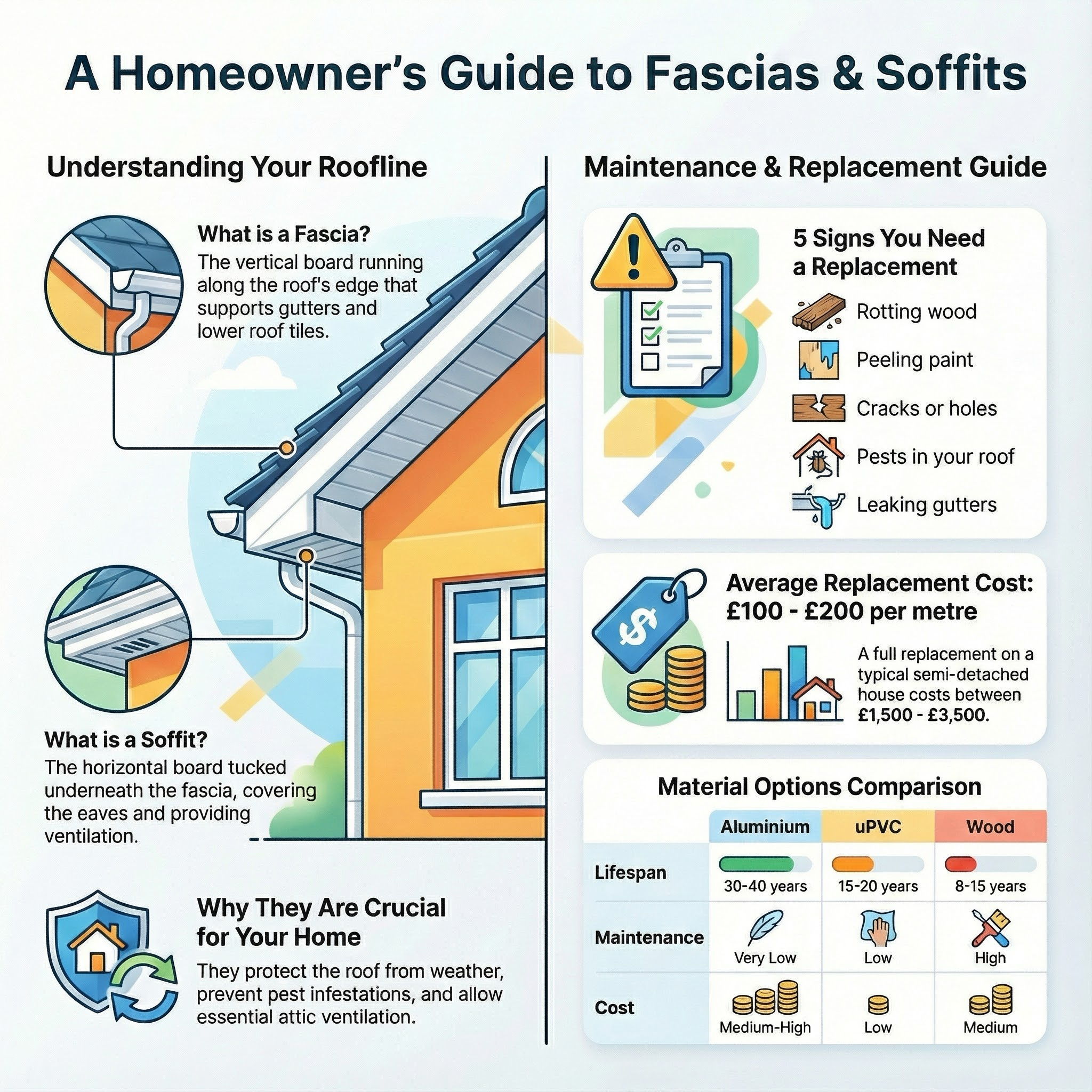
Fascia & Soffits explained
Replacing or repairing these sections is a specialist task that ensures the structural integrity of your roofline and protects the building's fabric. Addressing these issues early prevents further damage to the underlying steel reinforcement and avoids more costly structural repairs in the future.
The cost of concrete soffit work is heavily influenced by the height of the building and the extent of the "blown" areas. Scaffolding often represents a significant portion of the total invoice for safety reasons.
| Item | Low £ | High £ | Notes |
|---|---|---|---|
| Survey & Assessment | £150 | £300 | Includes structural check and report. |
| Scaffolding (per side) | £450 | £900 | Essential for safe working at height. |
| Patch Repair (per m) | £120 | £250 | Includes rebar treatment and mortar. |
| Full Section Replacement | £800 | £1,500 | Per 3-metre section including formwork. |
| Protective Coating/Painting | £20 | £40 | Per linear metre for specialist masonry paint. |
Prices include VAT and are based on 2025/26 UK averages. Factors such as the severity of reinforcement corrosion and the ease of access to the roofline will dictate the final quote.
Concrete soffit replacement is strictly a professional task. The weight of concrete and the risks associated with working at height make this unsuitable for DIYers.
Structural concrete repairs require specific knowledge of carbonation and reinforcement protection; incorrect repairs can actually accelerate "concrete cancer" by trapping moisture.
Professional tradespeople will ensure that the repair is chemically compatible with the original structure and that all safety regulations, including the Work at Height Regulations 2005, are strictly followed.
This is usually caused by carbonation, where CO2 from the air penetrates the concrete and lowers its pH. This causes the internal steel reinforcement to rust, expand, and crack the concrete from the inside out (spalling).
This is highly discouraged if the concrete is already crumbling. Capping over "concrete cancer" hides the problem while the structural integrity continues to decline, potentially leading to heavy debris falling behind the plastic cladding.
Solid poured concrete rarely contains asbestos, but "asbestos cement" boards were very common. If your soffit is a thin board rather than a thick, solid slab, you must have it tested before any work begins.
For minor surface repairs, a specialist contractor is usually sufficient. However, if large sections of the soffit are falling away or if the soffit is an integral part of a cantilevered balcony or roof, an engineer's report is recommended.
The cost is driven by the need for safe access (scaffolding) and the specialist materials required. The actual "concrete" is cheap, but the primers, bonding agents, and labour-intensive preparation are not.
This guide was written with AI assistance and is intended for general information only. Prices are estimates based on UK averages and may vary by region. Always get at least three quotes and consult a qualified professional before starting any work.
Ask follow-ups in plain English. The AI explains options, sequencing and what to ask the fascia & soffits — so you walk in informed.
Finlock gutters were a popular architectural choice for UK homes built between the 1950s and 1970s. These heavy, precast concrete blocks were designed to serve ...
READ GUIDE →GuideMaintaining the exterior woodwork of your UK home is about more than just kerb appeal. In our damp climate, timber fascias, soffits, and windowsills act as the ...
READ GUIDE →GuideSoffits are the horizontal boards tucked under your roof’s eaves, bridging the gap between the siding and the roofline. While often overlooked, they are critica...
READ GUIDE →GuideFascia boards are the unsung heroes of your home’s exterior, acting as the primary barrier between the British weather and your roof’s timber structure. These b...
READ GUIDE →GuideGuttering is your home's first line of defence against the British weather. While often overlooked, a functioning gutter system is essential for directing rainw...
READ GUIDE →GuideYour guttering system is the first line of defence against the British weather. In the UK, failing gutters can quickly lead to saturated masonry, internal damp,...
READ GUIDE →