Instant
01 · Ask
Repair, cap-over or full replace?
Localised damage, tired-looking timber or full rot? Describe what you see and the AI tells you the right scope.

uPVC fascia, soffits, cladding and bargeboards — scaffolded, sealed and vented properly.
Read the brief on ventilation, cap-over vs replace and guarantees — then let Three local specialists quote.
Localised damage, tired-looking timber or full rot? Describe what you see and the AI tells you the right scope.
Ventilation rules, vent sizes, cap-over pitfalls, scaffold vs ladder, sub-fascia condition. Know what to ask.
Three local specialists quote on the same spec — material, ventilation, guarantee — so the cheapest isn't the airtight loft.
Ready when you are
Enter your postcode and get free quotes from local pros.
Four moves that separate a smooth job from a nightmare.
Without ventilation in the soffit, loft moisture has nowhere to go — and the timbers rot. Insist on continuous-vent or circle-vent soffits.
Doing them separately costs twice. Anything blown, bowed or peeling now will fail the same way the rest is failing — replace as a set.
Quality uPVC fascia comes with manufacturer guarantees of 10–20 years. Quotes without this paperwork are cutting corners somewhere.
Rotten timber bargeboards or felt support pieces must be replaced before new fascia goes on. A reputable installer photographs and quotes for this — cowboys cover it up.
Indicative UK ranges and what affects price.
By job type
Quote spread is typically ± 18% — always get 3 quotes.
Visual breakdown of costs, timelines and the questions you should be asking.
Fascia & Soffits quick-view
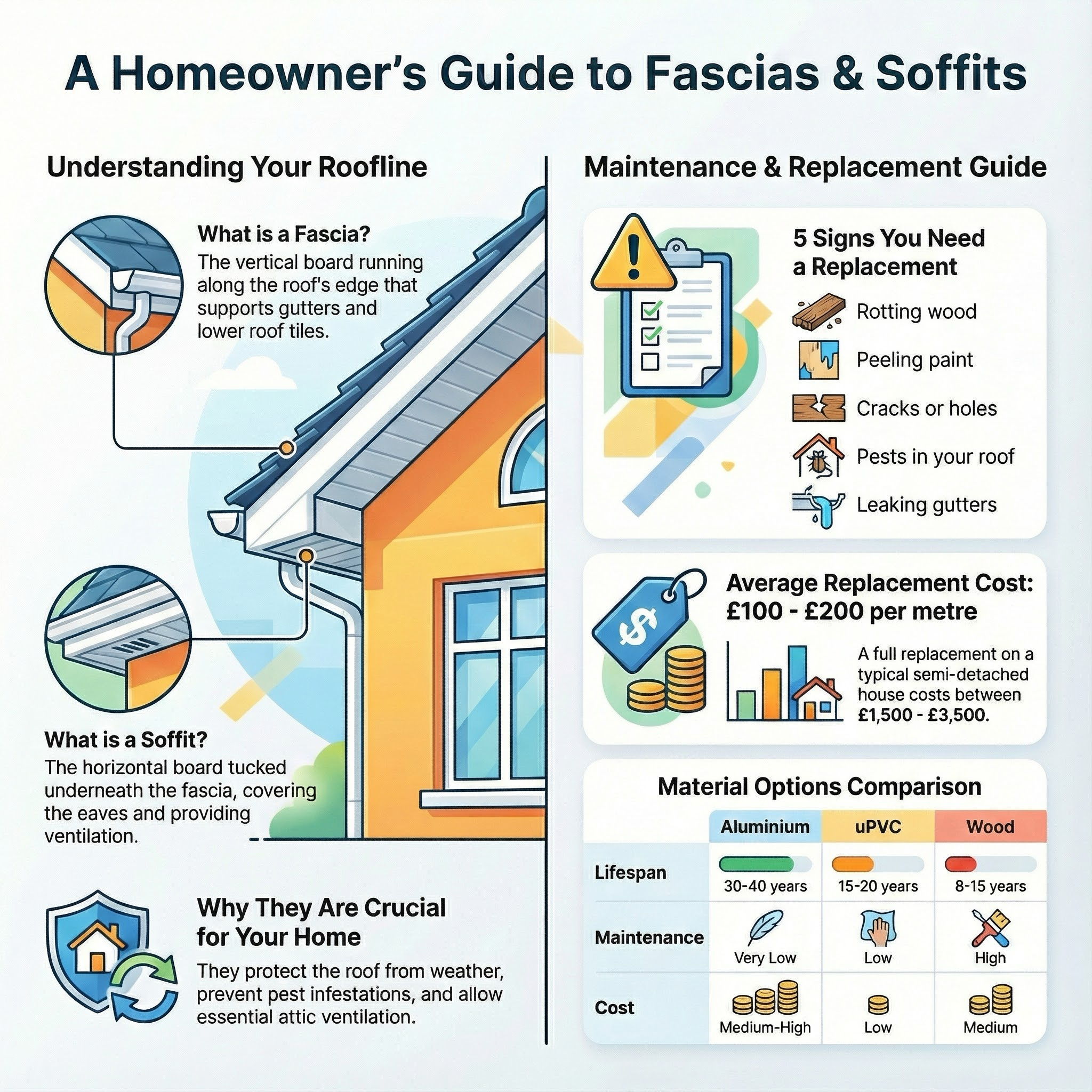
Fascia & Soffits explained
Everything you need to know before hiring a fascia & soffits.
Fascia and soffit specialists are the experts responsible for protecting your home’s roofline. These components serve as the vital barrier between your roof rafters and the unpredictable UK weather, preventing rainwater from entering the eaves and causing structural rot. Beyond protection, they provide the necessary support for your guttering system and ensure your loft remains ventilated to prevent condensation and mould.
Most modern homeowners opt for high-quality uPVC installations, but these tradespeople also work with traditional timber, aluminium, and composite materials. Whether you are dealing with peeling paint on old wooden boards or looking to upgrade to a maintenance-free plastic system, a roofline specialist ensures the job is done safely at height and to a standard that protects your property for decades.
A professional fascia and soffit installer doesn't just "cover up" problems. They inspect the underlying rafter feet for rot, replace damaged timber, and install integrated ventilation strips. Their work also includes fitting bargeboards on gable ends and decorative cladding to refresh the aesthetic appeal of your home.
When you hire a specialist for a roofline overhaul, the process typically follows a structured path to ensure a long-lasting, watertight finish. Here is what you can expect during a standard project:
While some homeowners consider roofline work a DIY task, it is one of the most physically demanding and high-risk jobs in home improvement. Working at height requires specialist equipment and a firm understanding of the Work at Height Regulations 2005. A professional installer has the correct towers or scaffolding to ensure the job is completed safely and legally.
The biggest risk of a non-professional installation is "capping." Unscrupulous or inexperienced contractors may suggest nailing new uPVC boards directly over old, rotting timber. This traps moisture, accelerates the rot in your roof structure, and can lead to the entire roofline collapsing under the weight of heavy snow or rain. A professional will insist on a full replacement if the underlying wood is compromised.
Furthermore, professionals understand the importance of ventilation. Modern building regulations require specific airflow levels to prevent timber decay in your loft. A specialist will install hidden vents or vented soffits that meet these standards without compromising the look of your home.
The cost of fascia and soffit work depends largely on the size of your property, the materials chosen (uPVC vs timber or aluminium), and the complexity of the access required. Below are realistic 2025/26 price estimates for UK homeowners.
| Service | Low £ | High £ | Notes |
|---|---|---|---|
| Full Replacement (per linear metre) | £100 | £160 | Includes removal of old timber and new uPVC. |
| Guttering Replacement (per linear metre) | £35 | £60 | Standard uPVC half-round or square. |
| Bargeboard Replacement (per gable) | £450 | £850 | Depends on height and decorative detail. |
| uPVC Cladding (per m²) | £75 | £130 | Includes insulation and battening. |
| Scaffolding Hire (Small Semi) | £400 | £900 | Essential for safety and access. |
Prices are influenced by the colour of the materials; standard white uPVC is the most affordable, while woodgrain effects (like Rosewood or Anthracite Grey) typically carry a 15-25% premium. Always ensure your quote includes the cost of waste disposal, as old timber and plastic can be bulky to remove.
Choosing the right installer is the difference between a roofline that lasts 30 years and one that fails in five. Follow these steps to find a reputable tradesperson:
Questions to ask before hiring:
High-quality uPVC roofline products are designed to last between 20 and 30 years. Unlike timber, they do not require painting and will not rot or warp. Most reputable manufacturers offer a 10-20 year guarantee against discolouration (yellowing) on white boards.
If the wood is soft to the touch or showing signs of "wet rot," replacement is the only permanent solution. Patching up rotten timber with filler or capping it with plastic only hides the problem while the rot spreads to your rafters, which are much more expensive to fix.
Yes. While white is the most common, uPVC is now available in a wide range of colours including Anthracite Grey, Black Ash, and Chartwell Green. You can also choose wood-effect finishes that mimic the look of oak or mahogany without the maintenance requirements of real wood.
In most cases, yes. Health and Safety regulations require a safe working platform for tasks that take a significant amount of time at height. While some bungalows can be done from ladders or Easi-Dec systems, most two-storey homes will require at least partial scaffolding to ensure a professional and safe finish.
Describe the job in plain English. The AI asks a few smart questions, then tells you whether a fascia & soffits is the right call, what it should cost, and what to ask before they start.
Maintaining the exterior woodwork of your UK home is about more than just kerb appeal. In our damp climate, timber fascias, soffits, and windowsills act as the ...
READ GUIDE →GuideYour fascia boards do more than just provide a neat finish to your roofline; they are a critical structural component that supports your guttering and protects ...
READ GUIDE →GuideFascia boards are the unsung heroes of your home’s exterior, acting as the primary barrier between the British weather and your roof’s timber structure. These b...
READ GUIDE →GuideFascias, soffits, and guttering—collectively known as the roofline—are your home’s first line of defence against the British weather. While often overlooked, th...
READ GUIDE →Finlock gutters were a popular architectural choice for UK homes built between the 1950s and 1970s. These heavy, precast concrete blocks were designed to serve ...
READ GUIDE →GuideYour guttering system is the first line of defence against the British weather. In the UK, failing gutters can quickly lead to saturated masonry, internal damp,...
READ GUIDE →GuideMaintaining your home’s exterior is a two-fold battle against the British weather. While guttering protects your foundations and walls from water damage, sturdy...
READ GUIDE →Concrete gutters, commonly known as Finlock gutters , were a popular architectural choice in the UK between the 1950s and 1970s. Unlike modern uPVC systems, the...
READ GUIDE →GuideConcrete soffits are a common feature in UK homes built between the 1930s and 1970s, particularly in social housing and modernist-style private builds. While in...
READ GUIDE →GuideGutter maintenance is a vital yet often overlooked task for UK homeowners. Given our frequent rainfall and the prevalence of moss-heavy roof tiles, a blocked dr...
READ GUIDE →