Instant
01 · Ask
Ask the AI a follow-up
Got more questions about garage Shelving Installation? Describe the bit you're unsure about — the AI explains options, sequencing and what to ask the handyman.

Heavy-duty garage shelving — wall-fixed metal or wood, with proper load capacity per shelf.
You've read the brief on garage Shelving Installation. Now lean on us to find the right handyman — and stay in control of the job.
Got more questions about garage Shelving Installation? Describe the bit you're unsure about — the AI explains options, sequencing and what to ask the handyman.
Costs, timelines, pitfalls and the right questions to ask before any handyman starts on garage Shelving Installation.
Itemised quotes from up to 3 local handymans on garage Shelving Installation — so you can compare like-for-like, not lump sums.
Ready when you are
Enter your postcode and get free quotes from local pros.
Four moves that separate a smooth job from a nightmare.
Homeowners often underestimate the weight of boxes; professionals will calculate the "load per shelf" to prevent bowing.
Fixing timber directly against a single-skin brick wall can lead to rot; a pro will use spacers or treated battens.
Shelving often accidentally blocks access to stopcocks, gas meters, or consumer units.
Using standard "red plugs" in old, crumbly mortar or thermalite blocks, leading to the shelf pulling away from the wall.
Indicative UK ranges and what affects price.
By job type
Quote spread is typically ± 18% — always get 3 quotes.
Handyman quick-view
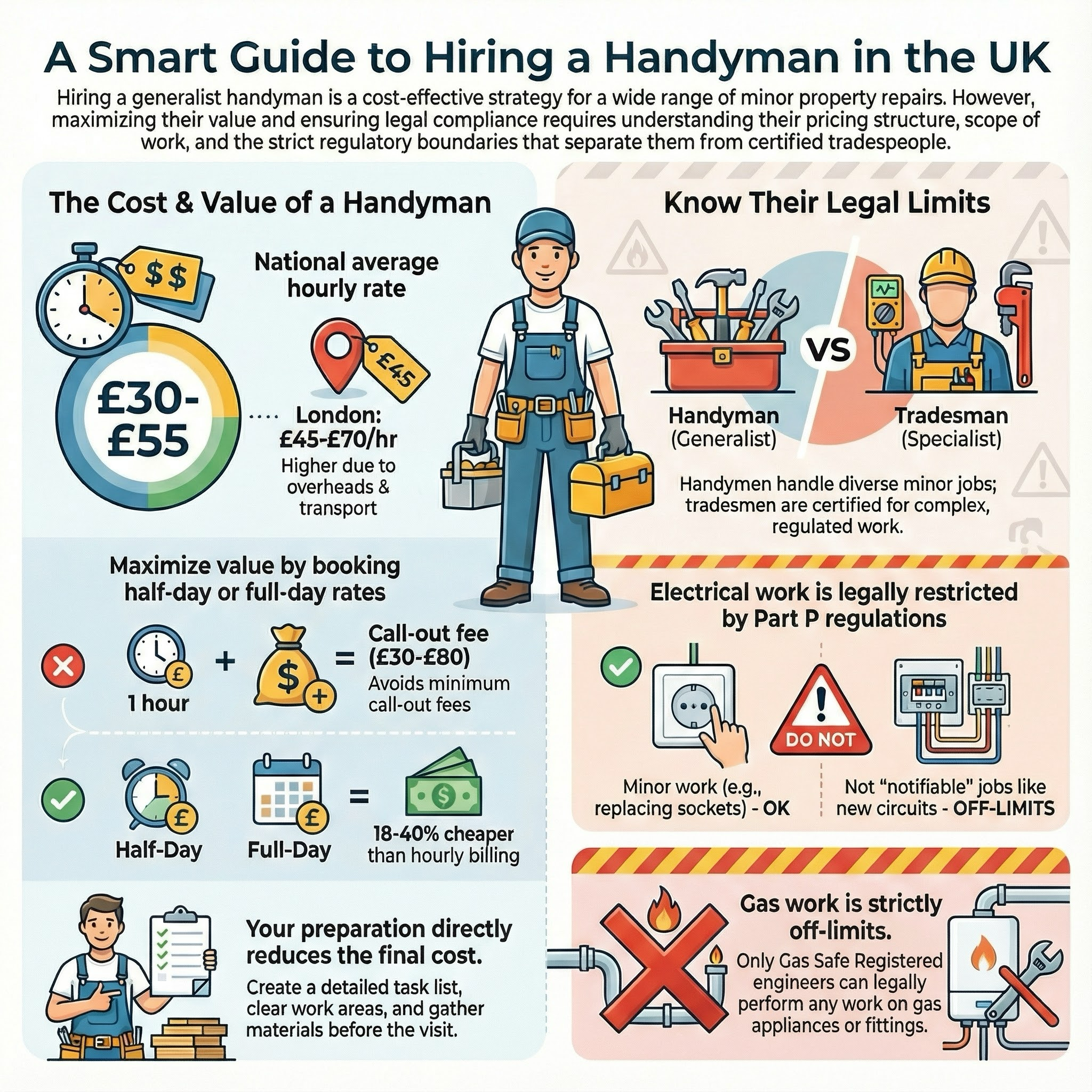
Handyman explained
Whether you are installing heavy-duty industrial racking or custom timber shelving, getting the fixings right is essential. A poorly installed shelf in a garage isn't just an eyesore; it is a significant safety hazard that can damage your vehicle or cause injury.
| Item | Low £ | High £ | Notes |
|---|---|---|---|
| Handyman Labour (Hourly) | £35 | £60 | Regional variations apply (higher in London/SE). |
| Flat-pack Racking Assembly | £80 | £150 | Labour only for 2-3 standard metal units. |
| Custom Timber Shelving (Full Wall) | £400 | £850 | Includes materials and bespoke joinery labour. |
| Wall-Mounted Twin Slot System | £150 | £300 | Adjustable metal brackets and melamine boards. |
| Heavy-Duty Floor Anchoring | £40 | £70 | Additional safety fixings for tall racking. |
Prices vary based on the "linear meter" of shelving required and the substrate of your walls. Custom-built timber solutions usually cost more in materials and labour but offer better weight distribution and fit for awkward spaces.
Assembling a basic plastic shelf unit is a straightforward DIY task. However, wall-mounted storage requires professional expertise, particularly in UK garages where walls are often damp-prone masonry or thin breeze blocks.
A handyman ensures the correct wall anchors are used; using the wrong plug in a breeze block wall can lead to the entire system collapsing under load.
If your shelving plan involves moving plug sockets or installing integrated lighting, you must hire a professional who complies with Part P Building Regulations for electrical safety.
Standard metal racking usually supports 150kg–250kg per shelf, while heavy-duty industrial units can hold up to 500kg. Wall-mounted timber shelves depend entirely on the quality of the wall fixings and the spacing of the brackets.
Yes. To keep labour costs down, ensure there is at least a 2-metre working clearance around the walls where the shelving will be installed. If the handyman has to move your items, they will likely charge their hourly rate for the extra time.
Metal is best for heavy car parts, tools, and damp environments as it won't warp. Wood (specifically treated timber) is better for custom, wall-to-wall solutions and provides a more "finished" look for hobbyist workshops.
Yes, but it requires specific masonry bolts or shield anchors. It is also vital to ensure the drilling doesn't compromise the external pointing or cause moisture to bridge into the garage.
Shelving can be built around these items, but you must maintain specific clearances for ventilation and future maintenance access. A professional handyman will ensure your boiler remains "serviceable" according to Gas Safe standards.
This guide was written with AI assistance and is intended for general information only. Prices are estimates based on UK averages and may vary by region. Always get at least three quotes and consult a qualified professional before starting any work.
Ask follow-ups in plain English. The AI explains options, sequencing and what to ask the handyman — so you walk in informed.
An emergency roof repair is often the only thing standing between a minor leak and a catastrophic repair bill. In the UK, where driving rain and high winds are ...
READ GUIDE →GuideLuggage Repair Guide Scope of Works Assess damage & quote – check zip, wheels, handle, shell cracks; photograph for records. Strip & clean component are...
READ GUIDE →GuideSofa Assembly Service Guide Scope of Works Check delivery note, photograph boxes and inspect for transit damage . Protect floors, then move boxed sofa to the as...
READ GUIDE →GuideWardrobe Assembly Costs Scope of Works Arrival & parts check – count panels, fixings and ensure no transit damage before work starts. Room protection & ...
READ GUIDE →GuideCustom kitchen shelving has become a staple of modern UK home design. Whether you are looking to create an open-plan feel with oak "floating" shelves or need he...
READ GUIDE →GuideSetting up a professional workspace requires more than just a screwdriver and some patience. Commercial-grade furniture is often heavier, more complex, and subj...
READ GUIDE →