Instant
01 · Ask
Ask the AI a follow-up
Got more questions about wall-Mounted Shelf Installation? Describe the bit you're unsure about — the AI explains options, sequencing and what to ask the handyman.

Floating or bracket shelving — measured, levelled and anchored to load-bearing fixings.
You've read the brief on wall-Mounted Shelf Installation. Now lean on us to find the right handyman — and stay in control of the job.
Got more questions about wall-Mounted Shelf Installation? Describe the bit you're unsure about — the AI explains options, sequencing and what to ask the handyman.
Costs, timelines, pitfalls and the right questions to ask before any handyman starts on wall-Mounted Shelf Installation.
Itemised quotes from up to 3 local handymans on wall-Mounted Shelf Installation — so you can compare like-for-like, not lump sums.
Ready when you are
Enter your postcode and get free quotes from local pros.
Four moves that separate a smooth job from a nightmare.
Caused by using brackets that are too small or spaced too far apart for the weight of the board.
A major hazard in UK homes; drilling into a cable can be expensive to repair and dangerous.
Using a hammer-action drill on old lime plaster can cause large chunks to fall away; a professional will use a masonry bit without hammer action first.
Even a 2mm error can look significant across a long shelf; professionals use long levels or lasers to prevent this.
Indicative UK ranges and what affects price.
By job type
Quote spread is typically ± 18% — always get 3 quotes.
Handyman quick-view
Handyman explained
A professional handyman ensures your shelves are perfectly level and, more importantly, securely anchored to withstand the weight of books, kitchenware, or ornaments. Incorrect installation doesn't just look poor; it poses a genuine safety risk if the shelf collapses or damages hidden utility lines.
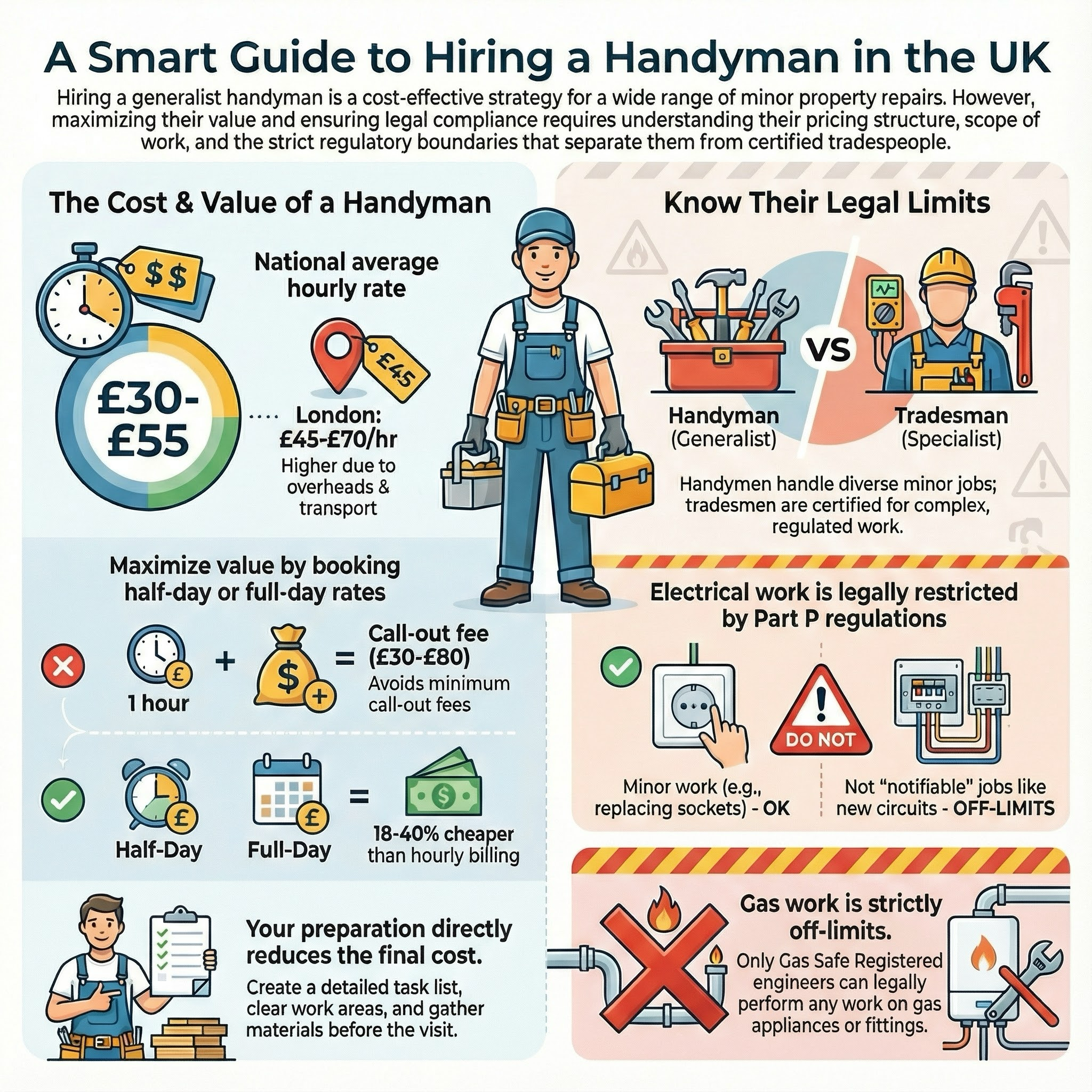
Prices for shelf installation usually depend on the number of shelves, the wall material, and whether the handyman charges a flat fee or an hourly rate. Most UK handymen have a minimum call-out charge to cover travel and setup.
| Item | Low £ | High £ | Notes |
|---|---|---|---|
| Minimum Call-out Fee | £50 | £90 | Covers the first hour or travel. |
| Labour (per hour) | £35 | £65 | Standard rate for subsequent hours. |
| Standard Shelf (Set of 2-3) | £80 | £150 | Excludes the cost of the shelves. |
| Floating Shelf (Heavy Duty) | £60 | £120 | Per shelf; more complex to align. |
| Specialist Fixings | £5 | £20 | High-weight plasterboard anchors. |
Cost factors include your location (London and the South East typically see a 20-30% premium) and the complexity of the wall. Solid brick walls are generally more straightforward for heavy loads than modern dry-lined (dot and dab) walls.
While putting up a small picture ledge is a common DIY task, larger or heavier installations often require a professional. The primary risk in UK homes is drilling into a vertical or horizontal "zone" where electrical cables run between sockets and switches.
Professional handymen carry public liability insurance and use high-end detectors to ensure your walls remain intact and your shelves stay on the wall.
If you are dealing with plasterboard (hollow) walls, a professional will know exactly which anchors to use to prevent the "pull-out" effect that ruins the wall surface. If the shelf is intended for heavy books or kitchen appliances, professional installation is highly recommended.
While shelf installation isn't governed by specific building permits, there are critical safety standards to follow:
Yes, but you must use specialist fixings like toggle bolts, metal spiral anchors, or Gripit fixings. For very heavy loads, the brackets should be screwed directly into the vertical timber studs behind the plasterboard.
Standard floating shelves usually hold between 5kg and 15kg depending on the wall type. Shelves fixed into solid masonry can hold significantly more than those fixed into hollow plasterboard.
Most professional handymen use a vacuum attachment or a dust collector while drilling to catch masonry dust before it hits your floor or furniture.
This is where plasterboard is stuck to a brick wall with dabs of adhesive, leaving a small gap. These require "Rigifix" or "Corefix" anchors that bridge the gap to ensure the shelf is supported by the solid wall behind, not just the board.
Most handymen carry a variety of professional-grade fixings and will include them in the service. However, it is always best to confirm this when booking.
Standard eye level is approximately 1.5 metres (5 feet), but for kitchen shelves, they are often placed 45cm to 50cm above the worktop. Your handyman can hold the shelf in place for you to "eye-ball" the position before drilling.
This guide was written with AI assistance and is intended for general information only. Prices are estimates based on UK averages and may vary by region. Always get at least three quotes and consult a qualified professional before starting any work.
Ask follow-ups in plain English. The AI explains options, sequencing and what to ask the handyman — so you walk in informed.
An emergency roof repair is often the only thing standing between a minor leak and a catastrophic repair bill. In the UK, where driving rain and high winds are ...
READ GUIDE →GuideLuggage Repair Guide Scope of Works Assess damage & quote – check zip, wheels, handle, shell cracks; photograph for records. Strip & clean component are...
READ GUIDE →GuideSofa Assembly Service Guide Scope of Works Check delivery note, photograph boxes and inspect for transit damage . Protect floors, then move boxed sofa to the as...
READ GUIDE →GuideWardrobe Assembly Costs Scope of Works Arrival & parts check – count panels, fixings and ensure no transit damage before work starts. Room protection & ...
READ GUIDE →GuideCustom kitchen shelving has become a staple of modern UK home design. Whether you are looking to create an open-plan feel with oak "floating" shelves or need he...
READ GUIDE →GuideSetting up a professional workspace requires more than just a screwdriver and some patience. Commercial-grade furniture is often heavier, more complex, and subj...
READ GUIDE →