Instant
01 · Ask
Ask the AI a follow-up
Got more questions about hard Landscaping Project? Describe the bit you're unsure about — the AI explains options, sequencing and what to ask the landscaper.

Paving, walls, decking, steps and drives — what each costs in 2026 and how a hard-landscape project actually runs.
You've read the brief on hard Landscaping Project. Now lean on us to find the right landscaper — and stay in control of the job.
Got more questions about hard Landscaping Project? Describe the bit you're unsure about — the AI explains options, sequencing and what to ask the landscaper.
Costs, timelines, pitfalls and the right questions to ask before any landscaper starts on hard Landscaping Project.
Itemised quotes from up to 3 local landscapers on hard Landscaping Project — so you can compare like-for-like, not lump sums.
Ready when you are
Enter your postcode and get free quotes from local pros.
Four moves that separate a smooth job from a nightmare.
Using too little MOT Type 1 or failing to compact it properly leads to "dipping" and loose pavers.
Paving laid flat or sloping toward the house causes puddles and potential damp issues in the brickwork.
Placing mortar only in the corners of slabs creates voids where water collects, causing slabs to rock or crack in frost.
White salty deposits appearing on new brick or stone; usually temporary but can be minimised with correct material storage.
Indicative UK ranges and a typical week-by-week schedule.
By job type
Quote spread is typically ± 18% — always get 3 quotes.
Mid-size garden redesign · week by week
Schedule slips on dependencies — pad each phase by 10–20% for real-world delays.
Landscaper quick-view
Landscaper explained
Hard landscaping provides the structural "bones" of your garden, transforming an overgrown or uneven plot into a functional outdoor living space. Whether it’s a natural stone patio, a sleek porcelain terrace, or a structural retaining wall, these permanent features define the layout and flow of your property. In the UK’s damp climate, professional hard landscaping is about more than just aesthetics; it is essential for managing surface water and ensuring the longevity of your garden. Investing in quality materials and correct installation prevents issues like sinking pavers, cracked walls, and waterlogged lawns. <h2>What Does the Work Involve?</h2> <ul> <li><strong>Site Survey and Design:</strong> Assessing levels, soil type, and drainage requirements to ensure the structure is sound.</li> <li><strong>Excavation and Clearance:</strong> Removing existing turf, old paving, and soil to the required depth (usually 150mm–200mm for patios).</li> <li><strong>Sub-base Installation:</strong> Laying and compacting MOT Type 1 crushed stone to create a stable, load-bearing foundation.</li> <li><strong>Drainage Integration:</strong> Installing soakaways, linear drains (Aco drains), or ensuring specific falls to move water away from buildings.</li> <li><strong>Edge Restraints:</strong> Setting haunched concrete or timber edges to prevent the finished surface from spreading or shifting.</li> <li><strong>Laying and Pointing:</strong> Bedding the chosen material (stone, brick, or porcelain) on a full mortar bed and finishing joints with resin or mortar.</li> </ul> <h2>Typical Costs</h2> <p>Prices for hard landscaping vary significantly based on material choice and site access. The following 2025/26 estimates include VAT and professional installation.</p> <table> <thead> <tr> <th>Item</th> <th>Low £</th> <th>High £</th> <th>Notes</th> </tr> </thead> <tbody> <tr> <td>Indian Sandstone Patio (per m²)</td> <td>£120</td> <td>£180</td> <td>Includes sub-base and labour.</td> </tr> <tr> <td>Porcelain Paving (per m²)</td> <td>£160</td> <td>£250</td> <td>Higher material cost and precision cutting.</td> </tr> <tr> <td>Block Paving Driveway (per m²)</td> <td>£90</td> <td>£140</td> <td>Requires deeper sub-base for vehicles.</td> </tr> <tr> <td>Brick Retaining Wall (per m²)</td> <td>£250</td> <td>£450</td> <td>Price depends on height and reinforcement.</td> </tr> <tr> <td>Waste Removal (6-yard skip)</td> <td>£280</td> <td>£400</td> <td>Varies by region and soil weight.</td> </tr> <tr> <td>Day Rate (Per Landscaper)</td> <td>£200</td> <td>£350</td> <td>Usually works in teams of two.</td> </tr> </tbody> </table> <p>Factors affecting the final bill include "muck-away" costs (the price of disposing of excavated soil), the complexity of the laying pattern, and whether the site requires manual handling rather than machine access.</p> <h2>How Long Does It Take?</h2> <ul> <li><strong>Small Patio (15-20m²):</strong> 3–5 working days, depending on weather and site prep.</li> <li><strong>Standard Driveway:</strong> 5–7 working days from excavation to final sanding.</li> <li><strong>Full Garden Overhaul:</strong> 3–6 weeks for complex designs involving walls, steps, and multiple levels.</li> <li><strong>Retaining Walls:</strong> 2–4 days per 5-metre stretch, allowing for foundation curing.</li> </ul> <h2>DIY or Professional?</h2> <p>While laying a few stepping stones is a manageable DIY task, major hard landscaping is back-breaking work that requires precision engineering. If the sub-base is insufficient or the drainage "fall" is incorrect, the entire project will likely fail within two winters, leading to costly repairs.</p> <blockquote>Professional landscapers understand soil mechanics and local drainage regulations, ensuring your investment doesn't sink, crack, or cause damp issues in your home.</blockquote> <h2>Choosing the Right Tradesperson</h2> <p>Hard landscaping is a significant investment. Finding a contractor who understands structural integrity is more important than finding the cheapest quote.</p> <ul> <li><strong>Check Memberships:</strong> Look for members of the <strong>Association of Professional Landscapers (APL)</strong> or the <strong>British Association of Landscape Industries (BALI)</strong>.</li> <li><strong>Verify Insurance:</strong> Ensure they have valid Public Liability insurance (minimum £2 million).</li> <li><strong>Portfolio:</strong> Ask to see photos of work "in progress," not just finished shots, to see the quality of their foundations.</li> <li><strong>Ask:</strong> "How do you manage surface water drainage?"</li> <li><strong>Ask:</strong> "What depth of sub-base do you specify for this soil type?"</li> <li><strong>Ask:</strong> "Do you provide a guarantee against sinking or movement?"</li> </ul> <h2>UK Regulations</h2> <ul> <li><strong>SUDS (Sustainable Drainage Systems):</strong> Since 2008, driveways over 5m² must be permeable or drain to a rain garden/soakaway to avoid planning permission.</li> <li><strong>Planning Permission:</strong> Generally not needed for patios, but walls over 1 metre high next to a highway (or 2 metres elsewhere) usually require it.</li> <li><strong>Part M Access:</strong> If your project affects the main entrance to your home, it must remain accessible for people with disabilities.</li> <li><strong>Building Regs:</strong> Required if a retaining wall supports a structure or is over a certain height (check with your local authority).</li> </ul> <h2>Common Problems</h2> <ul> <li><strong>Poor Sub-base:</strong> Using too little MOT Type 1 or failing to compact it properly leads to "dipping" and loose pavers.</li> <li><strong>Incorrect Falls:</strong> Paving laid flat or sloping toward the house causes puddles and potential damp issues in the brickwork.</li> <li><strong>"Dot and Dab" Bedding:</strong> Placing mortar only in the corners of slabs creates voids where water collects, causing slabs to rock or crack in frost.</li> <li><strong>Efflorescence:</strong> White salty deposits appearing on new brick or stone; usually temporary but can be minimised with correct material storage.</li> </ul> <h2>Frequently Asked Questions</h2> <details> <summary>Do I need planning permission for a new patio?</summary> <div> <p>In most cases, no. Patios are considered "permitted development." However, if you live in a listed building or a conservation area, or if the patio is significantly raised (above 30cm), you should check with your local council.</p> </div> </details> <details> <summary>What is the best material for a low-maintenance garden?</summary> <div> <p>Porcelain paving is the gold standard for low maintenance. It is non-porous, meaning it resists algae growth, staining, and frost damage, requiring only an occasional wash with soapy water.</p> </div> </details> <details> <summary>Why is my new patio turning green?</summary> <div> <p>Natural stones like sandstone are porous and absorb water, allowing algae and lichen to grow. This is common in shaded or north-facing gardens. Regular cleaning or applying a professional-grade sealant can prevent this.</p> </div> </details> <details> <summary>Can I lay new paving over an existing concrete base?</summary> <div> <p>It is possible if the concrete is in perfect condition and has the correct drainage falls. However, it often raises the height too much, potentially bridging the Damp Proof Course (DPC) of your house. Most pros prefer to start from scratch.</p> </div> </details> <details> <summary>How long should I wait before walking on a new patio?</summary> <div> <p>You should generally wait 24 to 48 hours for the mortar and pointing to set. Avoid placing heavy garden furniture or planters on the surface for at least a week to ensure the bed is fully cured.</p> </div> </details>
This guide was written with AI assistance and is intended for general information only. Prices are estimates based on UK averages and may vary by region. Always get at least three quotes and consult a qualified professional before starting any work.
Ask follow-ups in plain English. The AI explains options, sequencing and what to ask the landscaper — so you walk in informed.
Professional garden design is the blueprint for a successful outdoor transformation. It bridges the gap between a vague idea and a functional, beautiful space t...
READ GUIDE →GuideA crisp, well-defined lawn edge is often the difference between a garden that looks "done" and one that looks truly professional. In the UK, our damp climate an...
READ GUIDE →GuideA level garden is the essential foundation for almost every outdoor improvement, from installing a new lawn or patio to erecting a summerhouse. Beyond aesthetic...
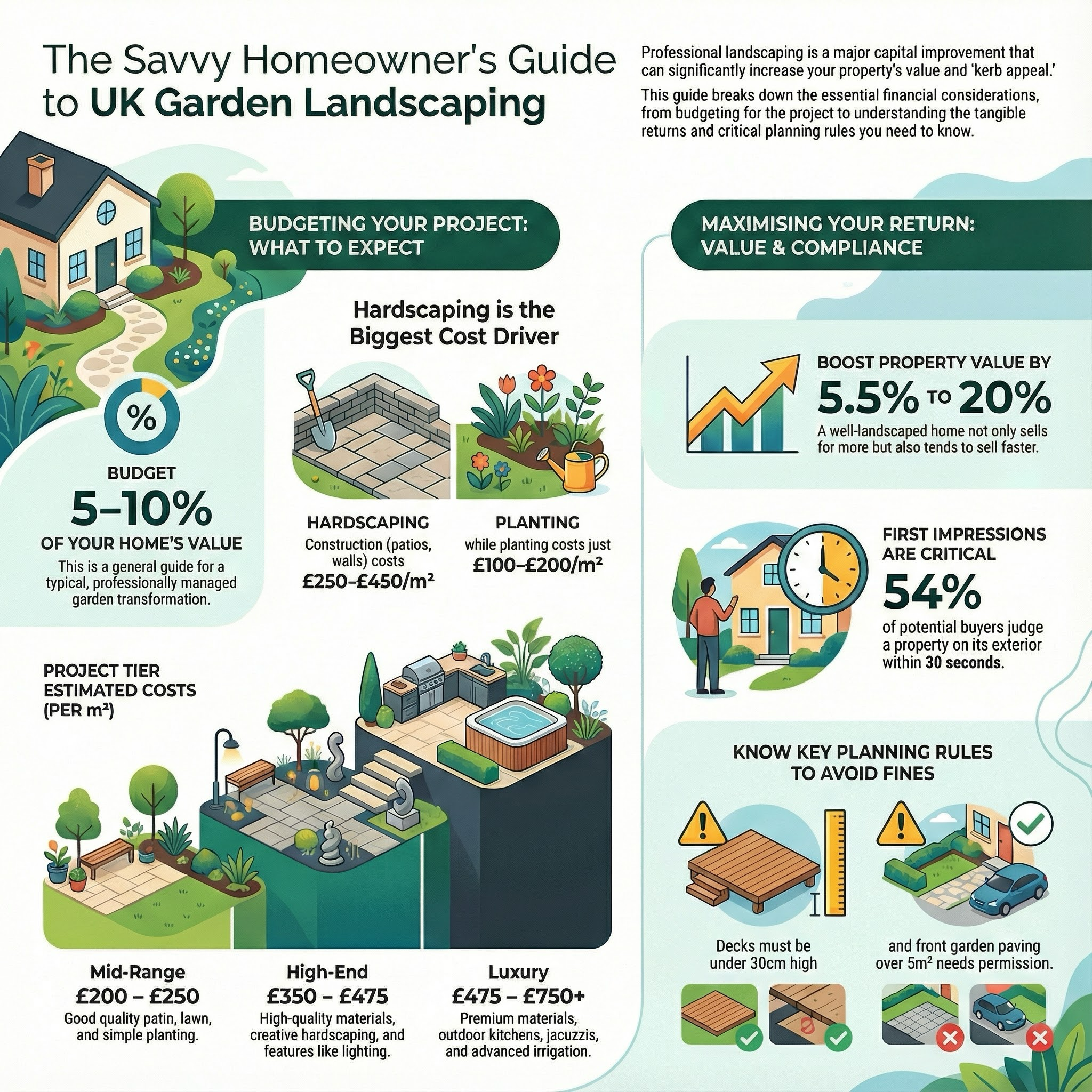
READ GUIDE →GuideProfessional landscaping is one of the most effective ways to increase your home’s kerb appeal and market value, often adding up to 20% to a UK property's price...
READ GUIDE →GuideRevitalising your outdoor space often starts with the basics: a lush, level lawn and a clean, stable patio. In the UK, our damp winters and variable summers tak...
READ GUIDE →GuideProfessional landscaping and garden design involve much more than just planting flowers or mowing a lawn. It is the process of modifying the visible features of...
READ GUIDE →