Instant
01 · Ask
Ask the AI a follow-up
Got more questions about mobility Adaptation Installation? Describe the bit you're unsure about — the AI explains options, sequencing and what to ask the mobility aids.

Grab rails, lever taps, raised toilet seats, walk-in shower — house adapted for safer day-to-day living.
You've read the brief on mobility Adaptation Installation. Now lean on us to find the right mobility aids — and stay in control of the job.
Got more questions about mobility Adaptation Installation? Describe the bit you're unsure about — the AI explains options, sequencing and what to ask the mobility aids.
Costs, timelines, pitfalls and the right questions to ask before any mobility aids starts on mobility Adaptation Installation.
Itemised quotes from up to 3 local mobility aidss on mobility Adaptation Installation — so you can compare like-for-like, not lump sums.
Ready when you are
Enter your postcode and get free quotes from local pros.
Four moves that separate a smooth job from a nightmare.
Installing rails at a "standard" height rather than tailoring them to the specific user's reach and height.
Using standard wall plugs for grab rails on hollow walls, leading to the rail pulling away under load.
Building ramps that are too steep (UK guidelines recommend a 1:12 gradient) making them dangerous for wheelchair users.
Poorly finished flooring transitions between a newly adapted wet room and the hallway.
Indicative UK ranges and what affects price.
By job type
Quote spread is typically ± 18% — always get 3 quotes.
Mobility Aids quick-view
Mobility Aids explained
From simple grab rails to complex through-floor lifts, these modifications allow UK homeowners to remain in their own properties for longer. Quality workmanship ensures that every adaptation is not only functional but also structurally sound and compliant with safety standards.
| Item | Low £ | High £ | Notes |
|---|---|---|---|
| Grab Rail Installation | £80 | £150 | Per rail, including high-quality fixings. |
| Modular Threshold Ramp | £250 | £800 | Depends on length and material (rubber vs. metal). |
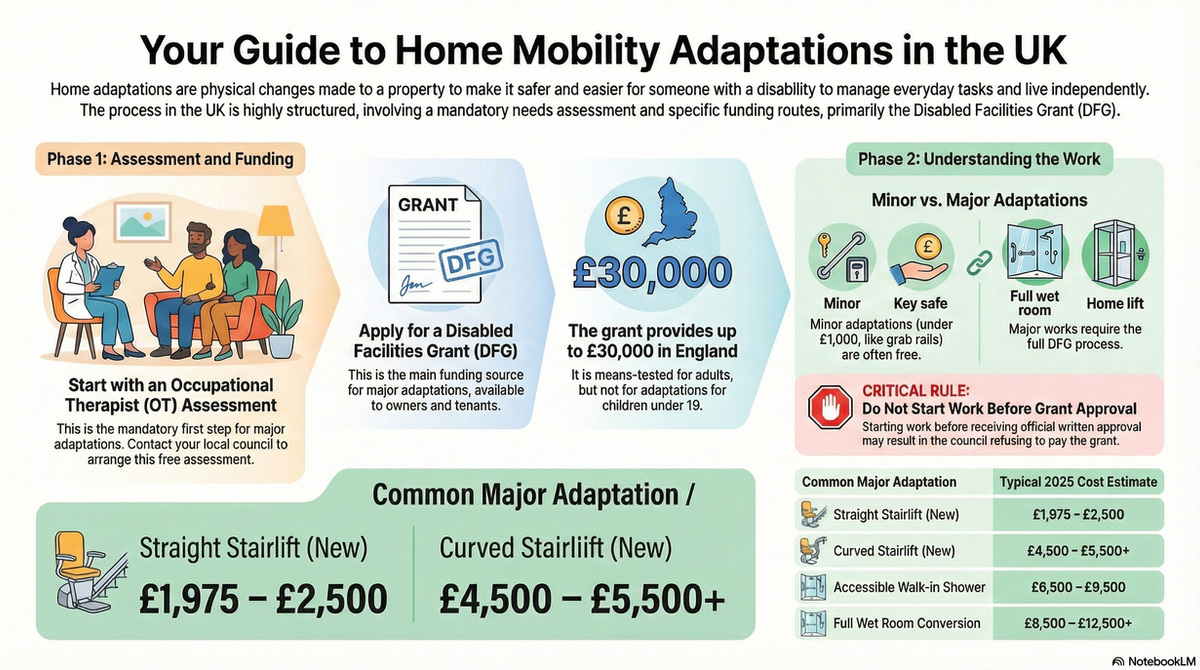
| Straight Stairlift | £1,800 | £3,500 | New unit with standard installation and warranty. |
| Curved Stairlift | £4,500 | £8,000+ | Bespoke rail manufactured for specific stairs. |
| Walk-in Bath/Shower Conversion | £4,000 | £10,000 | Full "wet room" conversion with non-slip flooring. |
| Outdoor Concrete Ramp | £1,500 | £4,000 | Includes excavation and non-slip finish. |
Prices vary based on the complexity of the installation and the quality of the fixtures chosen. Important: Most mobility adaptations for disabled users are eligible for 0% VAT, which can save you 20% on the total cost—ensure your contractor is familiar with VAT Notice 701/7.
While fitting a basic suction-cup rail might seem like a DIY task, anything permanent must be installed by a professional. Mobility aids are life-critical safety features; if a rail pulls out of a wall or a ramp is too steep, the consequences can be severe.
Professional installers understand weight distribution and the specific fixings required for different wall types (e.g., thermalite block vs. plasterboard). Furthermore, any electrical work for lifts or power-assisted doors must be completed by a Part P registered electrician to comply with UK Building Regulations.
Ask your tradesperson: "Can you provide references from previous mobility clients, and do you offer an emergency 24-hour call-out service for mechanical lift failures?"
Yes, you may be eligible for a Disabled Facilities Grant (DFG) from your local council. These grants can cover costs from £5,000 up to £30,000 in England, depending on a means test and an assessment by an Occupational Therapist.
In most cases, small ramps fall under "Permitted Development." However, if your home is a listed building or in a conservation area, or if the ramp is exceptionally large, you should check with your local planning office first.
You do not need to "claim it back" from the government. Instead, you sign a self-declaration form provided by your installer stating that you have a qualifying condition. The installer then invoices you without the 20% VAT added.
Most modern stairlifts are fixed to the stair treads, not the wall. This means there is minimal damage to your wallpaper or paintwork. When the lift is removed later, only small holes in the carpet or wood will remain.
Mechanical items like stairlifts, hoists, and bath lifts should be serviced at least once a year. For lifting equipment used in a care capacity, a LOLER inspection may be required every six months.
This guide was written with AI assistance and is intended for general information only. Prices are estimates based on UK averages and may vary by region. Always get at least three quotes and consult a qualified professional before starting any work.
Ask follow-ups in plain English. The AI explains options, sequencing and what to ask the mobility aids — so you walk in informed.
A stairlift is a transformative investment for UK homeowners facing mobility challenges. It restores full access to the home, provides peace of mind for family ...
READ GUIDE →GuideRecliner Chair Repair Guide Scope of Works Verify proof of ownership and carry out a brief fault interview. Remove base‑cover and inspect mechanism, cabling, mo...
READ GUIDE →GuideFor many UK homeowners, a mobility scooter is more than just a vehicle; it is a lifeline to independence and the local community. Ensuring your scooter is profe...
READ GUIDE →GuideFlat-pack furniture has become a staple of UK homes, offering stylish designs at accessible price points. However, the complexity of modern assembly—often invol...
READ GUIDE →GuideWheelchair Tyre Replacement Costs Scope of Works Initial inspection & sizing – confirm wheel diameter, tyre type (pneumatic, solid, puncture‑proof), hand‑ri...
READ GUIDE →GuideA stairlift is a vital piece of equipment for maintaining independence in your home. Regular servicing ensures the unit remains reliable, safe, and whisper-quie...
READ GUIDE →