Instant
01 · Ask
Ask the AI a follow-up
Got more questions about stairlift Installation Cost &? Describe the bit you're unsure about — the AI explains options, sequencing and what to ask the mobility aids.

Straight, curved, reconditioned, hire or buy — every stairlift option costed for UK homes in 2026.
You've read the brief on stairlift Installation Cost &. Now lean on us to find the right mobility aids — and stay in control of the job.
Got more questions about stairlift Installation Cost &? Describe the bit you're unsure about — the AI explains options, sequencing and what to ask the mobility aids.
Costs, timelines, pitfalls and the right questions to ask before any mobility aids starts on stairlift Installation Cost &.
Itemised quotes from up to 3 local mobility aidss on stairlift Installation Cost & — so you can compare like-for-like, not lump sums.
Ready when you are
Enter your postcode and get free quotes from local pros.
Four moves that separate a smooth job from a nightmare.
Stairlifts must be "parked" on a charging point. If left off the point, the battery will drain. Modern units usually beep to warn you.
Items left on the stairs or a door at the bottom of the flight can trigger safety sensors, stopping the lift mid-journey.
Wireless wall buttons can occasionally lose sync or run out of batteries, though the main controls on the armrest will still function.
On very narrow stairs, your knees may hit the opposite wall or banister. A "perch" seat or a "space-saver" model is usually required here.
Indicative UK ranges and what affects price.
By job type
Quote spread is typically ± 18% — always get 3 quotes.
Mobility Aids quick-view
Mobility Aids explained
For most households, the process is surprisingly non-disruptive. Because the rails are typically fixed to the stair treads rather than the wall, there is minimal impact on your home's decor, and installations can often be completed in a single morning or afternoon.
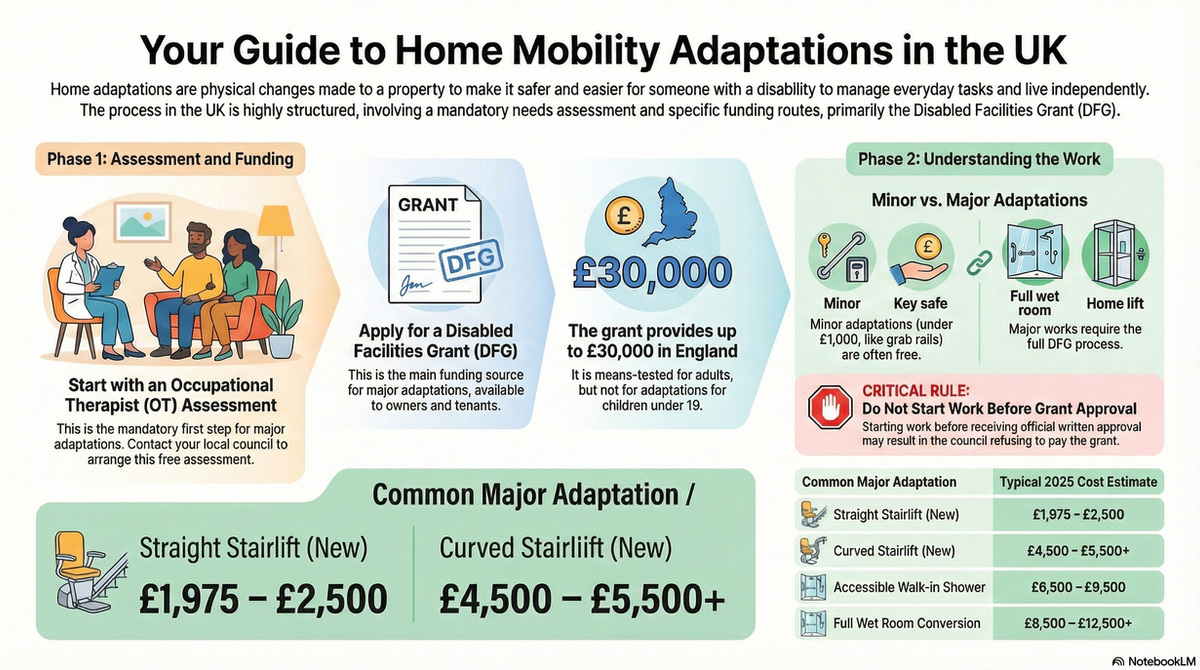
Prices vary significantly based on whether your stairs are straight or curved. Curved rails must be custom-made to the exact dimensions of your hallway, which increases both material and labour costs.
| Item | Low £ | High £ | Notes |
|---|---|---|---|
| New Straight Stairlift | £1,800 | £2,800 | Includes basic installation and warranty. |
| Reconditioned Straight Stairlift | £950 | £1,500 | Fully serviced with limited warranty. |
| New Curved Stairlift | £4,000 | £7,500 | Custom-manufactured rail for turns/landings. |
| Perch or Outdoor Lift | £2,200 | £4,500 | Specialist units for narrow stairs or weatherproofing. |
| Annual Service/Maintenance | £150 | £250 | Essential for safety and battery health. |
Pro Tip: Most UK homeowners with a chronic illness or disability are eligible for 0% VAT on stairlift installations. This can save you 20% on the total quoted price—always check if your provider includes this in their quote.
Stairlift installation is strictly a professional task. While you can find second-hand units online, modern stairlifts are complex pieces of machinery that require precise calibration of safety sensors and braking systems.
Attempting a DIY install will void any manufacturer warranty and could lead to catastrophic failure if the rail is not perfectly aligned. Furthermore, if a new power socket is required, this must be installed by a Part P qualified electrician to comply with UK Building Regulations.
When selecting an installer, look for companies that offer a comprehensive "turnkey" service, including the survey, installation, and future maintenance.
Questions to ask:
Yes, many UK companies offer rental schemes for straight staircases, typically costing around £40–£70 per month plus an initial installation/removal fee. This is an excellent option for short-term recovery or those on a tight budget.
Minimal damage occurs. The rail is fixed via small screws into the wooden or concrete treads of the stairs. If the lift is ever removed, the holes can be filled or hidden by the carpet pile.
Modern stairlifts run on DC battery power. The mains electricity only charges the batteries. In a power cut, the lift will typically still perform 10–20 journeys, ensuring you aren't stranded.
Yes. Most stairlifts feature folding seats, arms, and footrests. When folded, there is usually enough room for others to walk past safely, though very narrow staircases may feel a little cramped.
A standard model typically supports up to 18–19 stone (approx. 120kg). For heavier users, "Heavy Duty" models are available that can support up to 25–30 stone, though these require a wider staircase.
It is highly recommended to replace old carpets before the lift is fitted. Removing a stairlift to lay a new carpet later is expensive, as it requires a professional to dismantle and reinstall the rail.
This guide was written with AI assistance and is intended for general information only. Prices are estimates based on UK averages and may vary by region. Always get at least three quotes and consult a qualified professional before starting any work.
Ask follow-ups in plain English. The AI explains options, sequencing and what to ask the mobility aids — so you walk in informed.
A stairlift is a transformative investment for UK homeowners facing mobility challenges. It restores full access to the home, provides peace of mind for family ...
READ GUIDE →GuideRecliner Chair Repair Guide Scope of Works Verify proof of ownership and carry out a brief fault interview. Remove base‑cover and inspect mechanism, cabling, mo...
READ GUIDE →GuideFor many UK homeowners, a mobility scooter is more than just a vehicle; it is a lifeline to independence and the local community. Ensuring your scooter is profe...
READ GUIDE →GuideFlat-pack furniture has become a staple of UK homes, offering stylish designs at accessible price points. However, the complexity of modern assembly—often invol...
READ GUIDE →GuideWheelchair Tyre Replacement Costs Scope of Works Initial inspection & sizing – confirm wheel diameter, tyre type (pneumatic, solid, puncture‑proof), hand‑ri...
READ GUIDE →GuideA stairlift is a vital piece of equipment for maintaining independence in your home. Regular servicing ensures the unit remains reliable, safe, and whisper-quie...
READ GUIDE →