Instant
01 · Ask
Skim or full re-plaster?
Hairline cracks, sagging ceilings, blown plaster behind paint — describe the symptoms and the AI tells you if it's a skim or a strip-back.

Skim, render, board-and-skim or plasterwork repair — what each costs and how each suits the surface.
Read the brief on prep, drying times and finish quality — then let Three local plasterers quote.
Hairline cracks, sagging ceilings, blown plaster behind paint — describe the symptoms and the AI tells you if it's a skim or a strip-back.
PVA seal, mist coat timing, drying schedules, when scratch + browning coat are needed. Know what good prep looks like before the float comes out.
Three local plasterers quote on the same spec — prep, coats, finish level, drying time — so you pay for the surface you'll actually paint.
Ready when you are
Enter your postcode and get free quotes from local pros.
Four moves that separate a smooth job from a nightmare.
On bare brick or old plaster, the wall must be properly sealed before skim or it cracks within a year. Watch the prep, not just the final coat.
New plaster needs to dry fully — usually 3–6 weeks depending on weather. Paint too soon and it bubbles, peels, or traps moisture in the wall.
First paint coat on fresh plaster is a 50/50 water + emulsion mist coat. Going straight in with full emulsion sucks the bond and creates patchy results.
Run your hand along the wall and look across it from a steep angle — that's when waves and trowel marks show up. Face-on, every wall looks flat.
Indicative UK ranges and what affects price.
By job type
Quote spread is typically ± 18% — always get 3 quotes.
Plasterer quick-view
Plasterer explained
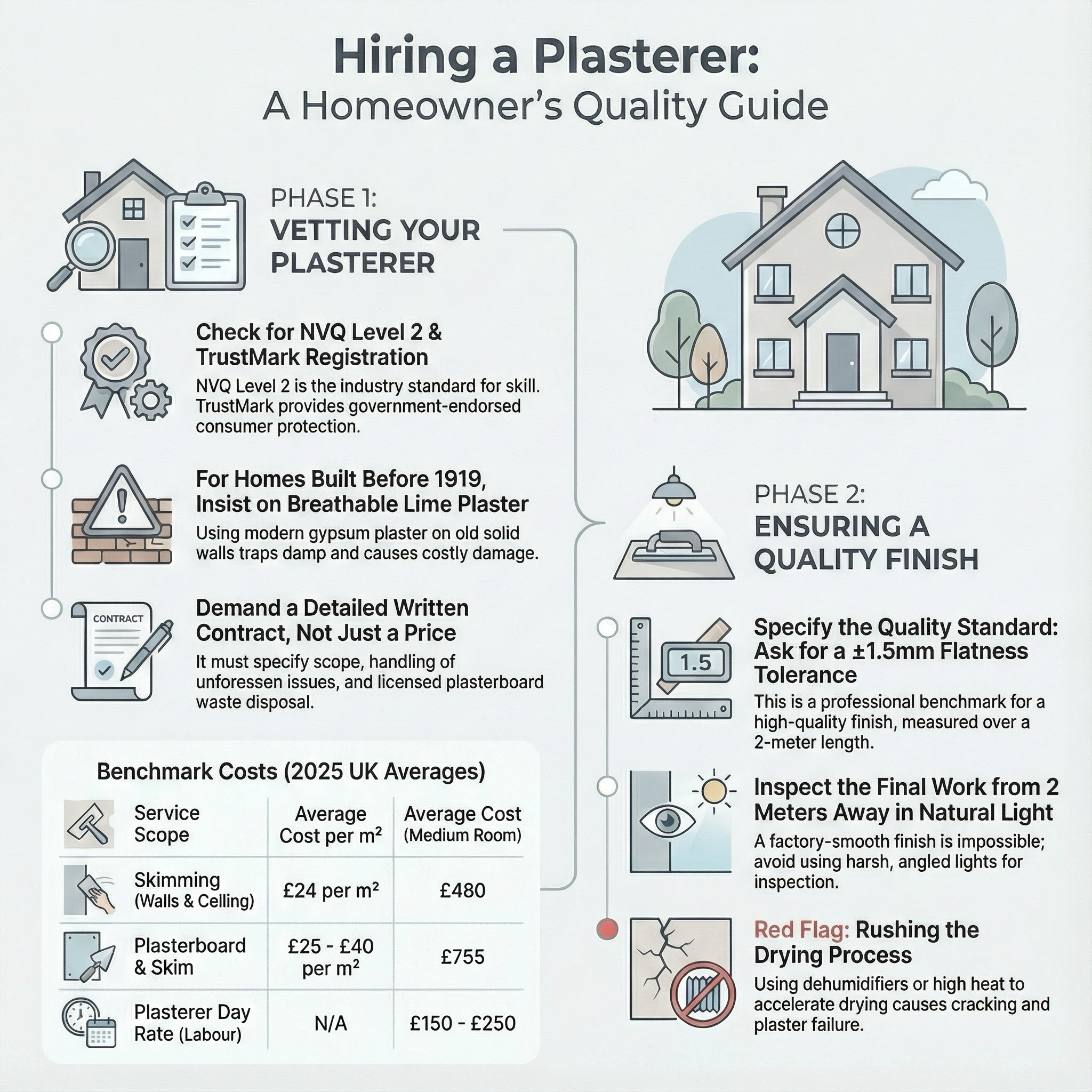
Plaster installation (skimming a wall, full re-plaster, or new build first plaster) in the UK typically costs £15–£35 per m² for skim coats over existing sound surfaces; £25–£60 per m² for full re-plaster including dot-and-dab plasterboard or rendering. A typical room (4×4 m, ~50 m² wall area) costs £400-£900 for a skim, £1,000-£2,500 for a full re-plaster.
The work is fast (1-3 days for a typical room) but technique-sensitive. Bad plastering shows up under paint as ridges, dips, and trowel marks; good plastering produces walls so smooth they look like glass under paint.
| Work | Typical £/m² | Typical room |
|---|---|---|
| Skim over existing sound plaster | £15–£35 | £400–£900 |
| Skim over plasterboard (new) | £18–£40 | £500–£1,200 |
| Full re-plaster (hack off + skim) | £35–£60 | £1,000–£2,500 |
| Plasterboard + skim (dot & dab) | £35–£70 | £1,200–£2,800 |
| Lath and plaster repair (period homes) | £50–£120 | £1,500–£4,000 |
| External rendering (per m²) | £40–£90 | (per house) |
| Bonding coat + skim (uneven walls) | £30–£55 | £900–£1,800 |
Skim of a typical bedroom: 1 day. Full re-plaster: 2-3 days. Plus 1-2 weeks drying before painting. Plan around this; you can't paint or move furniture in immediately.
Wait until the plaster is completely dry — typically 7-14 days for skim coats, 2-3 weeks for thicker re-plaster. The plaster goes from pink (wet) through a lighter pink to almost white when dry. First coat must be a 50-50 water-thinned mist coat to seal the plaster.
For artex / textured ceiling and walls, options: (1) skim over (cheaper but adds 3-5 mm thickness) or (2) hack off and re-plaster (more thorough but 3x the cost). For Artex installed before 2000, asbestos testing is recommended before any disturbance.
Skimming small areas (small patch repairs) is achievable for confident DIYers. Whole walls or rooms benefit dramatically from a professional — the technique difference shows up unforgivingly under paint. Plasterers are typically £200-£400/day; the result is much better.
Bonding coat is the base coat used for thicker (over 5 mm) backing layer on uneven walls. Skim is the top finish coat (2-3 mm). Most jobs need both; a skim alone over very uneven walls won't level out.
Properly applied internal plaster: 30-60+ years before any repair needed. Period lath-and-plaster: 100+ years if maintained. Modern dot-and-dab: 25-40 years. Damp and structural movement are the typical reasons for plaster failure.
Want a local pro to handle this? A skilled plasterer is worth seeking out — the trade has a wide skill range and a £900 plaster job done badly looks worse than walls left alone. Word-of-mouth recommendations and seeing recent work in person are the best ways to find quality plasterers.
This guide was written with AI assistance and is intended for general information only. Prices are estimates based on UK averages and may vary by region. Always get at least three quotes and consult a qualified professional before starting any work.
Ask follow-ups in plain English. The AI explains options, sequencing and what to ask the plasterer — so you walk in informed.
Decorative coving and cornicing are more than just aesthetic flourishes; they provide a professional bridge between your walls and ceiling. For UK homeowners, c...
READ GUIDE →GuideWall Damage Repair Costs Scope of Works Assess & protect area – inspect crack or hole, test for background soundness, sheet floors/furniture. Prepare substr...
READ GUIDE →GuidePolished plastering, often referred to as Venetian plaster, is a high-end decorative finish that has seen a massive surge in popularity across UK homes. Unlike ...
READ GUIDE →GuideStripping away old wallpaper often reveals more than just a change in decor; for many UK homeowners, it uncovers decades of hidden wear, blown plaster, or crumb...
READ GUIDE →GuidePlaster Repairs and Assessment Guide Scope of Works Survey & diagnose : tap‑test walls, use moisture meter, mark hollow/blown areas and hairline cracking. P...
READ GUIDE →GuideRender restoration is more than a cosmetic facelift; it is a critical maintenance task for protecting your home’s structural integrity. In the UK’s damp climate...
READ GUIDE →