Instant
01 · Ask
Ask the AI a follow-up
Got more questions about listed Building Stonework? Describe the bit you're unsure about — the AI explains options, sequencing and what to ask the stonemason.

Listed stonework — repointed in lime mortar, damaged stones replaced. Conservation officer signed off.
You've read the brief on listed Building Stonework. Now lean on us to find the right stonemason — and stay in control of the job.
Got more questions about listed Building Stonework? Describe the bit you're unsure about — the AI explains options, sequencing and what to ask the stonemason.
Costs, timelines, pitfalls and the right questions to ask before any stonemason starts on listed Building Stonework.
Itemised quotes from up to 3 local stonemasons on listed Building Stonework — so you can compare like-for-like, not lump sums.
Ready when you are
Enter your postcode and get free quotes from local pros.
Four moves that separate a smooth job from a nightmare.
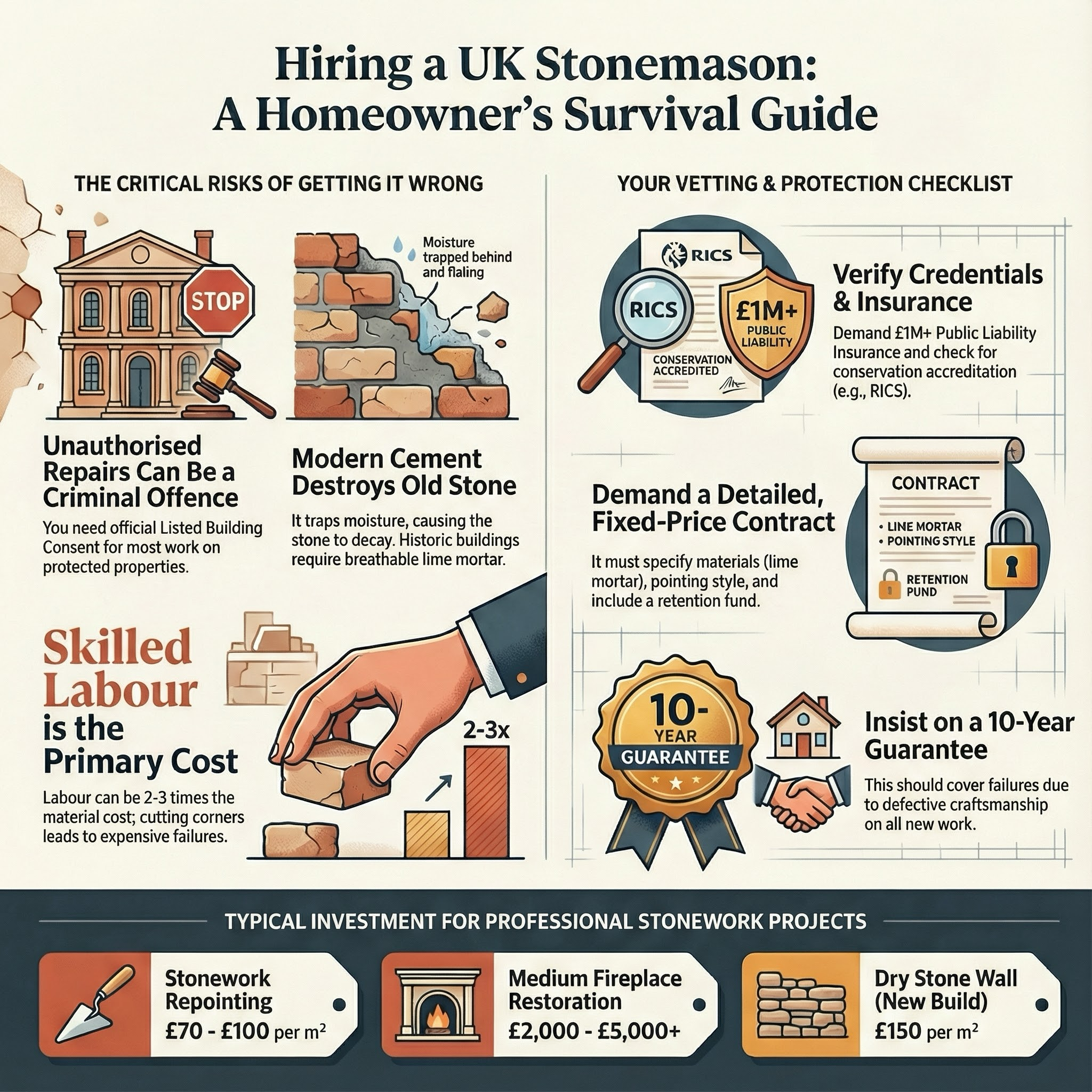
Listed building consent breach is criminal offence. Fines and remedial orders. Always consent first.
Listed building insurance specialist. Heritage rebuild costs much higher.
Conservation officer rejects repair that doesn't match. Method statement essential.
Listed building with non-consented work creates sale problem. Always retrospectively obtain consent where possible.
Indicative UK ranges and what affects price.
By job type
Quote spread is typically ± 18% — always get 3 quotes.
Stonemason quick-view
Stonemason explained
Listed building stonework requires conservation officer consent and specialist heritage stonemason. Expect to pay £150–£15,000+ for UK listed building stonework depending on scope. Premium rates reflect heritage expertise.
Listed building consent application (free but mandatory). Heritage architect or surveyor often involved. SPAB-accredited stonemason engaged. Method statement documenting techniques. Original materials matched (quarry source, lime mortar type, finish). Work documented for future reference.
| Item | Low (£) | High (£) | Notes |
|---|---|---|---|
| Listed building consent (no fee) | 0 | 0 | Mandatory submission |
| Heritage architect/surveyor | 500 | 3,500 | For approval and oversight |
| Quarry research (matching) | 200 | 800 | Identify original source |
| SPAB-accredited stonemason daily rate | 250 | 500 | Heritage day rate |
| Small heritage repair | 500 | 2,500 | Per area |
| Major listed building restoration | 15,000 | 500,000+ | Whole-building scope |
| Scaffolding (heritage safe) | 500 | 5,000+ | No damage to fabric |
Listed building consent: 8–12 weeks. Heritage stonemason scheduling: 3–6 months wait. Work itself: variable from days to years.
SPAB-accredited heritage stonemason only. Listed building consent typically requires named specialists.
SPAB (Society for the Protection of Ancient Buildings) accredited. RICS Heritage Consultant. Local conservation officer can recommend. Get listing details (Grade I, II*, II) which dictate work standards.
Listed Building Consent (mandatory under Planning Act 1990). Heritage England guidance. SPAB Code of Practice. Local conservation officer approval.
Check Historic England website (national heritage list). Grade I (top tier), Grade II* (high importance), Grade II (special interest). About 500,000 listed buildings in UK.
Listed building: yes, always. Conservation area: usually yes if visible. Standard property: usually no.
8–12 weeks for standard application. Complex cases: longer. Pre-application discussion with conservation officer often shortens process.
Yes — to the Planning Inspectorate. 6 months from refusal. Specialist consultant recommended.
Premium materials (matched quarries), apprenticed labour (5+ year training), consent process, slower pace, careful documentation. Heritage rates 50–200% above standard.
Historic England grants for Grade I and II* (occasionally). Local councils may have heritage funds. Tax relief on VAT for some works.
This guide was written with AI assistance and is intended for general information only. Prices are estimates based on UK averages and may vary by region. Always get at least three quotes and consult a qualified professional before starting any work.
Ask follow-ups in plain English. The AI explains options, sequencing and what to ask the stonemason — so you walk in informed.
Stone is a defining feature of British architecture, from the honey-coloured limestone of the Cotswolds to the robust granite of Aberdeen. While incredibly dura...
READ GUIDE →GuideNatural stone flooring is a premium feature in many UK homes, from Victorian hallways with original encaustic tiles to modern open-plan kitchens finished in lim...
READ GUIDE →GuideStone is one of the most durable building materials used across the UK, from Cotswold cottages to Victorian terraces. However, even the toughest granite or sand...
READ GUIDE →GuideHeritage stone restoration is more than just a repair job; it is the essential preservation of a building’s character and structural integrity. In the UK, our a...
READ GUIDE →GuideCustom stone carving is one of the oldest and most prestigious crafts in the UK building industry. Whether you are looking to add a bespoke date stone to a new ...
READ GUIDE →GuideChoosing a memorial is a deeply personal task, but ensuring its safe and lasting installation is a technical job for a skilled stonemason. In the UK, strict cem...
READ GUIDE →