Instant
01 · Ask
Ask the AI a follow-up
Got more questions about reconstituted Stone vs Natural Stone? Describe the bit you're unsure about — the AI explains options, sequencing and what to ask the stonemason.

Reconstituted stone (cast) vs natural quarried stone — cost, look and how each ages.
You've read the brief on reconstituted Stone vs Natural Stone. Now lean on us to find the right stonemason — and stay in control of the job.
Got more questions about reconstituted Stone vs Natural Stone? Describe the bit you're unsure about — the AI explains options, sequencing and what to ask the stonemason.
Costs, timelines, pitfalls and the right questions to ask before any stonemason starts on reconstituted Stone vs Natural Stone.
Itemised quotes from up to 3 local stonemasons on reconstituted Stone vs Natural Stone — so you can compare like-for-like, not lump sums.
Ready when you are
Enter your postcode and get free quotes from local pros.
Four moves that separate a smooth job from a nightmare.
Budget brands fade in 10–15 years. Premium (Haddonstone) holds colour longer.
Cheap reconstituted looks like grey concrete blocks. Premium gets stone-like patina.
Listed building consent often refuses reconstituted in visible locations.
Both natural and reconstituted accumulate biological growth. Annual cleaning maintains appearance.
Indicative UK ranges and what affects price.
By job type
Quote spread is typically ± 18% — always get 3 quotes.
Stonemason quick-view
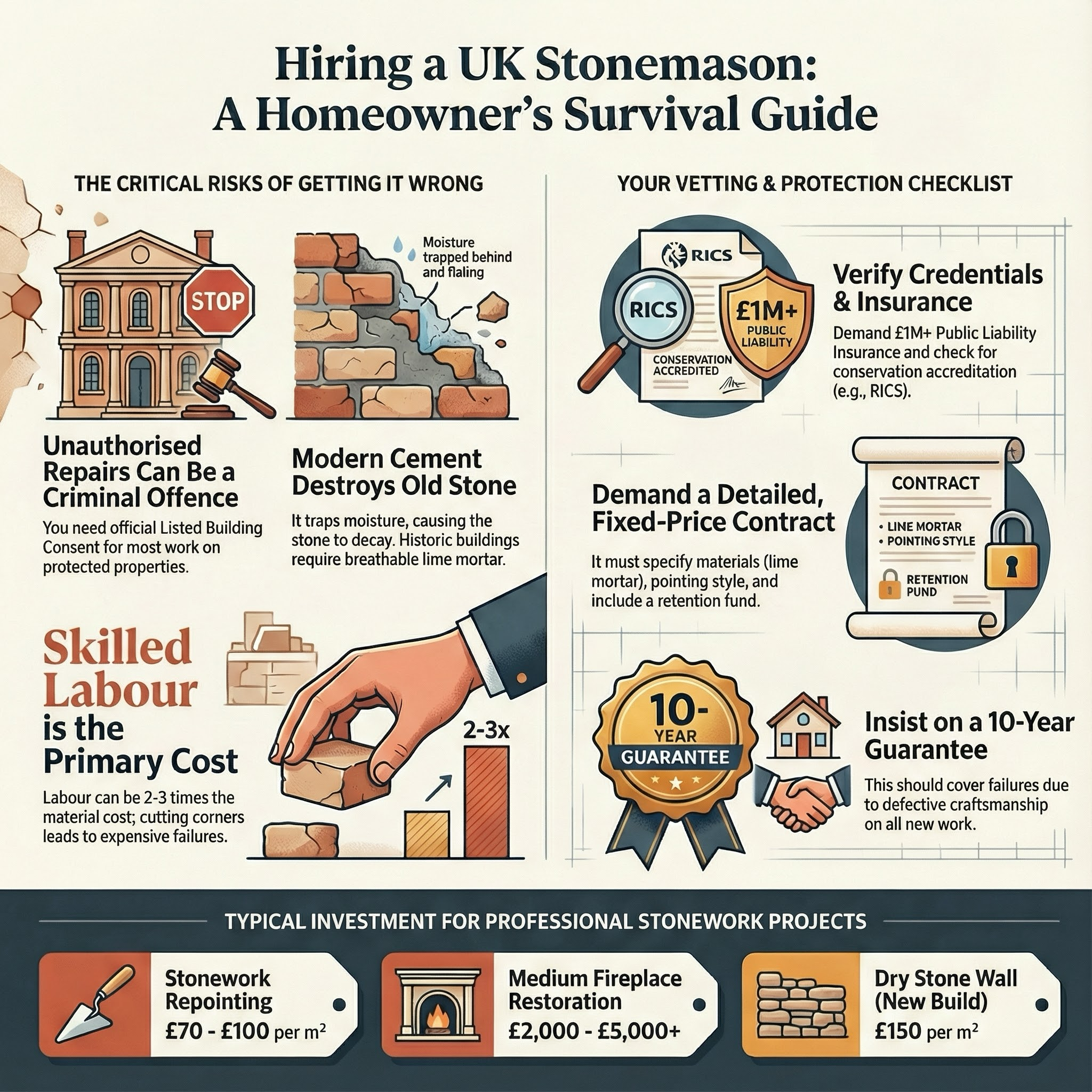
Stonemason explained
Reconstituted stone (cast stone) is concrete coloured and shaped to look like natural stone. Cheaper, lighter, more consistent — but doesn't age like real stone. Expect prices to be 30–60% lower than natural equivalent.
Reconstituted stone: cement + crushed stone aggregate + pigments cast in moulds. Includes Haddonstone (premium UK reproduction), Bradstone, Marshalls Stoneflair. Natural stone: real stone quarried and cut. Each has different installation methods, weight, and characteristics.
| Item | Low (£) | High (£) | Notes |
|---|---|---|---|
| Reconstituted stone walling per m | 30 | 90 | Bradstone, Marshalls |
| Natural stone walling per m | 120 | 400 | Cotswold, Yorkstone |
| Reconstituted paving per m² | 20 | 60 | Material only |
| Natural sandstone paving per m² | 40 | 90 | Indian sandstone |
| Reconstituted planter (medium) | 80 | 300 | Cast stone |
| Natural stone planter (medium) | 250 | 1,200 | Cotswold limestone |
| Premium reconstituted (Haddonstone) | 200 | 2,500 | Architectural pieces |
| Natural architectural detail | 500 | 5,000+ | Heritage-grade |
Same install time for both. Lighter weight of reconstituted may save labour.
Reconstituted easier to handle (lighter). Both ultimately professional install for quality results.
Same as for natural stone — stonemason or landscaper depending on application. Reconstituted from established brands (Haddonstone, Bradstone, Marshalls) better than generic.
Reconstituted stone usually accepted where natural is. Listed buildings often require natural stone. Conservation areas may accept reconstituted with conservation officer approval.
No — natural stone gets patina, weathered character. Reconstituted stays more uniform. Some weathering accepted, but never the same.
New-build modern homes (no heritage context). Garden landscaping (cheap planters, walls). Internal feature walls. Architectural detail where heritage doesn't matter.
Heritage buildings. Visible elevations in heritage areas. Premium homes. Memorial work. Architectural detail in period properties.
Yes — UK premium brand. Better colour matching, more weathering, architectural detail. Worth premium over generic.
Premium (Haddonstone): 50–80 years. Budget: 25–40 years. Generally less than natural stone.
Reconstituted: replace whole piece (no patching tradition). Natural: indent repair common. Heritage favours natural.
This guide was written with AI assistance and is intended for general information only. Prices are estimates based on UK averages and may vary by region. Always get at least three quotes and consult a qualified professional before starting any work.
Ask follow-ups in plain English. The AI explains options, sequencing and what to ask the stonemason — so you walk in informed.
Stone is a defining feature of British architecture, from the honey-coloured limestone of the Cotswolds to the robust granite of Aberdeen. While incredibly dura...
READ GUIDE →GuideNatural stone flooring is a premium feature in many UK homes, from Victorian hallways with original encaustic tiles to modern open-plan kitchens finished in lim...
READ GUIDE →GuideStone is one of the most durable building materials used across the UK, from Cotswold cottages to Victorian terraces. However, even the toughest granite or sand...
READ GUIDE →GuideHeritage stone restoration is more than just a repair job; it is the essential preservation of a building’s character and structural integrity. In the UK, our a...
READ GUIDE →GuideCustom stone carving is one of the oldest and most prestigious crafts in the UK building industry. Whether you are looking to add a bespoke date stone to a new ...
READ GUIDE →GuideChoosing a memorial is a deeply personal task, but ensuring its safe and lasting installation is a technical job for a skilled stonemason. In the UK, strict cem...
READ GUIDE →