Instant
01 · Ask
Ask the AI a follow-up
Got more questions about laminate Flooring Repair? Describe the bit you're unsure about — the AI explains options, sequencing and what to ask the surface repair.

Damaged or scratched laminate planks — replaced from spare stock or matched and repaired.
You've read the brief on laminate Flooring Repair. Now lean on us to find the right surface repair — and stay in control of the job.
Got more questions about laminate Flooring Repair? Describe the bit you're unsure about — the AI explains options, sequencing and what to ask the surface repair.
Costs, timelines, pitfalls and the right questions to ask before any surface repair starts on laminate Flooring Repair.
Itemised quotes from up to 3 local surface repairs on laminate Flooring Repair — so you can compare like-for-like, not lump sums.
Ready when you are
Enter your postcode and get free quotes from local pros.
Four moves that separate a smooth job from a nightmare.
The most common issue. Laminate often has multiple tones; a single-colour filler will look like a "blob" rather than a repair.
Caused by water ingress. This cannot usually be repaired with filler; the affected planks must be replaced.
Occurs if the area wasn't properly degreased or if the floor has too much vertical movement (bounce).
A shiny ring around the repair site caused by using the wrong cleaning solvent or over-polishing the surrounding area.
Indicative UK ranges and what affects price.
By job type
Quote spread is typically ± 18% — always get 3 quotes.
Surface Repair quick-view
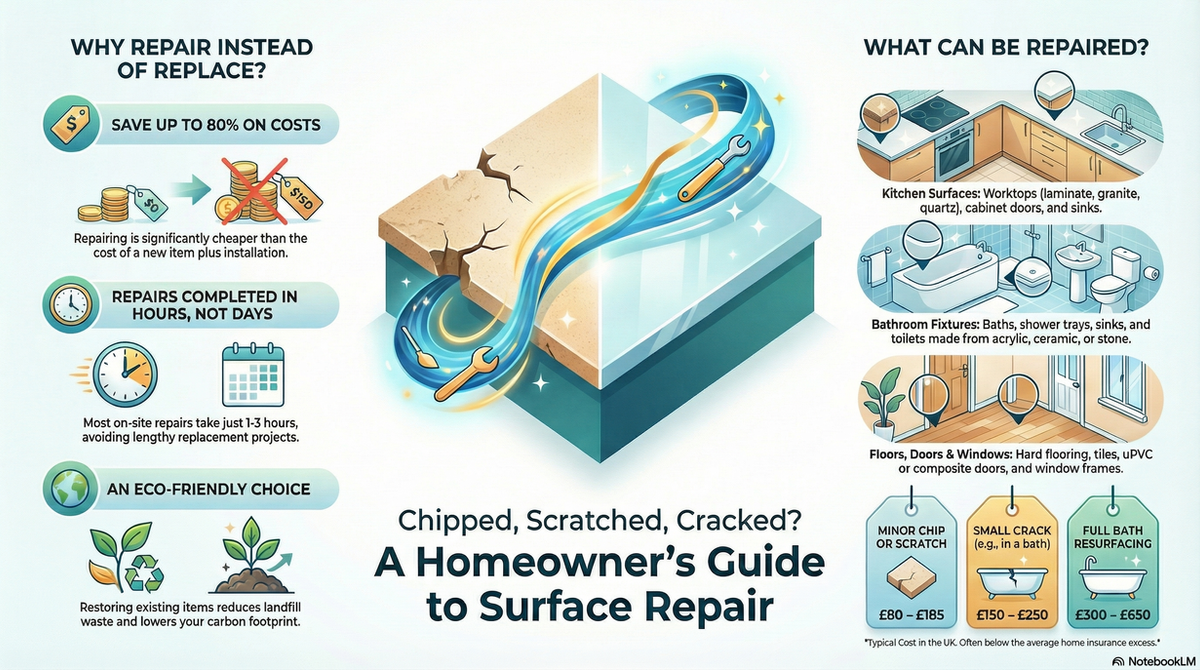
Surface Repair explained
Professional surface repair can save you the significant expense and upheaval of replacing an entire room’s flooring. By using specialist resins, hard waxes, and precision colour-matching, a skilled technician can make damage virtually invisible, extending the life of your floor by years.
The cost of laminate repair is largely driven by the time required for colour matching and the location of the damage. Most professionals charge a minimum call-out fee that covers the first hour of work.
| Item | Low £ | High £ | Notes |
|---|---|---|---|
| Call-out / Minimum Charge | £80 | £150 | Covers travel and first hour of labour. |
| Minor Scratch Repair (per area) | £40 | £70 | Using wax kits or resin fillers. |
| Single Plank Replacement | £100 | £200 | Labour only; assumes you have spare boards. |
| Specialist Surface Restoration | £250 | £450 | Full day rate for multiple repairs across a house. |
| Materials & Consumables | £20 | £60 | Waxes, resins, and specialized cleaning agents. |
Prices will vary depending on your location in the UK, with London and the South East typically seeing rates 20-30% higher than the national average. If you do not have spare planks left over from the original installation, sourcing a matching batch can add significant time and cost to the project.
For very minor surface scratches, a DIY laminate repair kit (available for £15-£25) can be effective. These usually involve soft wax sticks that you rub into the scratch. However, these repairs are often temporary and can attract dirt over time, making the scratch more visible.
Professional repair is essential for deep chips or when damage occurs in the middle of a room. Professionals use "hard wax" systems that require a heat gun and specialist levelling tools. While there are no specific UK building regulations for laminate repair (unlike gas or electrical work), a professional will ensure the expansion gaps are maintained, preventing the floor from "peaking" or "buckling" in the future.
Professional surface repairers are artists as much as technicians; their value lies in their ability to recreate wood grain patterns that vanish into the floor.
Generally, no. When water gets into the HDF (High-Density Fibreboard) core, it swells and "bubbles" the edges. This structural damage cannot be flattened back down. The only permanent fix is to replace the affected planks.
Yes. A specialist can use high-strength resin or hard wax to fill holes up to the size of a 50p piece. They will hand-paint the grain pattern over the filler to match the rest of the board.
No. Laminate is a photographic image printed onto a fibreboard core, topped with a clear wear layer. Sanding it will simply destroy the image and reveal the brown core underneath. Only localized repairs are possible.
A professional hard-wax repair is designed to be permanent. It is moisture-resistant and can withstand normal foot traffic and cleaning. However, it may eventually wear down in very high-traffic commercial areas.
This is usually due to an uneven subfloor or poor-quality underlay. While a surface repair won't fix this, a tradesperson can sometimes inject a specialist expanding foam through a small hole to stabilise a "hollow" spot.
Yes. Light surface scratches in the wear layer can often be buffed out with specialist polish or filled with a clear "burn-in" resin that restores the shine without needing a full colour match.
This guide was written with AI assistance and is intended for general information only. Prices are estimates based on UK averages and may vary by region. Always get at least three quotes and consult a qualified professional before starting any work.
Ask follow-ups in plain English. The AI explains options, sequencing and what to ask the surface repair — so you walk in informed.
Damaged bathroom tiles are more than just an eyesore; they can lead to significant structural issues if water penetrates the substrate. Whether it is a hairline...
READ GUIDE →GuideKitchen Countertop Replacement Guide Scope of Works Pre‑visit survey & templating – measure runs, confirm joins, splashback height and hob/sink cut‑outs. Di...
READ GUIDE →GuideWood hole filling is an essential maintenance task for UK homeowners looking to preserve the aesthetic and structural integrity of their timber. From repairing ...
READ GUIDE →GuideCeramic Surface Repair: A Guide for UK Homeowners Ceramic surfaces—from bathroom tiles and kitchen splashbacks to porcelain sinks and floor tiles—are incredibly...
READ GUIDE →GuideA cracked or chipped shower tray is more than just a cosmetic eyesore; it is a significant risk to your home’s structural integrity. Even a hairline fracture ca...
READ GUIDE →GuideReplacing a glass panel is about more than just fixing a crack. Whether you are dealing with a shattered pane, a "blown" double-glazed unit filled with condensa...
READ GUIDE →