Instant
01 · Ask
Which surface, what damage?
Stone chip, wood scratch, leather rip? Describe and the AI tells you which specialist to find.

Chips and scratches on worktops, baths, tiles and stone — colour-matched, on-site fixes.
Read the brief on materials, testing and warranty terms — then let Three local specialists quote.
Stone chip, wood scratch, leather rip? Describe and the AI tells you which specialist to find.
Chemistry compatibility, daylight inspection, before/after photos, warranty terms. Know what 'invisible' means.
Three local specialists quote on the same damage — technique, warranty, callback policy — so the repair stays repaired.
Ready when you are
Enter your postcode and get free quotes from local pros.
Four moves that separate a smooth job from a nightmare.
Stone, wood, laminate, marble, leather — each needs different chemistry. Don't let a stone polisher near your leather sofa.
Surface repair compounds can react with finishes. Reputable specialists test in an inconspicuous corner before going public.
A patched surface should look invisible from 1m. If it's still visible, the specialist should re-do free under warranty. Get this in writing.
Final inspection in daylight, walking past the patch. If you can spot it, the job's not done. Stand on it before signing.
Indicative UK ranges and what affects price.
By job type
Quote spread is typically ± 18% — always get 3 quotes.
Visual breakdown of costs, timelines and the questions you should be asking.
Surface Repair quick-view
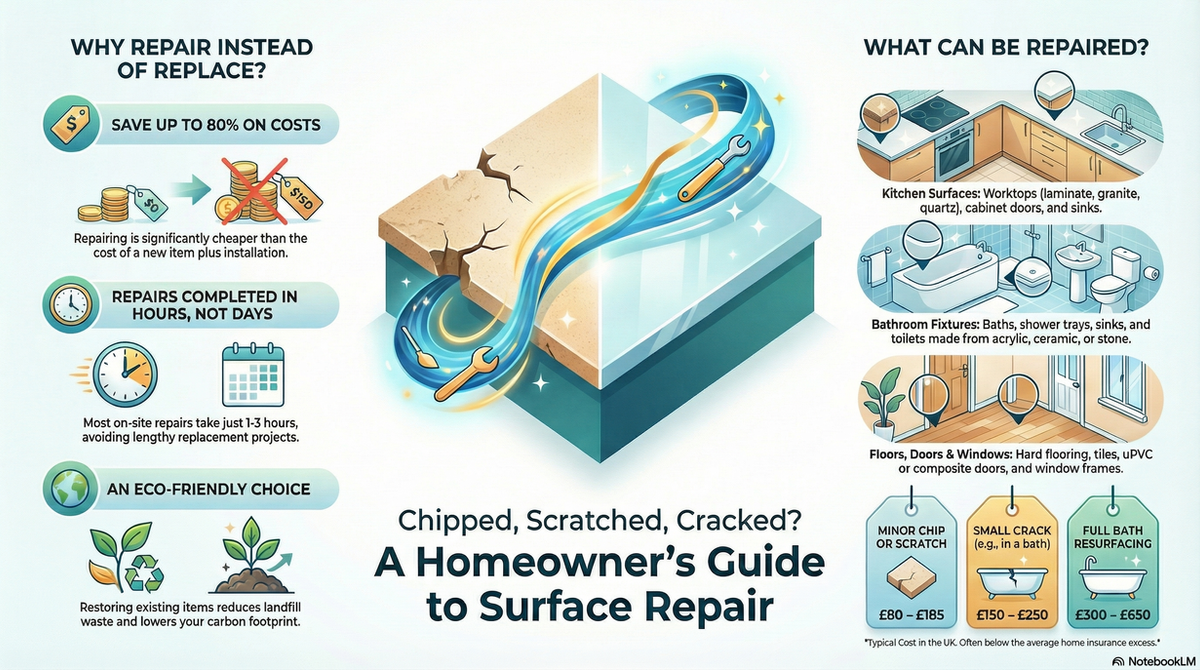
Surface Repair explained
Everything you need to know before hiring a surface repair.
Surface repair specialists are the "invisible" experts of the home improvement world. They specialise in restoring damaged hard surfaces to their original condition, using advanced resins, fillers, and precision colour-matching techniques. Instead of the upheaval and expense of replacing a whole kitchen worktop or a fitted bathtub, these technicians "make it disappear."
UK homeowners typically call upon surface repairers for accidental damage caused during renovations or everyday mishaps. This includes everything from a dropped heavy pan chipping a ceramic hob to a slipped chisel scarring a new wood floor. Their work is an eco-friendly alternative to replacement, keeping perfectly functional items out of landfill while saving you significant time and money.
Commonly repaired items include laminate and stone worktops, acrylic and enamel baths, uPVC window frames, ceramic tiles, and engineered wood flooring. If a surface is hard and has a visible dent, scratch, or chip, a specialist can likely restore it to a near-factory finish.
A professional surface repair is a meticulous process that requires a keen eye for detail and a steady hand. Here is what you can expect from the typical workflow:
While DIY repair kits are available in high-street hardware stores, they often result in a "patchwork" look that can be more eyesore than the original damage. A professional surface repairer is an artist as much as a technician. They understand how light interacts with different materials and how to "feather" a repair so the edges are invisible to the naked eye.
Beyond aesthetics, professional repairs are structural. A specialist knows which resins to use for a heat-resistant kitchen worktop versus a flexible flooring repair. In wet areas like bathrooms, a professional repair ensures the surface remains 100% watertight, preventing sub-floor rot or mould growth that a failed DIY attempt might allow.
Hiring a pro also offers a significant "hassle-free" factor. Replacing a chipped kitchen island could involve disconnecting plumbing and hobs, risking damage to cabinets, and weeks of lead time. A specialist can usually complete a high-quality repair in two to four hours with zero mess and no need for other trades.
Pricing for surface repairs is generally based on the complexity of the material and the time required for colour matching. Most technicians have a minimum call-out charge that covers the first repair, with reduced rates for subsequent chips fixed during the same visit.
| Service | Low £ | High £ | Notes |
|---|---|---|---|
| Single Tile or Stone Chip | £120 | £180 | Includes precision colour matching. |
| Acrylic/Enamel Bath Repair | £150 | £250 | Must be watertight and polished. |
| Laminate Worktop Burn/Dent | £160 | £280 | Complex grain patterns cost more. |
| uPVC Frame Repair | £100 | £175 | Common for drill holes or scuffs. |
| Wood/Laminate Floor Scratch | £140 | £220 | Price depends on the depth of gouge. |
| Full Day Rate | £350 | £550 | Best value for multiple small repairs. |
Note: Prices are estimates for 2025/26 and include VAT. Location (especially London and the SE) and the rarity of the material (e.g., exotic marble) can increase these costs.
Not all "handymen" have the tools or pigments required for high-end surface restoration. To ensure a "seamless" result, follow these guidelines:
Questions to ask before booking:
A high-quality professional repair should be invisible from a standing position under normal lighting. While no repair is technically "perfect" under a microscope, a specialist's goal is to make it undetectable to the casual observer.
Yes, the resins and fillers used are designed to bond chemically or mechanically to the substrate. When performed correctly, the repair should last as long as the rest of the fixture, provided you follow the recommended cleaning instructions.
Small chips and surface scratches can be repaired easily. However, "stress cracks" or "hairline fractures" that go all the way through the ceramic are usually structural issues. While they can be cosmetically hidden, they may eventually leak, so replacement is often recommended for items that hold water under pressure.
The process is very clean. Some sanding may be required, but technicians typically use localized dust extraction. Some resins have a strong chemical odour during the curing process (usually 15-30 minutes), but this dissipates quickly with a cracked window.
Describe the job in plain English. The AI asks a few smart questions, then tells you whether a surface repair is the right call, what it should cost, and what to ask before they start.
Damaged flooring is more than just an aesthetic issue for UK homeowners. Whether it is a sagging Victorian floorboard, a chipped laminate plank, or a loose parq...
READ GUIDE →GuideHeat marks on a cherished wooden dining table are a common frustration for UK homeowners. These unsightly white clouds or dark scorch marks usually occur when h...
READ GUIDE →GuideLaminate flooring is a popular choice for UK homeowners due to its durability and aesthetic appeal. However, despite its tough wear layer, it is not indestructi...
READ GUIDE →GuideWindow sills are a critical line of defence against the British weather, responsible for shedding water away from your home's structure. When sills fail, moistu...
READ GUIDE →GuideWood hole filling is an essential maintenance task for UK homeowners looking to preserve the aesthetic and structural integrity of their timber. From repairing ...
READ GUIDE →GuideA high-quality wooden table is often the centrepiece of a UK home, serving as everything from a workspace to a family gathering point. Over time, even the hardi...
READ GUIDE →GuideA burn mark on a cherished wooden table—whether from a hot pan, a stray cigarette, or a fallen candle—can feel like a permanent disaster. However, professional ...
READ GUIDE →Ceramic Surface Repair: A Guide for UK Homeowners Ceramic surfaces—from bathroom tiles and kitchen splashbacks to porcelain sinks and floor tiles—are incredibly...
READ GUIDE →GuideDamaged bathroom tiles are more than just an eyesore; they can lead to significant structural issues if water penetrates the substrate. Whether it is a hairline...
READ GUIDE →GuideMaintaining the integrity of your shower's grout and sealant is the first line of defence against water damage in a UK home. Over time, moisture, soap scum, and...
READ GUIDE →GuideLoose tiles in a UK home are often more than a cosmetic annoyance. They can be the first sign of water ingress or substrate failure, particularly in high-moistu...
READ GUIDE →A cracked ceramic or porcelain sink can quickly become the focal point of a kitchen or bathroom for all the wrong reasons. Beyond the unsightly appearance, crac...
READ GUIDE →GuideA cracked or chipped shower tray is more than just a cosmetic eyesore; it is a significant risk to your home’s structural integrity. Even a hairline fracture ca...
READ GUIDE →