Instant
01 · Ask
Buying, selling or snagging?
Property age, condition and purpose drive the survey level. Describe the situation and the AI tells you what to commission.

Buying or selling commercial property — what surveyors do, what reports are needed, what each costs.
Read the brief on RICS levels, lender vs buyer surveys and follow-up specialist reports — then let Three local surveyors quote.
Property age, condition and purpose drive the survey level. Describe the situation and the AI tells you what to commission.
RICS Levels 1/2/3, red/amber/green ratings, specialist referrals, professional indemnity. Know the language.
Three local surveyors quote on the same property — survey level, turnaround, follow-up support — so you pick on competence.
Ready when you are
Enter your postcode and get free quotes from local pros.
Four moves that separate a smooth job from a nightmare.
RICS Level 1 (Condition): new build / good condition only. Level 2 (Homebuyer): standard. Level 3 (Building): period, neglected or unusual. Pay for the right one.
The mortgage valuation is for the lender, not you. Always commission your own survey — even if you trust the property.
RICS reports are long. The summary lists urgent (red) and significant (amber) issues — those are the negotiation lever for the sale price.
Damp, electrical, drains, structural — surveyors flag but don't diagnose. Budget for specialist reports on red flags before exchange.
Indicative UK ranges and what affects price.
By job type
Quote spread is typically ± 18% — always get 3 quotes.
Surveying quick-view
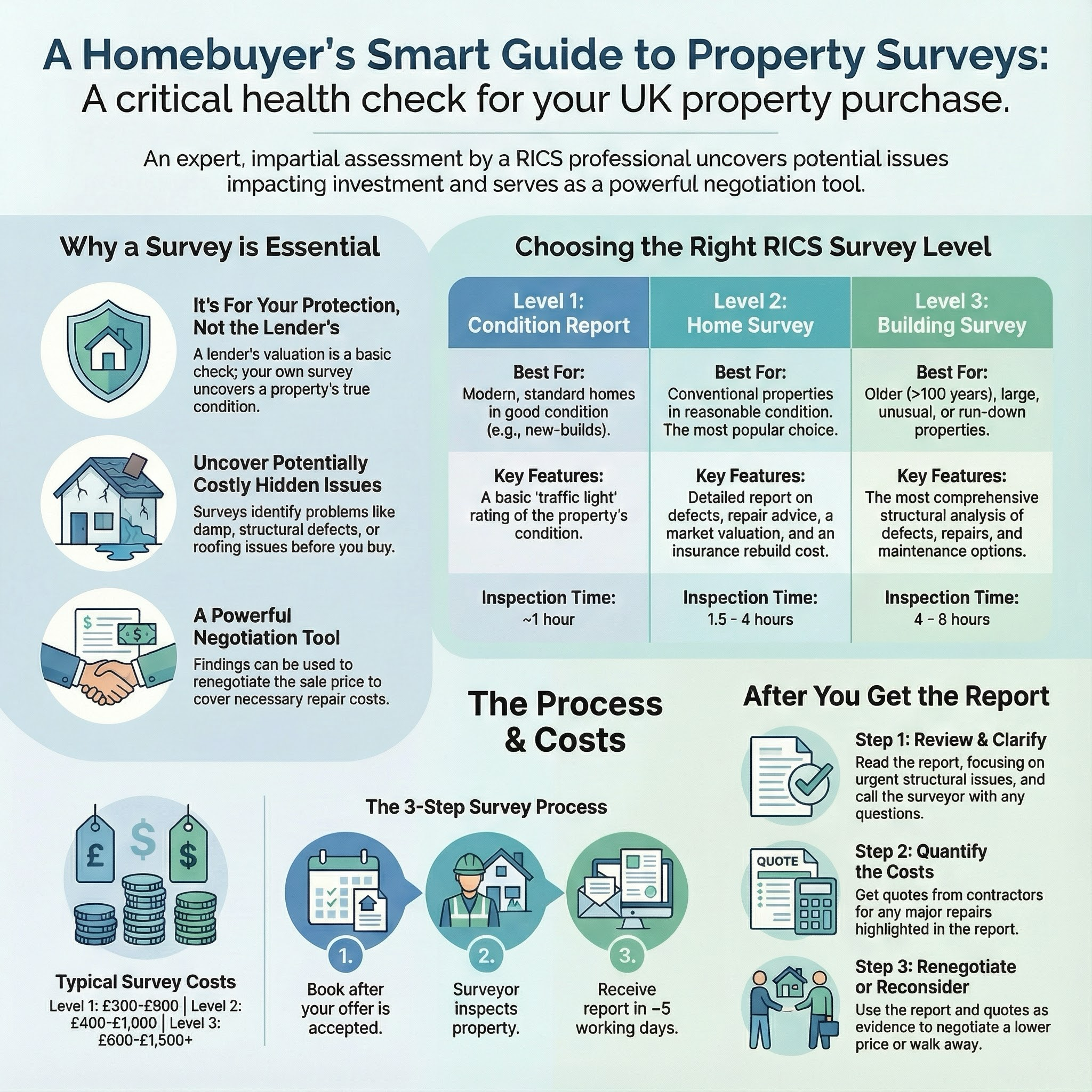
Surveying explained
Commercial property transactions in the UK — buying or selling shops, offices, warehouses, restaurants — typically involve a chartered surveyor's report costing £600–£3,000+ depending on property complexity. Larger or specialist properties (industrial, hospitality, multi-let portfolios) can run £3,000-£10,000+. Engaging a RICS-registered surveyor early in the transaction is the single most important risk-reduction step.
For UK businesses or investors entering commercial property, understanding the surveying process saves money and protects against expensive surprises. Different transaction types need different surveys.
| Survey type | Typical price |
|---|---|
| Building Survey (small commercial) | £600–£1,500 |
| Building Survey (medium commercial) | £1,500–£3,500 |
| Building Survey (large / specialist) | £3,500–£10,000+ |
| Schedule of Condition (lease) | £800–£2,500 |
| Schedule of Dilapidations | £1,200–£4,000 |
| Valuation report | £500–£2,500 |
| Pre-acquisition technical due diligence | £2,000–£8,000+ |
| Measured survey | £500–£2,500 |
| Asbestos refurbishment / demolition survey | £600–£2,500 |
| Environmental Phase 1 desktop study | £300–£1,000 |
For purchases — strongly recommended. Commercial properties have far more potential issues than residential (asbestos, contamination, plant condition, statutory compliance). A £1,500-£3,500 survey on a £500,000 purchase is excellent value.
External fabric, structural condition, M&E (mechanical / electrical) services, statutory compliance, asbestos register check, environmental risks, capital expenditure forecast, repairing liabilities. Comprehensive document — typically 30-100 pages.
Site visit: half-day to full-day depending on size. Report turnaround: 5-15 working days typical. For complex / large properties, 3-4 weeks not uncommon.
Yes, almost always. Without one, the lease implies you took the property in "good repair" — meaning end-of-lease dilapidations claims can be substantial. The £800-£2,500 cost can save £tens of thousands.
Survey: condition and risk assessment. Valuation: market value for lender / acquisition purposes. Same surveyor often does both as combined service. Different methodologies and reports.
RICS Find a Surveyor service (rics.org). Local recommendations from solicitors, agents, accountants. For specialist properties (hotels, healthcare, industrial), use surveyors with sector experience.
Want a local pro to handle this? A RICS-registered chartered surveyor with relevant sector experience is essential for any commercial property transaction. The £1,500-£3,500 fee is small relative to the protection from £tens of thousands or £hundreds of thousands of risk.
This guide was written with AI assistance and is intended for general information only. Prices are estimates based on UK averages and may vary by region. Always get at least three quotes and consult a qualified professional before starting any work.
Ask follow-ups in plain English. The AI explains options, sequencing and what to ask the surveying — so you walk in informed.
For UK homeowners embarking on a major renovation or extension, professional project management is the difference between a dream build and a financial headache...
READ GUIDE →GuideFor UK homeowners planning a significant renovation, extension, or new build, a professional estimation service is the foundation of a successful project. Unlik...
READ GUIDE →GuideA Property Condition Assessment (PCA) acts as a vital health check for UK homeowners and prospective buyers. Unlike a basic mortgage valuation, which only confi...
READ GUIDE →GuideA professional house inspection is an essential safeguard for UK homeowners, whether you are buying a new property, planning a major renovation, or simply maint...
READ GUIDE →GuideA professional building inspection is a critical safeguard for UK homeowners, whether you are purchasing a new property or planning significant renovations. It ...
READ GUIDE →GuideA Level 3 Building Survey, formerly known as a Full Structural Survey, is the most comprehensive "health check" available for UK residential properties. It prov...
READ GUIDE →