Instant
01 · Ask
Single side or whole house?
Roof work, chimney, render? Describe the project and the AI tells you the right scaffold spec.

Erection, hire and dismantle — domestic and small-commercial scaffold with permits where needed.
Read the brief on cards, designs, inspections and licences — then let three NASC scaffolders quote.
Roof work, chimney, render? Describe the project and the AI tells you the right scaffold spec.
TG20 designs, SG4 inspections, CISRS cards, pavement licences. Know what compliance looks like.
Three NASC scaffolders quote on the same spec — duration, design, inspections, licence — so you compare cleanly.
Ready when you are
Enter your postcode and get free quotes from local pros.
Four moves that separate a smooth job from a nightmare.
Every scaffolder on site needs a CISRS card. No card = no insurance cover if there's an accident. Insist on seeing them.
Any scaffold over 38m, or non-standard, needs a TG20 design or bespoke drawing. Without it, the scaffold isn't compliant — and your project isn't either.
Working scaffolds need a SG4-compliant inspection at handover and every 7 days. Insist on the signed inspection paperwork.
Anything on pavement or road needs a council pavement licence (£70–£300). Scaffolder usually arranges; check it's in place before they start.
Indicative UK ranges and what affects price.
By job type
Quote spread is typically ± 18% — always get 3 quotes.
Visual breakdown of costs, timelines and the questions you should be asking.
Scaffolder quick-view
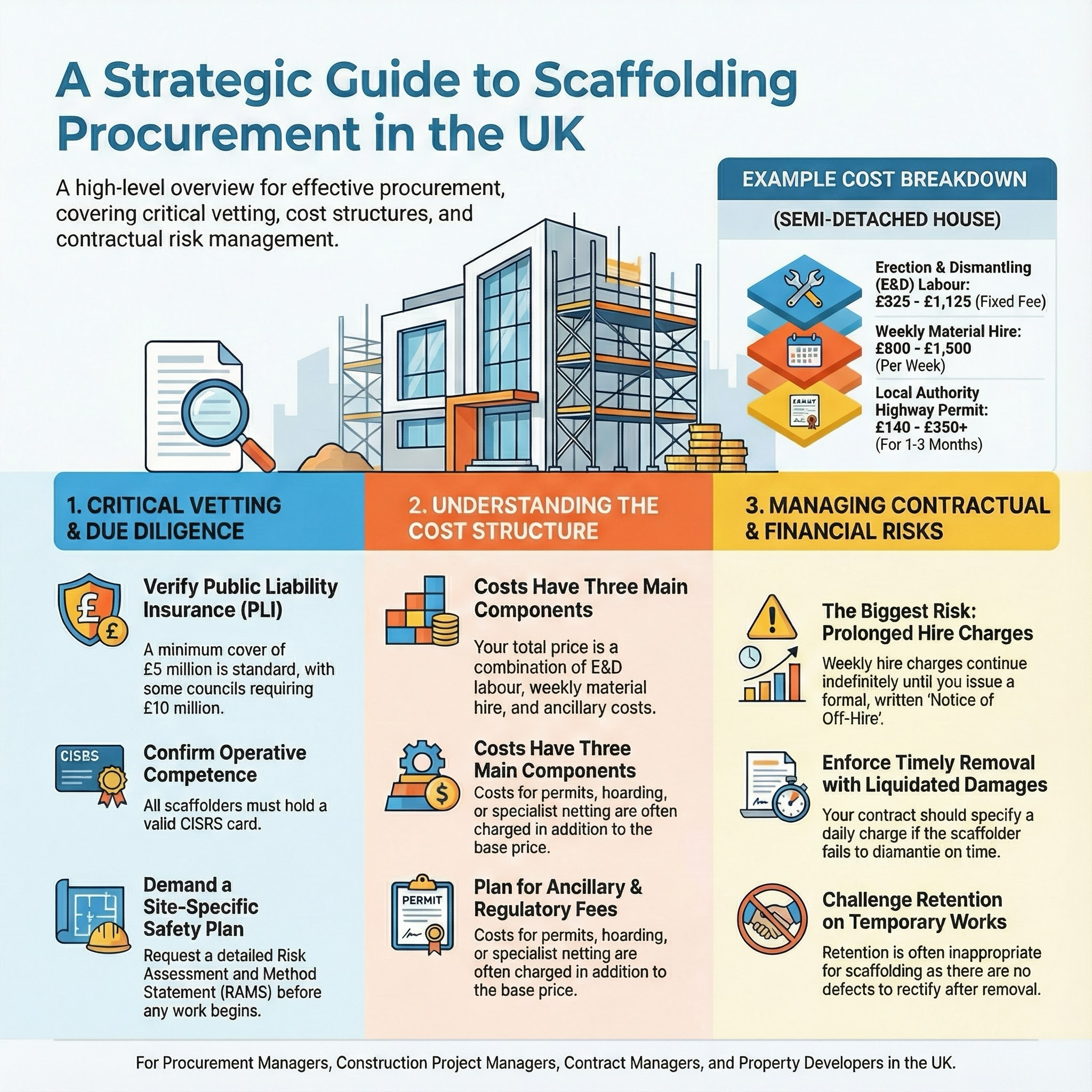
Scaffolder explained
Everything you need to know before hiring a scaffolder.
Scaffolders provide the essential framework that allows other trades to work safely at height. Whether you are replacing a roof, painting hard-to-reach gables, or building a multi-storey extension, a professional scaffolder ensures the structure is stable, secure, and compliant with UK safety laws.
From simple access towers to complex "independent" scaffolds that wrap around a property, these specialists handle the design, transport, assembly, and eventual dismantling of steel or aluminium tubes and timber boards. For UK homeowners, hiring a reputable scaffolder is the first step in ensuring a major renovation project proceeds without injury or structural damage.
Beyond simple platforms, scaffolders provide specialised solutions such as "tin hats" (temporary roofs) to keep a project dry during structural work, and "bridging" to allow work to continue over conservatories or glass porches without putting pressure on the fragile structures below.
Hiring a scaffolder is a structured process focused heavily on site-specific safety. You can typically expect the following workflow:
Scaffolding is one of the most regulated trades in the UK for a good reason. Falling from height remains the leading cause of workplace fatalities, and an incorrectly built scaffold can collapse or damage your home’s foundations.
Professional scaffolders operate under the Work at Height Regulations 2005. They possess the physical strength and technical knowledge to ensure the structure is tied securely to your building using "anchor ties." Attempting to build your own scaffold or using "cowboy" operators puts you at significant legal and physical risk.
Hiring a pro also ensures you are covered by Public Liability Insurance. If a pole is dropped and damages a neighbour's car, or if a passerby is injured, a professional firm’s insurance handles the claim. Without this, the financial burden falls entirely on the homeowner.
Scaffolding costs are generally split into the "fixed" cost of erection and dismantling, and the "rental" cost for the duration it stays on-site. Prices vary based on your location in the UK and the complexity of the access required.
| Service | Low £ | High £ | Notes |
|---|---|---|---|
| Chimney Stack Scaffold | £500 | £900 | Includes roof ladders and safety rails. |
| Tower (1 side of house) | £350 | £650 | Standard 2-storey height. |
| Semi-Detached (3 sides) | £950 | £1,800 | Full wrap for painting or rendering. |
| Conservatory Bridge | £450 | £750 | Specialist beams to span over glass. |
| Temporary Roof (Tin Hat) | £2,500 | £5,000+ | Essential for loft conversions. |
Pricing is heavily influenced by the hire period; most quotes include the first 4 to 6 weeks of hire, with a weekly "rent" charged thereafter. Location is also a factor, with London and the South East typically costing 20-30% more than the North of England.
Don't just choose the cheapest quote; scaffolding is a safety-critical service. Use this checklist to find a reliable professional:
Questions to ask before hiring:
If the scaffolding is contained entirely within your own garden or driveway, you do not need a permit. However, if any part of the structure sits on a public pavement, road, or grass verge, a Pavement Licence is required from your local council. Most professional scaffolders will apply for this and include the fee in your quote.
Scaffolders can work in rain, but high winds are a major safety hazard. If wind speeds exceed safe limits (usually around 30-40mph depending on the site), work will be paused. Once erected, scaffolds are designed to withstand UK storms, provided they are correctly tied to the building and inspected regularly.
A simple tower for a chimney repair can often be erected in 2 to 4 hours. A full wrap around a three-bedroom semi-detached house typically takes a full working day for a team of two or three scaffolders. Complex structures with temporary roofs may take several days to complete.
Professional scaffolders use "sole boards" (thick timber pads) under the metal base plates to spread the weight and protect your driveway or lawn. While some indentation on soft grass is common, a professional setup should prevent any permanent damage to hard surfaces like tarmac or block paving.
Describe the job in plain English. The AI asks a few smart questions, then tells you whether a scaffolder is the right call, what it should cost, and what to ask before they start.
Birdcage scaffolding for ceiling work. UK costs.
READ GUIDE →GuideChimney scaffolding for repairs. UK costs.
READ GUIDE →GuideCommercial scaffolding for buildings. UK costs.
READ GUIDE →GuideDomestic scaffolding hire. UK costs.
READ GUIDE →GuideEmergency scaffold dismantling is a critical service required when a structure becomes unstable due to severe UK weather, vehicle impact, or poor initial instal...
READ GUIDE →GuideEmergency scaffold repairs are critical when a structure becomes unstable due to severe weather, vehicle impact, or structural failure. For UK homeowners, a com...
READ GUIDE →GuideHeritage scaffolding. UK costs.
READ GUIDE →GuideProfessional scaffolding is a critical safety requirement for any UK home improvement project involving work at height. Whether you are replacing a roof, painti...
READ GUIDE →GuideScaffolding for loft conversions. UK costs.
READ GUIDE →GuideMobile tower scaffolding hire. UK costs.
READ GUIDE →GuideRoof scaffolding for repairs. UK costs.
READ GUIDE →GuideScaffold reassembly is a critical safety service for UK homeowners undertaking major renovations or extensions. Whether a structure has been partially dismantle...
READ GUIDE →GuideFor UK homeowners undertaking major renovations, extensions, or roof repairs, scaffolding is a vital safety structure. However, it is not a "set and forget" ins...
READ GUIDE →GuideSolar panel install scaffolding. UK costs.
READ GUIDE →