Instant
01 · Ask
Ask the AI a follow-up
Got more questions about deep cleaning service? Describe the bit you're unsure about — the AI explains options, sequencing and what to ask the cleaning services.

Top-to-bottom one-off — inside cupboards, behind furniture, every grout line. The annual reset.
You've read the brief on deep cleaning service. Now lean on us to find the right cleaning services — and stay in control of the job.
Got more questions about deep cleaning service? Describe the bit you're unsure about — the AI explains options, sequencing and what to ask the cleaning services.
Costs, timelines, pitfalls and the right questions to ask before any cleaning services starts on deep cleaning service.
Itemised quotes from up to 3 local cleaning servicess on deep cleaning service — so you can compare like-for-like, not lump sums.
Ready when you are
Enter your postcode and get free quotes from local pros.
Four moves that separate a smooth job from a nightmare.
If the property is significantly dirtier than described, the price may increase upon arrival.
Deep cleaning often reveals existing scratches or stains previously hidden by grime; a good cleaner will point these out before starting.
If carpets or upholstery are cleaned as part of the package, the rooms may be unusable for 4-6 hours due to dampness.
Strong cleaning agents can leave a lingering scent; always request "eco-friendly" or "fragrance-free" options in advance if you have allergies.
Indicative UK ranges and what affects price.
By job type
Quote spread is typically ± 18% — always get 3 quotes.
Cleaning Services quick-view
Cleaning Services explained
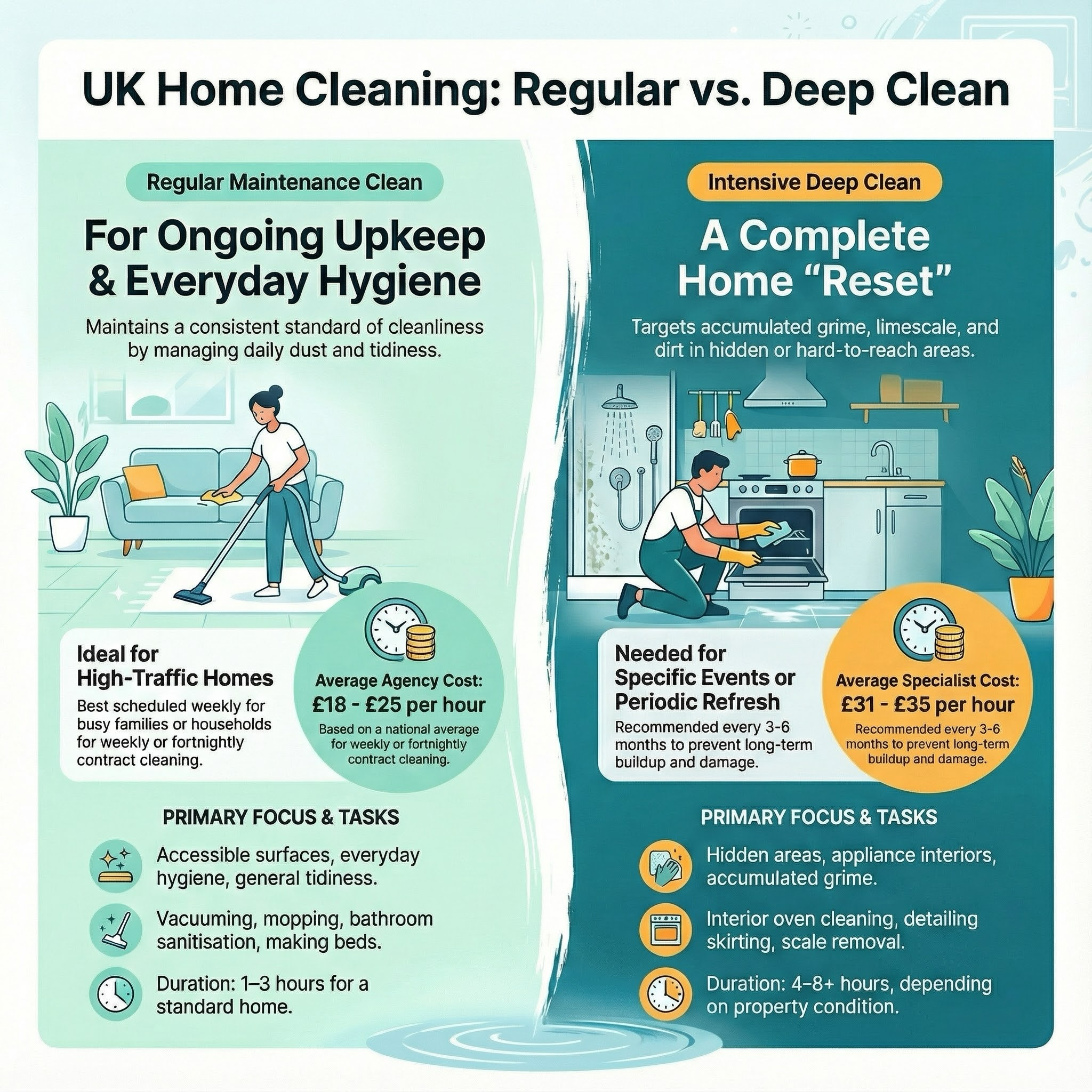
For UK homeowners, a deep clean is often essential when moving house (End of Tenancy), after building work, or as a seasonal "spring clean" to reset the hygiene levels of the property. It ensures a healthier living environment and can significantly extend the lifespan of your fixtures and fittings.
Deep cleaning is usually quoted as a fixed price based on the number of rooms, though some companies charge hourly for heavily soiled properties. Prices include professional-grade chemicals and equipment.
| Property Size / Item | Low £ | High £ | Notes |
|---|---|---|---|
| Studio / 1-Bed Flat | £150 | £250 | Standard soilage; includes 1 bathroom. |
| 3-Bed Semi-Detached | £280 | £450 | Most common UK property size. |
| 4-5 Bed Detached | £450 | £850+ | Often requires a team of 3-4 cleaners. |
| Professional Oven Clean | £50 | £90 | Single vs double oven/Range. |
| Carpet Steam Cleaning | £30 | £60 | Price per room; usually discounted as a bundle. |
| Hourly Rate (per cleaner) | £25 | £40 | Usually carries a 3-hour minimum. |
Total costs are influenced by the property's condition, the presence of pet hair, and your location (London and the South East typically see a 20% premium). Always clarify if VAT is included in your initial quote.
While you can deep clean a home yourself, it is physically demanding and time-consuming. Professionals use industrial-grade steamers, high-alkaline degreasers, and HEPA-filter vacuums that achieve a level of "clinical" clean difficult to replicate with supermarket products.
If you are a tenant seeking a deposit refund, a professional receipt is often the only way to prove the property has been cleaned to the required standard.
Professionals are also trained in COSHH (Control of Substances Hazardous to Health), ensuring that powerful chemicals don't damage delicate surfaces like natural stone or high-gloss cabinetry.
No, most professional cleaning companies are happy to work while you are out. You can arrange a key collection or use a key safe; however, it is recommended to be present at the start to walk through the scope and at the end to inspect the work.
Usually, no. Most companies treat oven cleaning as a specialist "add-on" because it requires specific dip-tanks and caustic chemicals. Always check your itemised quote to see what is included.
They are very similar, but an End of Tenancy (EOT) clean is more rigid. It specifically follows the checklists used by letting agents and inventory clerks, often including the insides of all cupboards, drawers, and appliances as standard.
For most UK households, a professional deep clean once or twice a year (typically Spring and Autumn) is sufficient to maintain the property and keep allergens at bay.
Cleaners will typically move light furniture (chairs, side tables, rugs) to clean underneath. However, for health and safety reasons, they usually won't move heavy wardrobes, sofas, or large appliances unless specifically agreed and assisted.
This guide was written with AI assistance and is intended for general information only. Prices are estimates based on UK averages and may vary by region. Always get at least three quotes and consult a qualified professional before starting any work.
Ask follow-ups in plain English. The AI explains options, sequencing and what to ask the cleaning services — so you walk in informed.
Leather furniture is a significant investment for any UK home, offering durability and timeless style. However, scuffs, scratches, and fading are inevitable ove...
READ GUIDE →GuideThe kitchen and lounge are the hardest-working rooms in any UK home. While the lounge is your primary space for relaxation, the kitchen is a high-traffic zone t...
READ GUIDE →GuideMaintaining a clean commercial environment is about more than just appearances; it is a fundamental requirement for health, safety, and operational efficiency. ...
READ GUIDE →GuideMaintaining a professional workspace is about more than just aesthetics; it is essential for employee health, productivity, and making the right impression on c...
READ GUIDE →GuideMoving house is one of life’s most stressful events, and the final hurdle is often the most daunting: the end-of-tenancy deep clean. This isn't a standard weekl...
READ GUIDE →GuideA flat deep clean is more than just a quick vacuum and a wipe-down of surfaces. It is a comprehensive, "top-to-bottom" sanitisation of your home, designed to ta...
READ GUIDE →