Instant
01 · Ask
Ask the AI a follow-up
Got more questions about flat cleaning? Describe the bit you're unsure about — the AI explains options, sequencing and what to ask the cleaning services.

1-bed or 2-bed apartment — regular or one-off, weekly or fortnightly, by a vetted local cleaner.
You've read the brief on flat cleaning. Now lean on us to find the right cleaning services — and stay in control of the job.
Got more questions about flat cleaning? Describe the bit you're unsure about — the AI explains options, sequencing and what to ask the cleaning services.
Costs, timelines, pitfalls and the right questions to ask before any cleaning services starts on flat cleaning.
Itemised quotes from up to 3 local cleaning servicess on flat cleaning — so you can compare like-for-like, not lump sums.
Ready when you are
Enter your postcode and get free quotes from local pros.
Four moves that separate a smooth job from a nightmare.
Many budget services only clean what is visible. Ensure you specify that you want "behind and under" furniture included.
In hard water areas, simple wiping won't work. Professionals must use acidic cleaners and allow "dwell time" to remove deposits.
Failure to provide parking or concierge access can lead to aborted visit fees. Always arrange a parking permit or space in advance.
Fixed prices can sometimes hide exclusions. Always get a written list of what is not included (e.g., inside the fridge or balcony cleaning).
Indicative UK ranges and what affects price.
By job type
Quote spread is typically ± 18% — always get 3 quotes.
Cleaning Services quick-view
Cleaning Services explained
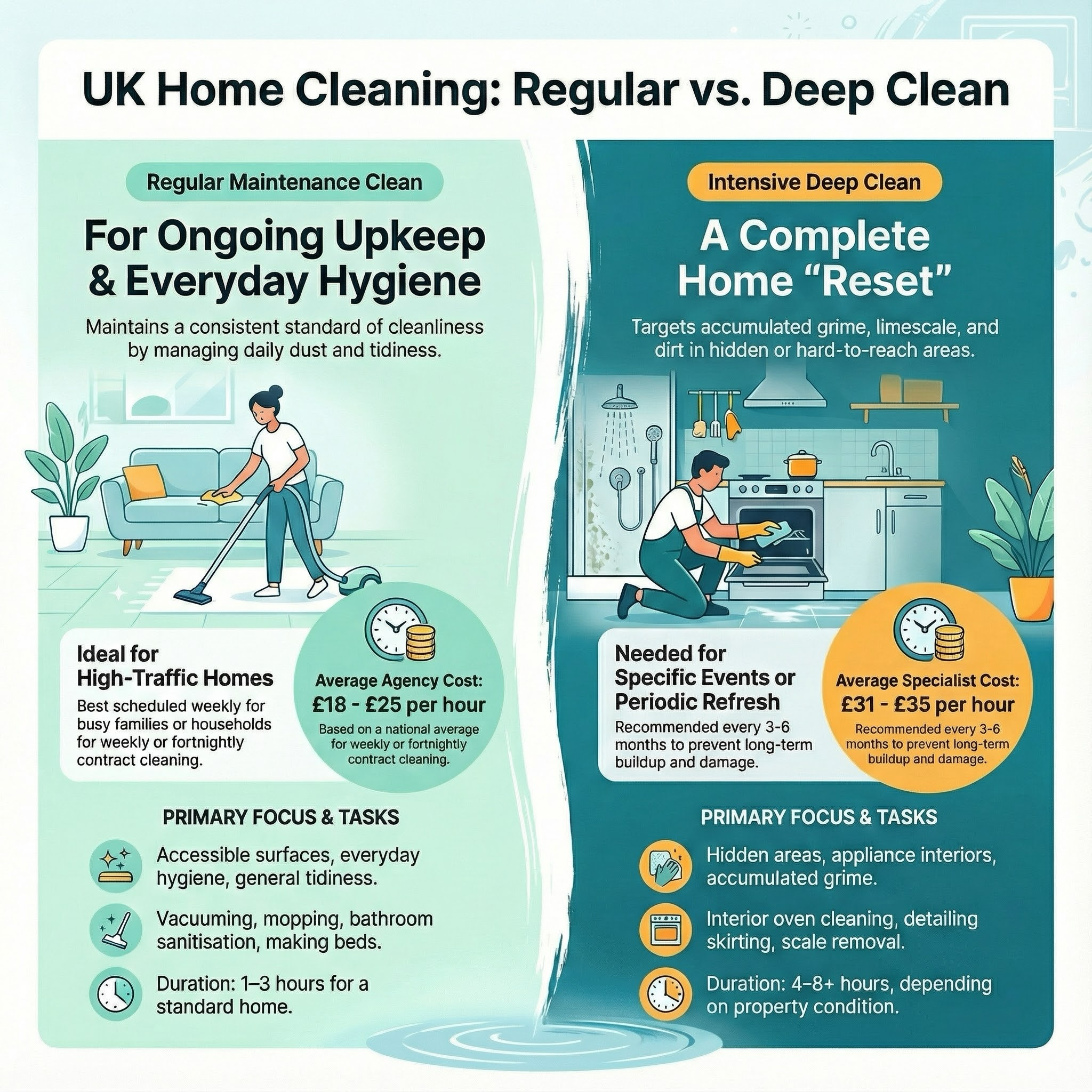
For UK homeowners and tenants, a professional clean isn't just about aesthetics; it’s about protecting your investment and ensuring a healthy living environment. From tackling stubborn limescale in hard-water areas like London and the South East to degreasing kitchen extractors, professional cleaners use commercial-grade products and proven techniques to transform your living space.
Cleaning costs in the UK vary based on your location (with a 15-25% premium in London), the size of your flat, and the current condition of the property. Most cleaners charge either an hourly rate for regular visits or a fixed "package price" for deep cleans and end-of-tenancy services.
| Item | Low £ | High £ | Notes |
|---|---|---|---|
| Hourly Rate (Regular) | £18 | £30 | Per cleaner; includes basic supplies. |
| 1-Bed Flat (Deep Clean) | £150 | £250 | One-off intensive visit. |
| 2-Bed Flat (Deep Clean) | £200 | £350 | Includes kitchen and bathroom descaling. |
| End of Tenancy (1-2 Bed) | £250 | £500 | Fixed price; usually includes oven clean. |
| Carpet Cleaning (Per Room) | £40 | £80 | Professional hot water extraction. |
| Oven Cleaning (Single) | £50 | £90 | Full dip-tank service for racks. |
Prices typically include the cost of standard cleaning chemicals and equipment. However, if the property is in a state of significant neglect or requires biohazard removal (such as mould remediation or pest-related waste), costs will escalate significantly due to the need for specialist PPE and disposal fees.
While routine vacuuming and dusting are easily handled by most homeowners, professional cleaning offers a "factory reset" for your home. Professionals use industrial-grade descalers and degreasers that are more effective than supermarket brands, particularly for UK homes dealing with heavy limescale. Furthermore, for end-of-tenancy situations, most letting agents require a professional receipt to prove the property has been cleaned to a standard that satisfies the inventory check.
Note: Professional cleaners carry Public Liability Insurance. If they accidentally damage a high-value item or cause a leak, you are protected. A DIY mishap could prove much more expensive than the cleaning fee.
While there is no single "Cleaning License" in the UK, professional companies must adhere to several health and safety standards:
No, most professional cleaners are comfortable working while you are out. You can arrange a key collection, leave a key with a concierge, or use a secure key-safe. However, for the first visit, it is often helpful to be there to walk through your specific requirements.
Usually, no. Oven cleaning is a specialist, time-consuming task involving caustic chemicals or dip-tanks. It is almost always an "add-on" service with a separate fee, though it is often bundled into end-of-tenancy packages.
A reputable cleaner or agency will have Public Liability Insurance to cover the cost of repairs or replacements. You should report any damage immediately (within 24 hours) and take photographs for the insurance claim.
Professional cleaning companies usually bring their own commercial-grade equipment. Individual "domestic" cleaners may prefer to use your vacuum and mop to prevent cross-contamination between houses. Always clarify this at the time of booking.
For most UK households, a weekly or fortnightly maintenance clean is standard. However, a "deep clean" is recommended every 6 months to tackle areas like skirting boards, upholstery, and limescale build-up that routine cleaning misses.
A Deep Clean focuses on hygiene and "refreshing" the home for the current occupant. An End of Tenancy clean is more clinical; it includes cleaning inside every cupboard, behind the fridge, and often includes a guarantee that the property will pass a landlord's inventory inspection.
This guide was written with AI assistance and is intended for general information only. Prices are estimates based on UK averages and may vary by region. Always get at least three quotes and consult a qualified professional before starting any work.
Ask follow-ups in plain English. The AI explains options, sequencing and what to ask the cleaning services — so you walk in informed.
Leather furniture is a significant investment for any UK home, offering durability and timeless style. However, scuffs, scratches, and fading are inevitable ove...
READ GUIDE →GuideThe kitchen and lounge are the hardest-working rooms in any UK home. While the lounge is your primary space for relaxation, the kitchen is a high-traffic zone t...
READ GUIDE →GuideMaintaining a clean commercial environment is about more than just appearances; it is a fundamental requirement for health, safety, and operational efficiency. ...
READ GUIDE →GuideMaintaining a professional workspace is about more than just aesthetics; it is essential for employee health, productivity, and making the right impression on c...
READ GUIDE →GuideMoving house is one of life’s most stressful events, and the final hurdle is often the most daunting: the end-of-tenancy deep clean. This isn't a standard weekl...
READ GUIDE →GuideA flat deep clean is more than just a quick vacuum and a wipe-down of surfaces. It is a comprehensive, "top-to-bottom" sanitisation of your home, designed to ta...
READ GUIDE →